
AI Overview
What is the best Seedance 2.5 fight scene prompt structure?
Assign the fighters, location, action order, camera path, timing, sound, and continuity rules. Describe visible combat beats instead of asking only for an “epic fight.”
How do you make fight choreography look coherent?
Divide the action into attack, defense, impact, and recovery beats. Keep each fighter’s position and role explicit from the opening pose to the final hold.
Which camera movement works best for a fight scene?
Begin with a readable wide shot, then use tracking or a restrained orbit. Reserve close-ups and slow motion for one important impact or reaction.
Can Seedance 2.5 use references for fight scenes?
Yes. Assign each image or video one role—identity, costume, location, movement, or camera—and state what must remain unchanged.
How to Write a Seedance 2.5 Fight Scene Prompt
A useful Seedance 2.5 fight scene prompt reads like direction, not a list of adjectives. “Fast, epic combat” leaves the blocking, distance, camera, and result undefined. Name who moves first, how the other fighter responds, where contact happens, and where both bodies finish. The broader Seedance 2.5 prompt guide covers the supporting visual ingredients.
| Prompt part | Question to answer | Practical example |
|---|---|---|
| Fighters | Who is visible and how are they distinguished? | Rust-jacket fighter versus charcoal-coat fighter |
| Location | What surfaces and objects affect movement? | Wet rooftop with low vents and puddles |
| Choreography | Who attacks, defends, and recovers? | Jab, outside slip, body kick, two-hand block |
| Timing | When does each beat happen? | Four beats across 15 seconds |
| Camera | Where is the viewer and how do they move? | Wide start, slow lateral track |
| Reactions | What proves contact or force? | Coat snaps, foot slides, water splashes |
| Audio | What should synchronize with the action? | Shoes, cloth, breath, one impact, rain |
The seven-part fight prompt formula
Build the scene in this order:
[Fighter anchors] + [location and starting distance] + [ordered choreography]
+ [timed beats] + [one camera path] + [physical reactions] + [sound]
Lead with permanent anchors—identity, clothing, and location—then describe events. If movement fails, revise the event without redesigning the cast.
Map every reference before describing the action
Write a compact asset map: Image 1 locks Fighter A; Image 2 locks Fighter B; Image 3 defines the rooftop; Video 1 provides camera motion only. The Seedance 2.5 reference guide explains strict and loose references. For precise blocking, start with image to video and a frame that already shows correct distance, eyelines, and travel space.
A reusable master prompt template
Two original adult fighters face each other in [location], [distance] apart.
Fighter A wears [anchor]; Fighter B wears [anchor]. Preserve both identities,
outfits, body proportions, and screen direction. Across [duration], Fighter A
[attack]; Fighter B [defense], then [counter]. Show [contact reaction] and end
with [stable final pose]. Camera: [one path]. Sound: [synchronized details].
Non-graphic staged choreography; no extra people, cuts, or costume changes.
Seedance 2.5 Fight Scene Prompt Examples
Copy an example, replace its anchors, and change one variable per test.
One-take martial arts fight prompt
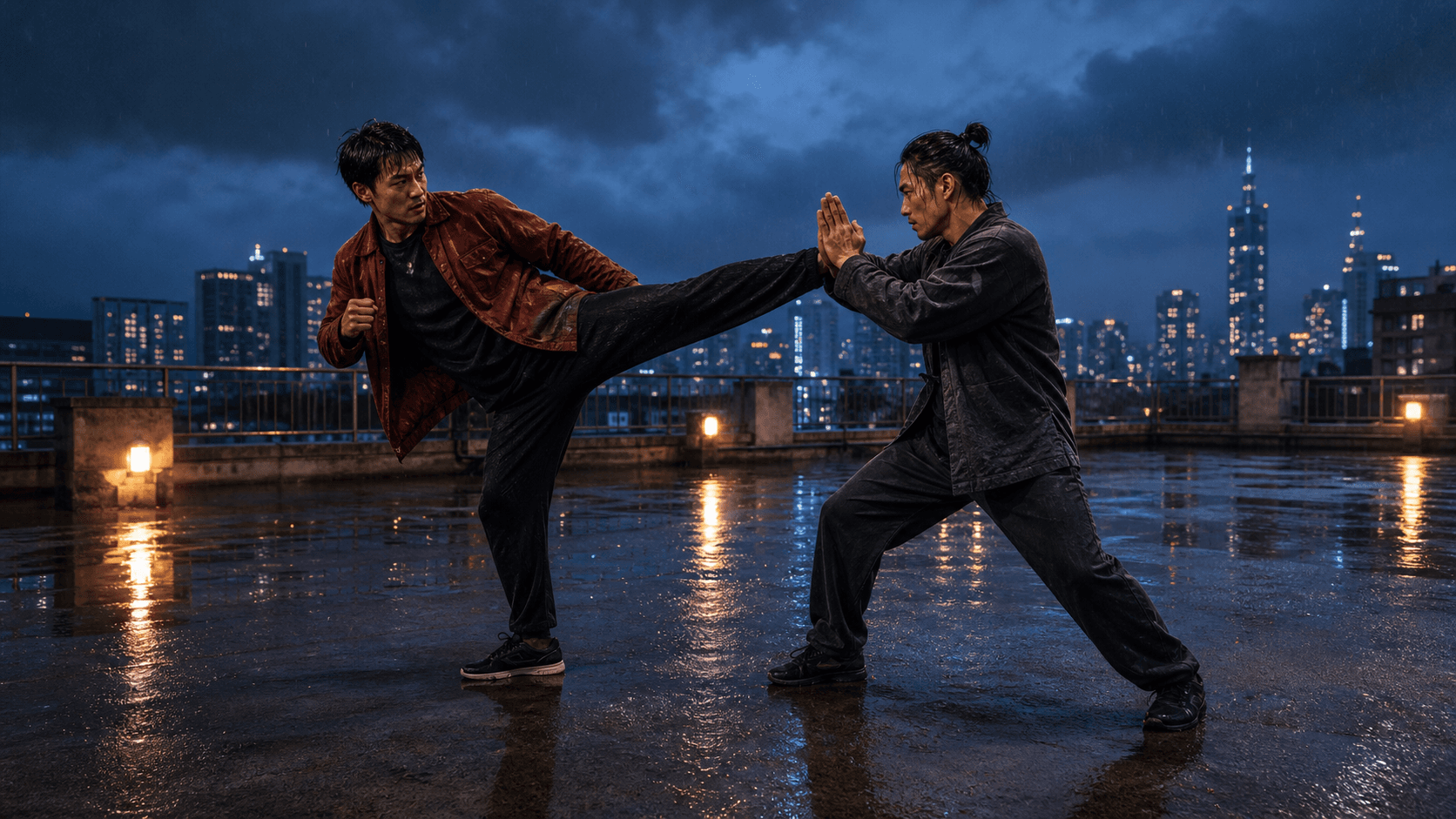
15-second continuous rooftop martial-arts exchange at blue hour. Two original
adult fighters begin three meters apart: Fighter A in a rust jacket, Fighter B
in a charcoal training coat. A steps forward with a right jab; B slips outside,
pivots, and answers with a controlled left body kick. A blocks with both forearms
and slides one foot through a puddle. Both separate and settle into ready poses.
Wide eye-level start, slow lateral tracking only, full bodies always visible.
Rain, shoes on wet concrete, cloth movement, breath, and one muted impact.
Cinematic sword duel prompt
Define weapon length and hand placement so the prop stays consistent.
Two adult stage performers duel with identical blunt practice sabers in an empty
stone courtyard. Three measured exchanges: high strike and parry, low sweep and
back step, final crossed-blade lock. Keep both sabers rigid and unchanged. Slow
clockwise orbit, medium-wide framing, sparks only at the final contact, no injury
or blood. End on a stable profile silhouette as the music stops.
Multi-character action scene prompt
For one-versus-many action, serialize attackers so only one occupies the active lane.
One original adult courier faces three masked stunt performers in a warehouse.
Opponent 1 enters from screen left and is redirected past the courier; Opponent 2
approaches only after the first exits the center lane; Opponent 3 remains in the
background until the final beat. One continuous backward track, no cuts, all four
people readable, no pile-up, no graphic injury, stable closing formation.
Stylized fantasy battle prompt
An original armored guardian and a stone creature clash on a storm-lit bridge.
The guardian deflects one slow stone swing with a glowing shield, steps inside,
and releases a non-contact energy pulse that pushes dust and loose pebbles away.
Low wide tracking shot, consistent shield size, physically coherent debris, no
gore, no dismemberment, no copyrighted character design. Hold the final wide shot.
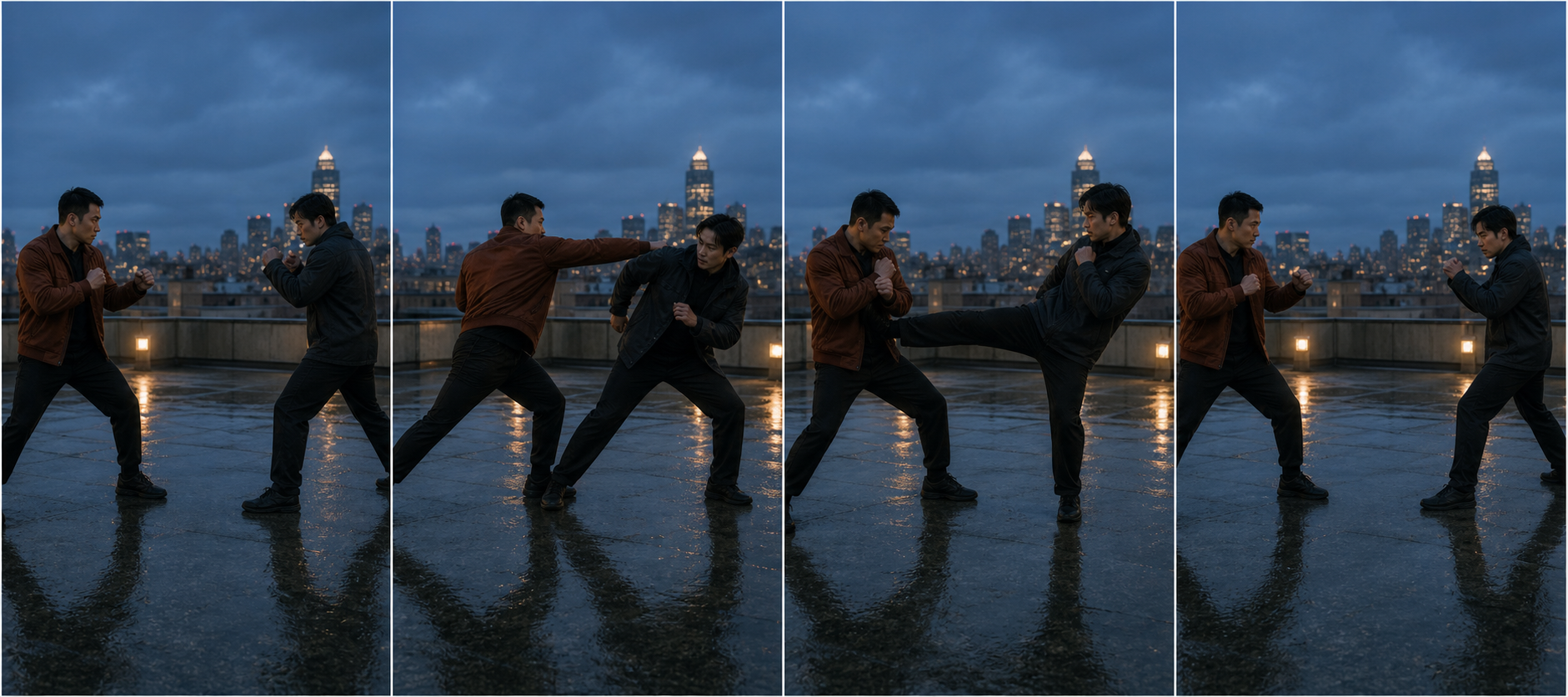
A readable AI fight scene progresses through setup, attack, counter, and recovery instead of displaying unrelated action poses.
Build Believable Fight Choreography Beat by Beat
Think in states: starting pose, movement, contact, reaction, and resolution. Every beat inherits the previous state. The Seedance 2.5 timeline prompt guide provides the general timed structure.
Give every fighter a clear role
Label one fighter as initiator and the other as responder. A slip may lead into a counter, but the order must remain readable. Repeat clothing anchors instead of vague pronouns.
Use distance, direction, and contact points
“Throws a punch” is incomplete. “Steps from three meters to arm’s length and extends a right jab toward the left shoulder” defines a path. Add a pivot, cloth snap, slide, or splash as visible evidence of force.
Structure a 15–30 second fight timeline
| Time | Beat | Choreography job |
|---|---|---|
| 0–3s | Establish | Show identities, distance, exits, and screen direction |
| 3–7s | First exchange | One attack and one defense |
| 7–11s | Counter | Reverse initiative and show a reaction |
| 11–15s | Resolution | Separate, settle the camera, and hold the final pose |
For 30 seconds, use two connected exchanges with a reset beat between them.
Camera Movement, Timing and Audio for Cinematic Action
Camera instructions should reveal choreography, not compete with it.
Choose one dominant camera path
Use a lateral track for side-to-side movement, an orbit for a contained duel, or a backward track for advancing action. Do not stack zoom, whip pan, orbit, drone dive, and shake. Preserve screen direction after any crossing.
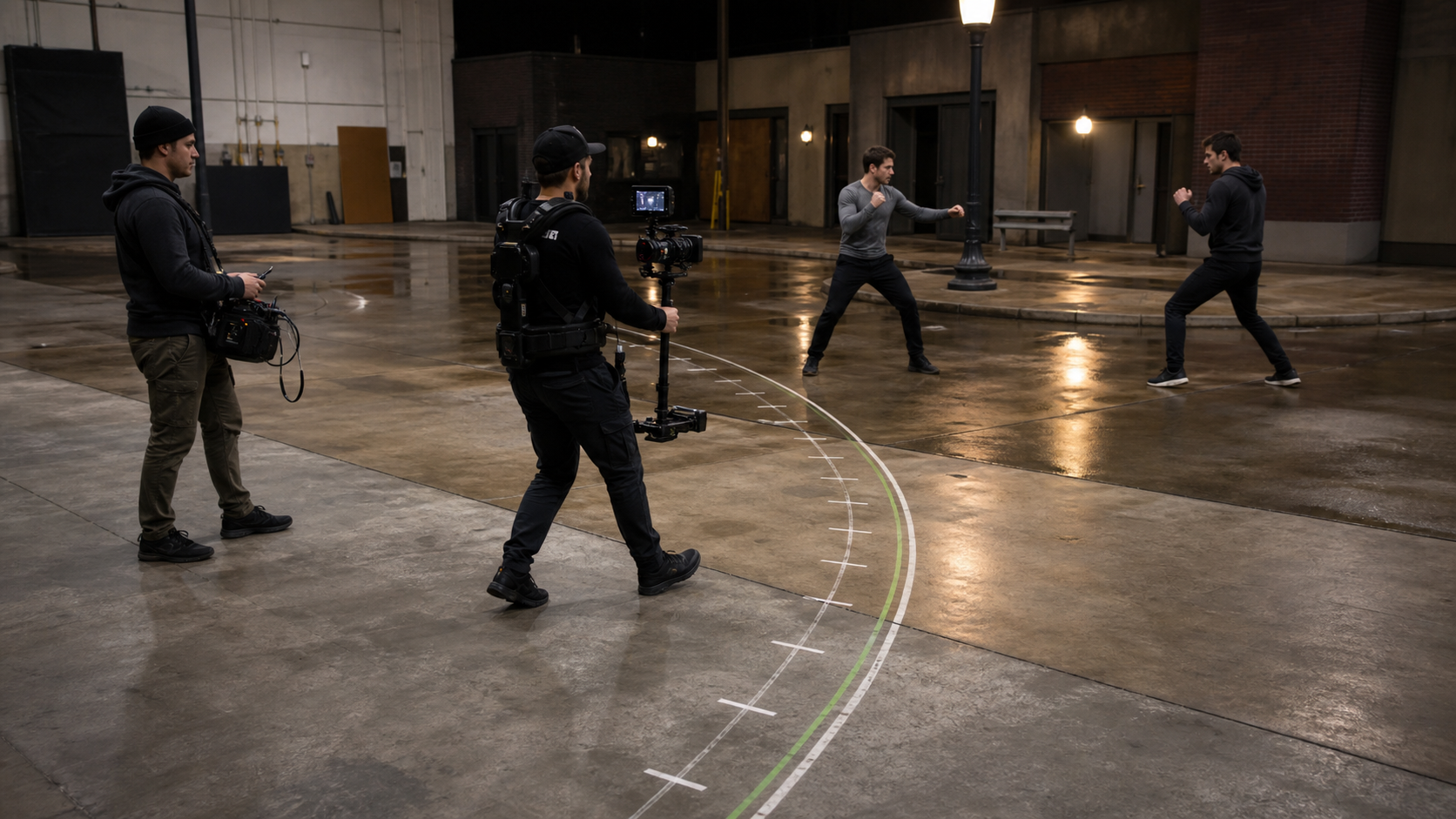
Plan the path around the choreography: the camera follows the exchange while the fighters retain a clear action lane.
Match shot size to the combat beat
Start wide to establish feet, distance, and obstacles. Use one close-up for a block, reaction, or prop detail, then return to a readable frame.
Add sound that follows the action
Synchronize sound to action: continuous rain, shoes during the pivot, fabric on the kick, one muted block, and breathing in the final hold. Limit music to tempo and mood.
How to Fix Common Seedance 2.5 Fight Scene Problems
Fighters merge or change appearance
Increase separation, repeat wardrobe anchors, and reduce simultaneous contact. Use one reference per identity. If faces drift during a turn, keep that beat wider and shorter.
Punches and kicks never connect
Add start distance, path, contact point, and reaction. A forearm block, shield contact, or clear dodge gives the exchange a readable result without facial impact.
The camera becomes chaotic
Keep only the dominant camera path. Test choreography in a static wide shot, then introduce a slow track. Do not debug bodies and camera complexity together.
The scene loses continuity
Repeat outfit, prop, lighting, environment, and screen direction. End each beat on an inheritable state. Rewrite the failing transition rather than the whole prompt.
A Copy-Ready Seedance 2.5 Fight Scene Prompt
Paste this complete prompt into text to video, then replace the bracketed creative details while preserving its structure.
Create a 15-second, 16:9 cinematic but non-graphic staged fight between two
original adult martial artists on a rain-slick rooftop at blue hour. Fighter A:
short dark hair, deep rust jacket, black trousers. Fighter B: tied-back dark hair,
charcoal training coat, black trousers. Preserve faces, outfits, proportions,
left-right screen positions, rooftop layout, rain direction, and lighting.

[0–3s] Both fighters stand three meters apart in stable ready poses. Static wide
eye-level frame; full bodies and open floor space visible.
[3–7s] Fighter A steps forward with a controlled right jab toward Fighter B’s
left shoulder. Fighter B slips outside and pivots on the rear foot. Camera begins
one slow lateral track, keeping both fighters centered.
[7–11s] Fighter B counters with a left body kick. Fighter A blocks with both
forearms and slides the rear shoe through a shallow puddle. Show coat movement,
one water splash, and believable balance; no injury.
[11–15s] Both fighters separate to the original distance, breathe, and settle into
ready poses. Camera stops and holds the final two seconds.

Sound: steady rain, shoes on wet concrete, fabric movement, breath, and one muted
block impact. No dialogue, captions, extra people, cuts, weapons, blood, gore,
costume changes, merged limbs, or unstable camera motion.
This test preserves subject separation and screen direction, but the movement stays restrained. Use it as a diagnostic example: if distinct attack and counter beats do not appear, shorten each action and increase the contrast between poses.
Run one test for positions and timing. Revise only the beat where the state breaks.
Conclusion
A strong Seedance 2.5 fight scene prompt turns action into a readable chain: distinct fighters, clear distance, one initiator per beat, visible contact reactions, one camera path, synchronized sound, and a deliberate final pose. Start with the copy-ready template, test the choreography in a wide shot, then add cinematic movement only after the bodies remain coherent. Create your Seedance fight scene →
Ready to try it yourself?
Put the steps from this guide into practice with Seedance and turn prompts or images into polished videos in minutes.
Free credits on signup. Plans from $28/month.
Related Articles
More posts in the same locale you may want to read next.
Seedance App Preview Video Generator 2026: Create App Store and Product Launch Clips
Use Seedance to turn app screenshots, feature copy, and launch goals into App Store previews, Google Play promo videos, and product launch clips.
Read article
Kling 4.0 vs Seedance 2.5: Full Comparison
Kling 4.0 vs Seedance 2.5 compared by spec: 30-second clips, keyframes vs 50 references, audio, 4K and 10-bit color, editing, and which model fits which job.
Read article
Kling 4.0 Keyframes & Omni Reference Guide
Learn how Kling 4.0 uses up to 10 keyframes and 15 Omni Reference assets in one 30-second video, with 3 worked plans, common mistakes, and Seedance 2.5 tips.
Read article