
Wan 3.0 Open Source Model: Weights, GitHub, License, and Local Access

AI Overview
Is Wan 3.0 an open-source model?
Not in a reproducible local-model sense. Wan 3.0 is available as a hosted video service, but its downloadable weights and complete local inference package have not been officially released.
Can you download Wan 3.0 model weights?
No verified official Wan 3.0 weight files are available as of September 1, 2026. A repository or license page alone is not a model-weight release.
Is Wan 3.0 available on GitHub?
A Wan 3.0 repository exists, but it currently contains documentation and a license rather than the weights, inference code, configuration, and model card needed to run the model.
Can Wan 3.0 run locally in ComfyUI?
Not as a fully local official workflow yet. A ComfyUI integration may call a hosted API, but that still sends the job to remote infrastructure.
What “Open Source” Means for Wan 3.0
The fastest answer to is Wan 3.0 open source depends on what “open” means to the searcher. Creators may only need access to the model. Developers usually mean something stricter: files they can download, inspect, modify, and execute on hardware they control.
Open-source code versus open weights
Source code explains how software runs; model weights contain the learned parameters that produce the output. An inference script without weights cannot generate Wan 3.0 video, while weights without a compatible loader, configuration, tokenizer, and dependencies may still be unusable. An open-source claim should therefore name exactly which artifacts are available.
Hosted access is not a model release
A web interface or API can make a model broadly accessible without exposing the model itself. Users submit prompts and media, the provider renders remotely, and the service returns a file. That is useful access, but it does not provide offline operation, weight inspection, fine-tuning, or control over the serving stack. If immediate creation is the goal, the Seedance AI video generator offers the same practical advantage: start with a prompt rather than maintaining infrastructure.
Four artifacts required for a verifiable release
Treat a future Wan 3.0 open-source announcement as complete only when four pieces arrive together: downloadable weights, runnable inference code, matching configuration and dependencies, and a license that explicitly covers the released files. A model card should also document inputs, output limits, hardware expectations, safety boundaries, and known failure modes.
What Alibaba Actually Released for Wan 3.0
The confirmed release is a hosted generation service, not a verified local model package. This distinction matters because the hosted product is real and usable even while the open-weight question remains unanswered.
Wan 3.0 hosted model and API access
Alibaba Cloud Model Studio lists Wan 3.0 video endpoints for managed inference. The service accepts a production request, performs generation in the provider’s cloud, and returns the result. Teams can integrate that access into an application without downloading a checkpoint or provisioning GPUs.
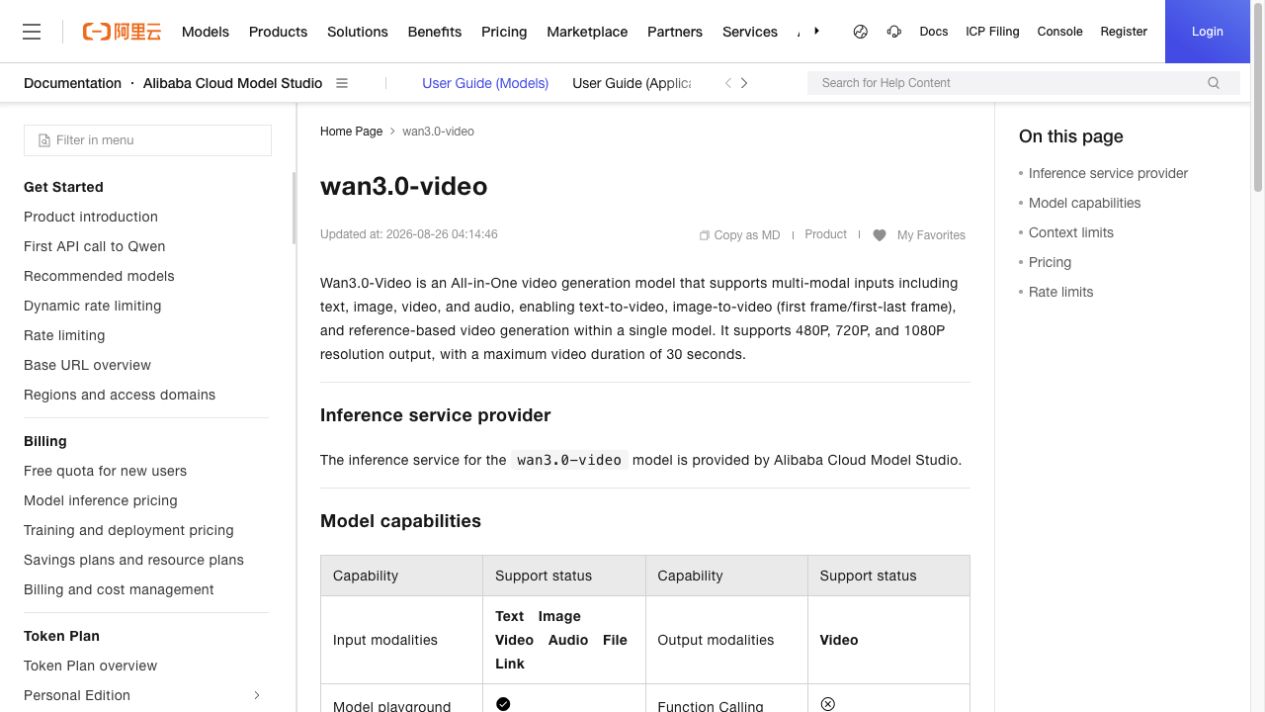
The official model page describes Wan 3.0 as a Model Studio inference service and lists its supported input and output modalities.
Confirmed capabilities
The documented hosted service supports clips from 2 to 30 seconds at 30 fps, with 480p, 720p, and 1080p output options. It can create native dialogue, background music, and sound effects, and it accepts up to 20 multimodal inputs—including images, video, audio, documents, and web references—within one request.
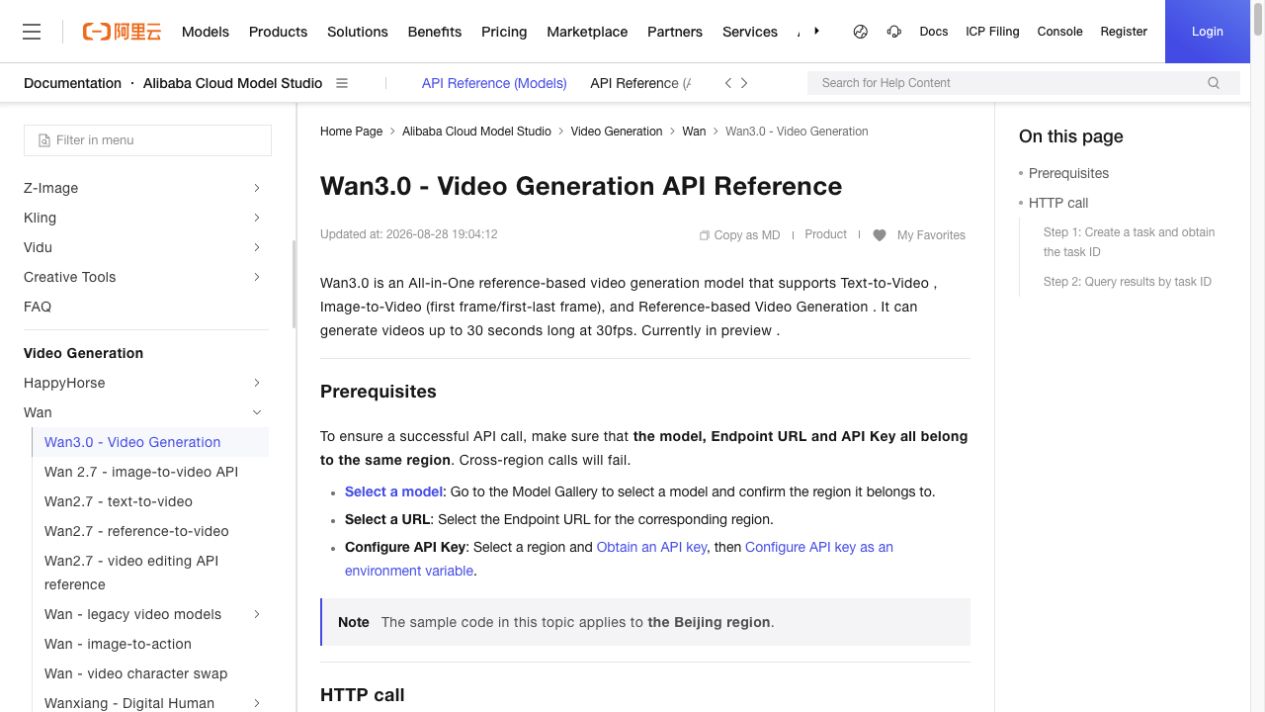
The API reference requires a model, endpoint URL, and API key in the same region—clear evidence of hosted access rather than a downloadable local checkpoint.
Official Wan 3.0 output sample
Play the official 30-second sample to inspect action timing, camera movement, character continuity, environmental detail, and synchronized audio. This demonstrates hosted output quality; it does not mean the model weights are available for download.

Across the sequence, compare whether the character design, costume, stone setting, lighting direction, and spatial relationships remain recognizable as the shot scale changes.
Those features make Wan 3.0 relevant for story-led and reference-heavy production. A team can prepare a starting composition with image to video or test a written shot in text to video, then compare continuity, sound, and revision cost rather than relying on a showcase sample.
What has not been released
There is no verified official download containing Wan 3.0 weights plus a complete local inference stack. Public materials do not establish a final architecture, parameter count, VRAM requirement, quantization path, or supported fine-tuning recipe. Until those artifacts appear, hardware claims and “one-click local” packages should be treated as unverified.
Wan 3.0 GitHub, Weights, and License Check
Searchers looking for Wan 3.0 GitHub often want the shortest path to a trustworthy download. The repository page is only the beginning of that verification, not the conclusion.
What is inside the Wan 3.0 GitHub repository?
As of September 1, 2026, the visible AlibabaCloud-Official Wan3.0 repository has a README and an Apache 2.0 license, with no released checkpoint, inference implementation, configuration bundle, or model card. The established Wan-Video organization also lists earlier Wan model projects and related tools, but no complete Wan 3.0 model repository.
Why an Apache 2.0 file does not open the model weights
A license applies to the material actually distributed under it. If a repository contains documentation but no checkpoint, the license does not make absent weights downloadable or grant practical access to them. Look for large model files or an official model-hosting manifest and confirm that the license names or covers those assets.
How to verify a future Wan 3.0 release
Use a repeatable five-step check:
- Confirm the publisher and linked announcement are official.
- Inspect the repository tree, release page, and model-hosting account.
- Match weight filenames and checksums to the stated architecture.
- Run the documented minimal command in a clean environment.
- Read commercial-use, redistribution, derivative-model, and data restrictions before production.
Do not install an executable merely because its title contains “Wan 3.0.” A legitimate package should explain its source, dependencies, network behavior, expected checksum, and whether inference is local or remote.
Can You Run Wan 3.0 Locally or in ComfyUI?
The current answer to Wan 3.0 local is no for an official, fully local workflow. You can still build a practical cloud-assisted pipeline, but it should be labeled accurately.
Local inference status
True local inference means prompts, reference media, weights, and generated frames stay on hardware you control. That requires an obtainable checkpoint and a compatible runtime. Since the official Wan 3.0 weights and runtime are not available, no public setup can independently reproduce the hosted model today.
Local ComfyUI versus API-based ComfyUI nodes
A node graph can look local while the model runs elsewhere. A native local node loads weights into system RAM or GPU memory and continues working without a generation endpoint. An API node uploads inputs, waits for a remote job, and downloads the result. The graph is local; the inference is not. Check network calls, credential fields, and installation notes before calling any Wan 3.0 ComfyUI workflow local.
Avoid misleading Wan 3.0 downloads
Be cautious when a download has no official checksum, requires a closed installer, hides its model source, or promises surprisingly low hardware requirements without describing quantization. It may be an API wrapper, an earlier Wan model renamed for search traffic, or unsafe software. For a broader privacy, cost, and maintenance framework, use the local vs cloud AI video generator guide.
Wan 3.0 vs Wan 2.2 for Open-Source Users
Wan 2.2 is the useful baseline because its official repository provides downloadable models and code under an open license. Wan 3.0 offers a newer hosted feature set, but not the same degree of model-level control.
Practical comparison table
| Question | Wan 3.0 today | Wan 2.2 open workflow |
|---|---|---|
| Official hosted generation | Yes | Available through multiple surfaces |
| Downloadable official weights | Not verified | Yes |
| Runnable local inference | Not officially available | Yes, with suitable hardware |
| Native audio in the confirmed service | Yes | Depends on workflow and added tools |
| Fine-tuning and stack inspection | Not available from hosted access | Possible within license and hardware limits |
| Best fit | Fast managed creation | Local control, research, and customization |
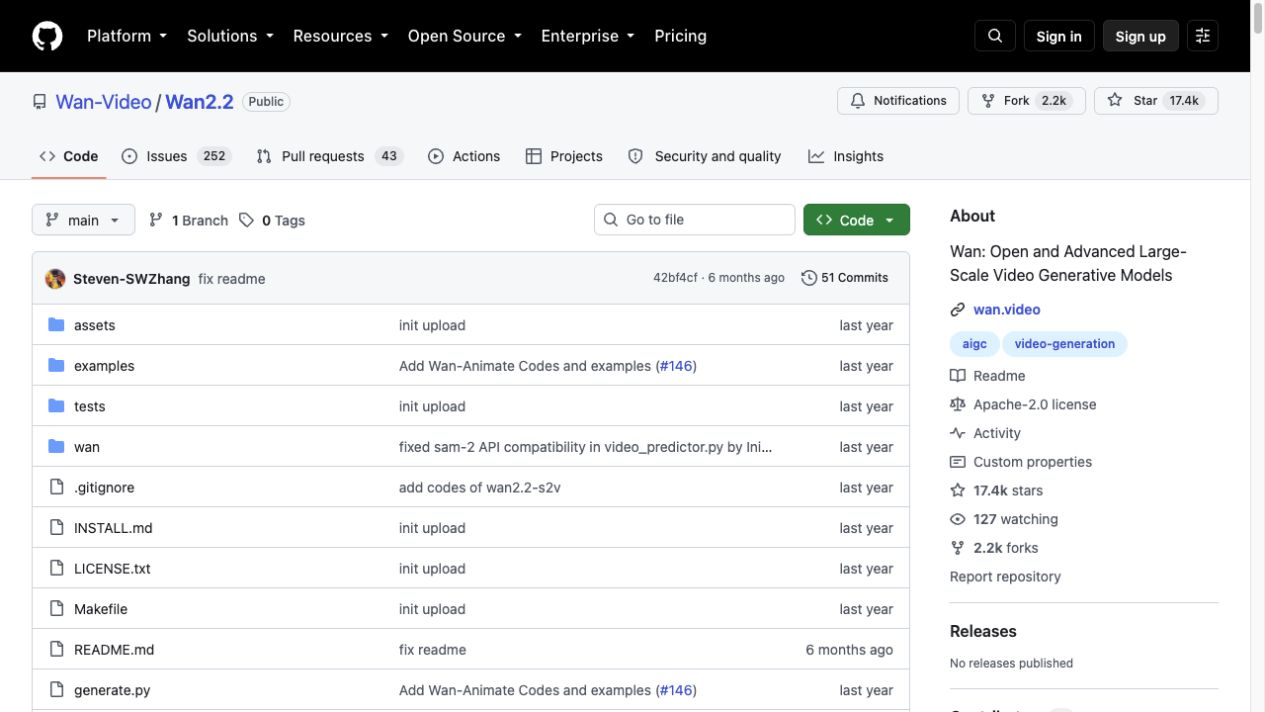
Wan 2.2 provides the artifacts developers expect from an open workflow: source folders, examples, installation documentation, a generation script, and a license.
Choose Wan 3.0 when…
Choose the hosted model when native audio, longer clips, multimodal references, and fast API integration matter more than owning the weights. It is also the simpler route for teams without dedicated GPU operations. Evaluate output quality, queue time, retention policy, price, and service availability on the actual shot types you publish.
Choose Wan 2.2 when…
Choose Wan 2.2 when offline inference, repeatable environments, custom nodes, privacy controls, or model experimentation are requirements. Local output may still need a finishing pass; the Wan 2.2 upscaler and detailer workflow explains how to improve detail without unnecessarily changing approved motion.
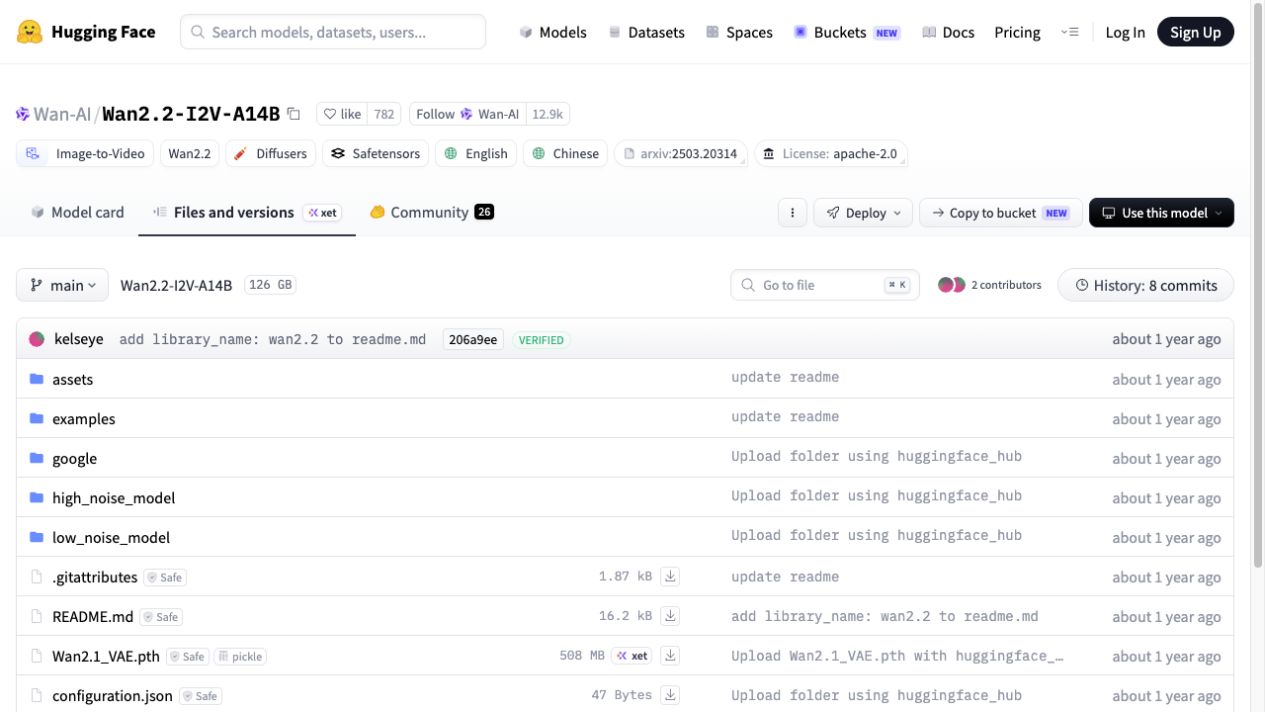
The official Wan 2.2 model page exposes a large downloadable repository with high-noise and low-noise model folders, configuration, VAE, and weight-related files—the evidence missing from the current Wan 3.0 repository.
Which Access Path Should You Choose?
The best answer is not “newest model wins.” Choose the access path that satisfies the project’s control, delivery, and evidence requirements.
For creators who want immediate generation
Use a hosted surface, start with one clear shot, and measure time to an approved export. Keep the prompt, references, duration, aspect ratio, and review criteria constant when comparing results. This path minimizes setup and lets a small team focus on directing, editing, and publishing.
For developers who need model control
Use an officially released open-weight model such as Wan 2.2 until Wan 3.0 provides equivalent artifacts. Pin dependencies, record model hashes, test memory use, and isolate the runtime. If you are comparing newer hosted systems instead, the Wan 3.0 vs Kling 3.0 guide offers a shot-level evaluation structure without pretending either service is a local checkpoint.
For users waiting for an open Wan 3.0 release
Build a small acceptance test now: one text shot, one image-led shot, one reference-heavy scene, and one audio-critical clip. Save prompts, inputs, expected output dimensions, and pass/fail criteria. When official weights arrive, you can test the release immediately instead of judging it from version labels or social clips.
Conclusion
Wan 3.0 is accessible as a capable hosted video service, but it is not currently a verified open-weight model you can download and reproduce locally. The public repository and license do not substitute for weights, inference code, configuration, and a model card; likewise, an API node inside ComfyUI remains cloud inference. Use Wan 3.0 when managed multimodal video and native audio fit the job, use Wan 2.2 when local control is essential, and verify every future release artifact before installing it. To begin producing while the open-source status evolves, create your next video with Seedance.
Ready to try it yourself?
Put the steps from this guide into practice with Seedance and turn prompts or images into polished videos in minutes.
Free credits on signup. Plans from $28/month.
Related Articles
More posts in the same locale you may want to read next.
Seedance App Preview Video Generator 2026: Create App Store and Product Launch Clips
Use Seedance to turn app screenshots, feature copy, and launch goals into App Store previews, Google Play promo videos, and product launch clips.
Read article
Best AI Video-to-Video Models in 2026
The best AI video-to-video models in 2026 for editing footage you already shot: Higgsfield Genjutsu, Seedance 2.x, Runway Aleph, Luma Modify and Kling Omni compared.
Read article
Kling 4.0 vs Seedance 2.5: Full Comparison
Kling 4.0 vs Seedance 2.5 compared by spec: 30-second clips, keyframes vs 50 references, audio, 4K and 10-bit color, editing, and which model fits which job.
Read article