
Leonardo AI vs Higgsfield Review: Which AI Tool Is Worth Your Money?
AI Overview
What is the difference between Leonardo AI and Higgsfield?
Leonardo AI is image-first, with strong generation, editing, model training, and an expanding video toolkit. Higgsfield is video-first, emphasizing cinematic camera motion, consistent characters, speaking clips, ads, and multi-model production.
How does Leonardo AI pricing compare with Higgsfield?
Leonardo has a free plan and paid individual plans from $12/month. Higgsfield has free access and regional paid plans from about $9/month. Credits, included models, queues, and unlimited modes matter more than the headline price.
Is Leonardo AI or Higgsfield better for video generation?
Higgsfield is the stronger dedicated video workflow, especially for camera language, character-led clips, and ads. Leonardo is better when video begins with a still-image pipeline. Test one real brief before subscribing.
Should I use Leonardo AI or Higgsfield for creative content?
Choose Leonardo for image-heavy work and reusable visual assets. Choose Higgsfield for video-heavy campaigns. If your workflow must move from image creation to editing and video without switching products, consider Seedance.
Leonardo AI vs Higgsfield — Quick Verdict
Choose Leonardo AI if…
Choose Leonardo when most deliverables are still images: concept art, product scenes, game assets, illustrations, campaign key art, or repeatable characters. Its advantage is not one signature look but a broad image workflow—generation, reference guidance, editing, Canvas, personal model training, presets, and access to multiple image and video models.
Choose Higgsfield if…
Choose Higgsfield when the deliverable is motion. Its product is organized around camera moves, start and end frames, consistent personas, speaking clips, social ads, effects, and parallel production. It is better suited to creators who think in shots, performances, and campaign variants rather than isolated images.
Consider Seedance if you need both
Seedance is the practical third option when a project moves from an approved still to a controlled clip. You can generate or upload an image, preserve the subject, compare video models, estimate the generation cost, and continue to a downloadable result in one browser workflow.
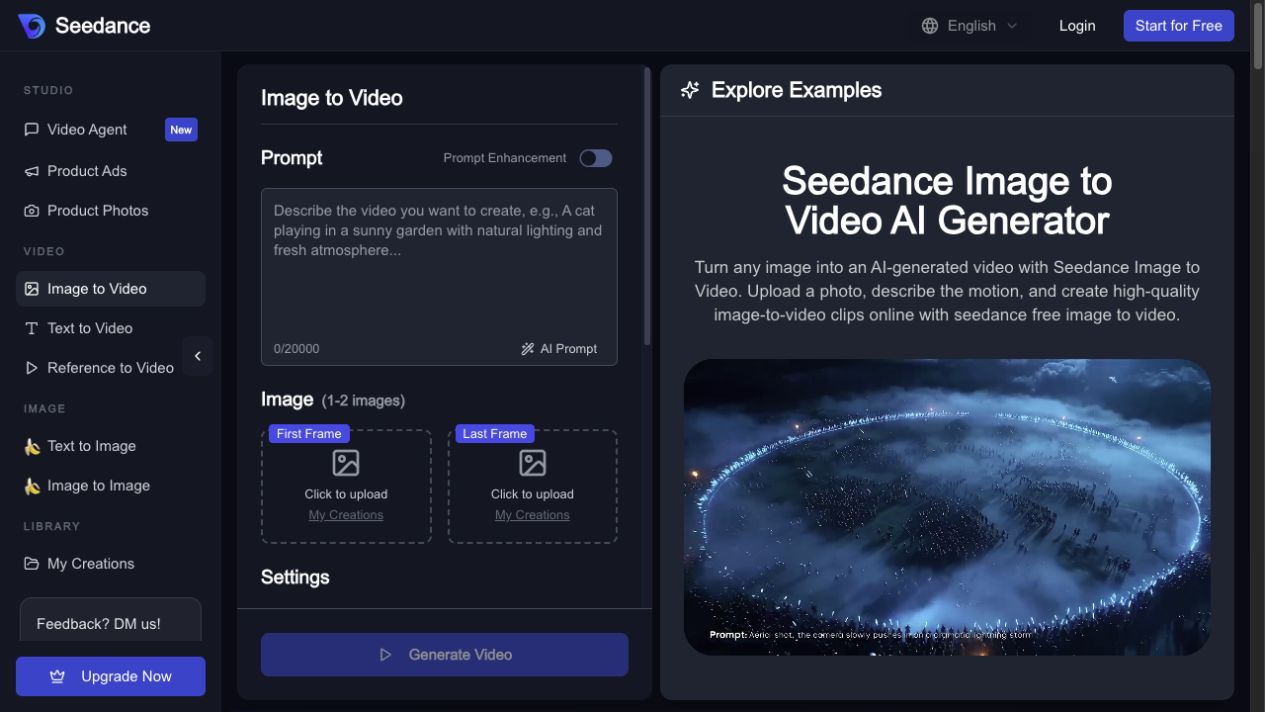
The Seedance Image to Video workspace keeps the prompt, source frames, model settings, cost preview, and generated examples in one browser view.
What Each Tool Actually Does
Leonardo AI — image-first, with video on the side
Leonardo begins with image creation. Users can work with text prompts, image references, style and character guidance, model presets, editing tools, a real-time Canvas, and personal model training. That makes it useful for exploring many visual directions while keeping a library of reusable assets.
Video is now a real capability rather than a token add-on: Leonardo exposes its Motion models alongside selected third-party video models. Even so, the product remains strongest when a polished still, character, or design system is the center of the workflow. For a reference-led edit, judge whether identity, layout, and text survive before adding motion.
Higgsfield — video-first, cinematic motion focus
Higgsfield is designed around short-form video production. Its creative suite combines camera controls, start/end-frame workflows, Soul ID characters, speaking and voice tools, ad templates, image generation, and access to multiple video models. The interface reduces prompt-only guesswork by turning common production choices into visible workflows.
Its main strength is direction: choosing how the camera moves, how a subject performs, and how a shot fits a repeatable content format. The tradeoff is a layered credit and subscription system; model access, unlimited modes, and parallel-generation limits vary by plan.
Where their feature sets overlap
Both products now cover images, video, references, presets, editing, commercial creation, and paid credit systems. The distinction is the center of gravity. Leonardo asks, “What visual asset should we make?” Higgsfield asks, “What shot should we produce?” That difference affects the number of steps between a prompt and the final deliverable.
Image Quality vs Video Quality
Leonardo AI image generation — strengths and style range
Leonardo is the stronger choice for image variety. It can move from photoreal product scenes to illustration, game art, characters, textures, and graphic concepts without forcing one aesthetic. Reference controls and personal models can improve repeatability, while Canvas supports correction and expansion.
Quality still depends on the selected model and brief. Exact packaging text, hands, multiple subjects, and strict product geometry may require retries. Evaluate a full-size export, not only a gallery thumbnail.

Original editorial benchmark still created for this review. Keep the subject, reference, ratio, and attempt count fixed when comparing image systems.
Higgsfield video generation — motion control and realism
Higgsfield is strongest when a still must become a directed shot. Camera presets and motion-oriented workflows help creators communicate dolly, orbit, crane, handheld, or subject actions more explicitly than a loose prompt alone. Soul ID and start/end frames address identity and transition tasks, while speaking and ad tools cover recurring commercial formats.
Control does not guarantee fidelity. Fast movement, changing angles, long hair, hands, logos, and dense text can still drift. A useful evaluation watches the entire clip at normal speed and frame by frame, then records the retries needed before the first usable result.
Side-by-side prompt output comparison
Run a fair test with one reference image, one five-to-eight-second action, one camera instruction, the same aspect ratio, and one attempt per platform. Score subject fidelity, motion accuracy, camera path, temporal stability, text, anatomy, artifacts, wait time, and export restrictions. For a wider methodology, see the best AI video generation models of 2026.
Pricing Comparison — Leonardo AI vs Higgsfield
Pricing checked on August 4, 2026. Regional prices, taxes, model access, and promotions can change, so confirm the checkout screen before paying.
Leonardo AI pricing breakdown
Leonardo currently lists Free at $0 with 150 fast tokens per day, Essential at $12/month, Premium at $30/month, and Ultimate at $60/month before tax. Paid plans add private creations, larger token banks, top-ups, more personal models, and higher concurrency. Premium includes relaxed image generation on selected models; Ultimate also includes relaxed video generation on selected models.
Higgsfield pricing breakdown
Higgsfield pricing is region-adjusted and can change with billing period or promotions. At the time of this review, its first-party pricing page lists annual-billing rates of $19/month for Starter, $47/month for Plus, and $99/month for Ultra, with 270, 1,200, and 3,000 monthly credits respectively. Taxes, monthly-billing prices, checkout totals, and promotional unlimited access may differ.
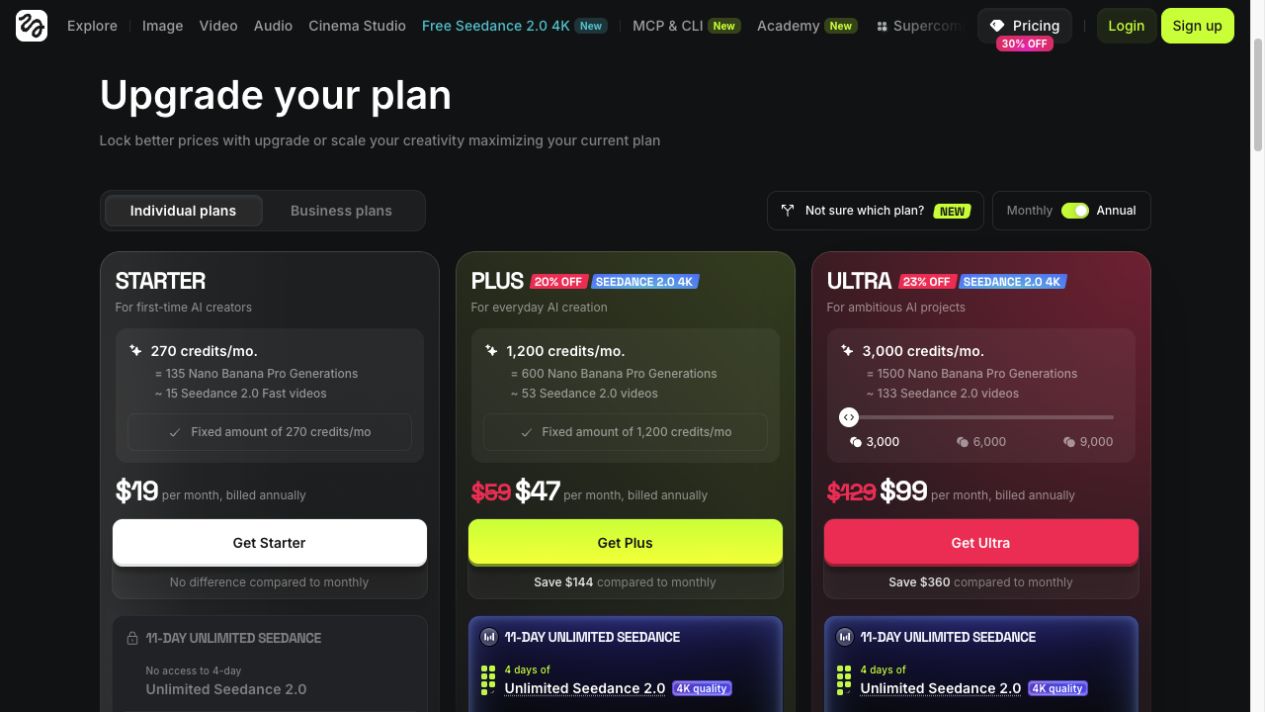
Higgsfield first-party pricing page captured on August 4, 2026. Annual billing is selected; regional prices and limited-time offers may change.
Which gives more value per dollar?
Leonardo offers better value when image volume, private asset libraries, and reusable visual development dominate the month. Higgsfield offers better value when camera control, personas, ads, and video throughput replace separate tools. Divide the monthly price by usable deliverables—not raw generations—because retries consume both credits and time.
Best free option if you are on a budget
Use free access to test one real deliverable under equal conditions. If neither workflow fits, compare the best free Midjourney alternatives, then keep the tool that reaches a usable result with the fewest manual steps and paid retries.
Features Face-Off
| Category | Leonardo AI | Higgsfield |
|---|---|---|
| Primary focus | Image generation and editing | Video direction and production |
| Best for | Concept art, assets, product stills, characters | Cinematic shots, personas, ads, social video |
| Image workflow | Deep model, reference, Canvas, and training options | Integrated image creation for video workflows |
| Video workflow | Motion models and selected third-party models | Camera controls, start/end frames, speaking, effects |
| Free start | 150 fast tokens per day; public creations | Free access may vary by region and promotion |
| Paid entry | $12/month before tax | From about $9/month, region-dependent |
| Privacy | Paid plans include private creations | Depends on plan and current terms |
| API/workflow | Production API with pay-as-you-go options | Programmatic access is covered by current terms; availability may vary |
| Main tradeoff | Video is secondary to the image ecosystem | Credit and model access rules are more layered |
Prompt control and customization
Leonardo provides more image-side choices: models, references, quality settings, personal models, Canvas actions, and reusable presets. Higgsfield provides more shot-side choices: motion, framing, character, speaking, and ad workflows. Neither eliminates the need for a clear anchor, one action, and explicit exclusions.
Commercial usage rights
Both platforms support commercial creation under their current terms, but ownership, privacy, public visibility, and third-party rights are separate questions. Leonardo's free creations are public and have different ownership treatment from paid private creations. Always verify the current plan terms before uploading client media or selling outputs.
API and workflow integrations
Leonardo offers a documented production API and pay-as-you-go credit model. Higgsfield's current terms cover API and other programmatic access, though product availability and usage limits can vary. For a creator who does not need an API, browser workflow, predictable cost, and result organization may matter more.
Seedance — The Better Alternative for AI Video + Image
Seedance is a better fit when the workflow—not one model—is the product decision. Create or approve a still, preserve the subject with explicit anchors, route it into Image to Video, and evaluate the completed clip in the same place. Teams making ecommerce creative can start from the dedicated Product Ads workflow instead of rebuilding product locks for every shot.
A real moving shot from the Seedance media library. Check rider consistency, road speed, background parallax, headlight detail, and the tracking camera across the complete clip. For reusable motion language, read the camera movement prompt guide.
The advantage is continuity: fewer handoffs between image creation, reference editing, model selection, cost approval, generation, and result review. The limitation is the same as any hosted credit platform—generation quality still depends on the model, source image, prompt, and number of attempts.
Conclusion
Choose Leonardo AI for image-first creation, style range, visual asset libraries, and customization; choose Higgsfield for video-first production, camera language, consistent personas, and ad workflows; and choose Seedance when one project must move from image creation and editing into controlled video without changing platforms. Ultimately, the best value is not the cheapest subscription or the prettiest showcase, but the workflow that produces a directly usable result with the least uncertainty, manual work, repeated generation, and repeated spend.
Ready to create your own AI video?
Turn ideas, text prompts, and images into polished videos with Seedance. If this article helped, the fastest next step is to try the product.
Free credits on signup. Plans from $28/month.
Related Articles
More posts in the same locale you may want to read next.
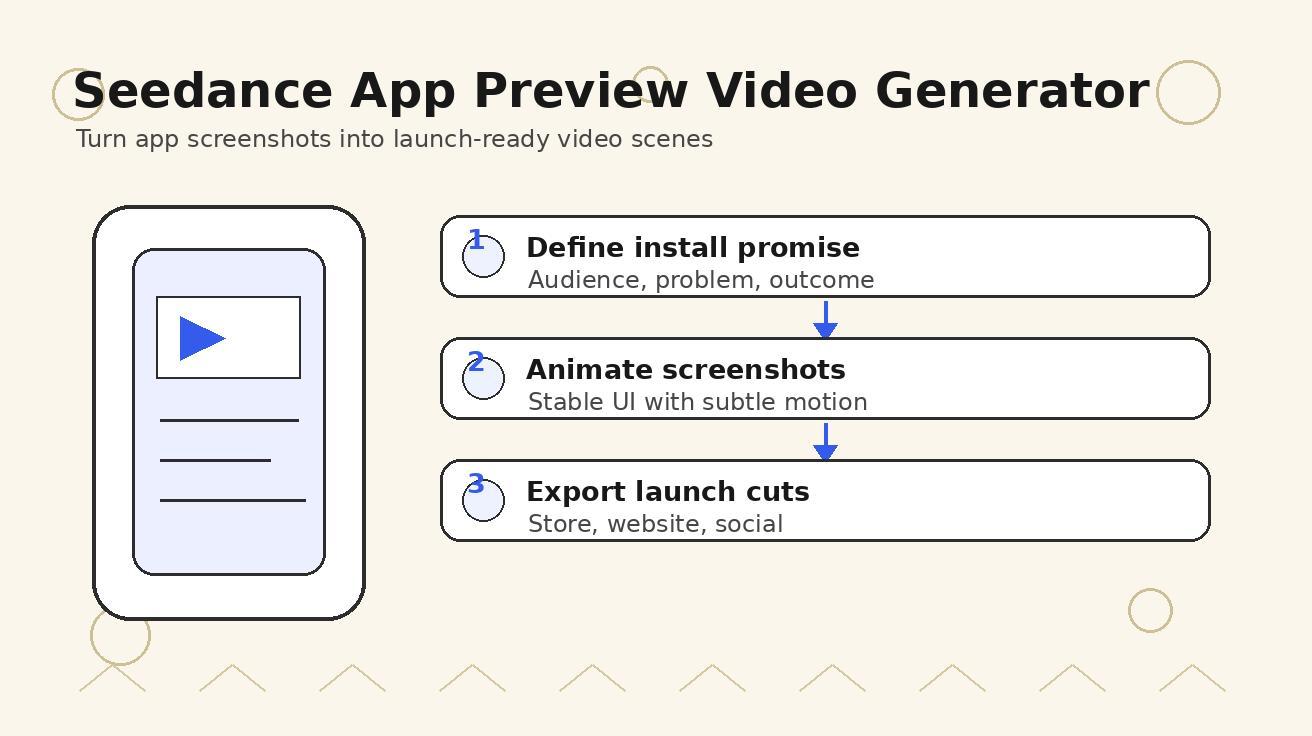
Seedance App Preview Video Generator 2026: Create App Store and Product Launch Clips
Use Seedance to turn app screenshots, feature copy, and launch goals into App Store previews, Google Play promo videos, and product launch clips.
Read article
PixVerse Lip Sync API Tutorial: Upload, Generate, Poll, and Review
A practical PixVerse lip sync API workflow covering source video IDs, audio upload or TTS, request payloads, asynchronous polling, and quality review.
Read article
OpenArt Consistent Character Video Tutorial: Keep One Person Across Scenes
Build one OpenArt character, prepare reference angles, animate short shots, and review or repair face and wardrobe drift across a video sequence.
Read article