
Wan 3.0 vs Seedance 2.5: Which AI Video Model Wins in 2026?
AI Overview
What is the difference between Wan 3.0 and Seedance 2.5?
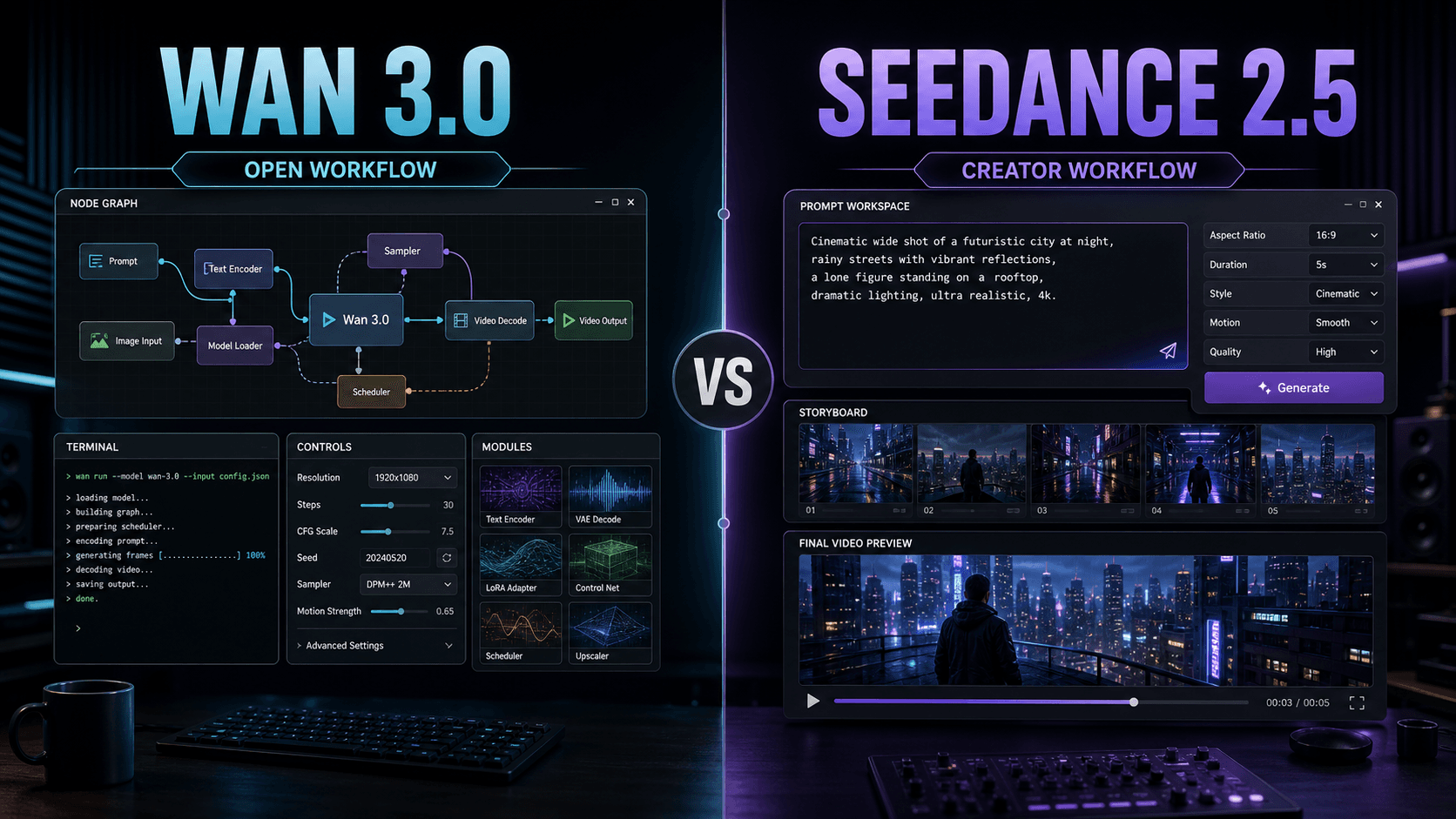
Wan 3.0 is an open-source video model designed for configurable developer workflows and hosted API access. Seedance 2.5 is a creator-facing cloud experience built to turn text, images, and references into finished clips with less setup.
Which model has better video quality, Wan 3.0 or Seedance 2.5?
Seedance 2.5 is the more dependable choice for polished creator output, especially when a scene combines identity, detailed environments, and camera movement. Wan 3.0 is highly capable, but results depend more on deployment choices and workflow tuning.
Is Wan 3.0 free to use?
Wan 3.0 is open-source under the Apache 2.0 license, so its code and weights can be used without a model license fee. Self-hosting still requires hardware, storage, engineering time, and inference operations; hosted access may charge by use.
Can I use Seedance 2.5 instead of Wan 3.0 for content creation?
Yes. Seedance 2.5 is usually the faster fit for social videos, ads, product shots, and story scenes because it works in the browser and needs no local deployment. Choose Wan when customization or infrastructure control matters more.
What Is Wan 3.0?
Wan 3.0 is Alibaba's open-source video-generation family for developers, research teams, and production groups that want to build around a model rather than use only a fixed web interface. The official release supports text-to-video, image-to-video, reference-driven generation, first-and-last-frame control, video editing, extension, and native audio capabilities. Supported hosted routes can produce 480p, 720p, or 1080p output and sequences up to 30 seconds, although the exact combination depends on the selected task and endpoint.
The important difference is control. A technical team can inspect the repository, integrate the model into a private pipeline, decide how inputs are stored, and add its own queues, review stages, or downstream editing. That flexibility is valuable for internal tools and specialized products. It also moves responsibility to the team: compute capacity, inference speed, versioning, monitoring, and output quality all become engineering decisions.
This official Wan 3.0 repository sample shows the model's finished-video capability; it is not presented as a matched Seedance benchmark.
What Is Seedance 2.5?
Seedance 2.5 is a cloud-based creation route focused on getting from a brief to a reviewable video without installing a model or managing GPUs. It supports creator workflows that begin with Text to Video as well as projects that use Image to Video to preserve a product, person, composition, or opening frame. That makes it practical for social posts, ecommerce assets, ads, music visuals, and short narrative sequences.
The creator-facing advantage is not merely a simpler screen. Seedance keeps model access, generation settings, asset input, and output review in one browser workflow. A marketer can test a five-second hook, refine the prompt, and then move to a longer approved shot without building an inference service. A filmmaker can anchor a character with an image and spend attention on blocking, timing, and camera language instead of environment setup.
A short real-world sample is more useful than a single sharpened frame: watch the subject, background geometry, and camera movement together.
Wan 3.0 vs Seedance 2.5 — Full Comparison
The two models overlap in generation capability but optimize different layers of the job. Wan 3.0 exposes a foundation that a technical team can shape. Seedance 2.5 packages high-quality generation into a direct creation experience. The right winner therefore depends on whether the constraint is infrastructure control or the time needed to reach an approved clip.
| Dimension | Wan 3.0 | Seedance 2.5 |
|---|---|---|
| Video quality | Strong; varies with route and deployment tuning | Polished, creator-ready output with stable detail |
| Prompt adherence | Good on structured prompts and reference-led tasks | Strong on complex briefs with subject, action, and camera constraints |
| Motion smoothness | Competitive, especially with carefully staged motion | Consistent on restrained action and continuous camera moves |
| Resolution and duration | Up to 1080p and 30 seconds on supported hosted tasks | Route-dependent, with short drafts and longer production shots |
| Ease of use | Requires technical setup for self-hosting; hosted API is available | Browser-based workflow with no local infrastructure |
| Cost to start | No model license fee when self-hosted; compute is not free | Free starting access; credits and routes can change |
| Model access | Open-source, configurable, integration-friendly | Managed cloud product focused on creation and delivery |
If you are also deciding between closed creator tools, our Seedance 2.5 vs Kling 3.0 Omni comparison examines a different tradeoff: two managed products rather than an open model versus a creator platform.
Video Quality Test — Side-by-Side Results
A useful comparison needs more than two attractive hero frames. The fair method is to lock the subject, action, camera move, duration, aspect ratio, and reference image, then review the entire clip at full size. We use four scene types because each exposes a different failure mode. Output is judged on identity stability, background geometry, motion continuity, prompt compliance, artifacts, and the amount of editing required—not on which still image looks most dramatic.
Test 1: Portrait with a Complex Background
The brief places one person in a busy interior, asks for a slow push-in, and keeps several background lines visible. Seedance 2.5 has the practical edge because the face, wardrobe, and environment tend to read as one controlled shot. Wan 3.0 can deliver an attractive portrait, but a self-hosted result is more sensitive to workflow choices such as reference preparation, resolution, and inference settings. Inspect the transition around hair, hands, and repeating background objects; those areas reveal instability before the face does.
Test 2: Landscape with Slow Motion
This is the closest category. A wide landscape, gentle wind, and slow lateral camera move do not force either system to solve dense interaction. Wan 3.0 can produce convincing atmospheric depth, while Seedance 2.5 keeps the creator workflow faster and makes a small revision easier to request. Seedance receives a slight production advantage, but the visual result can be close enough that art direction matters more than the model name.
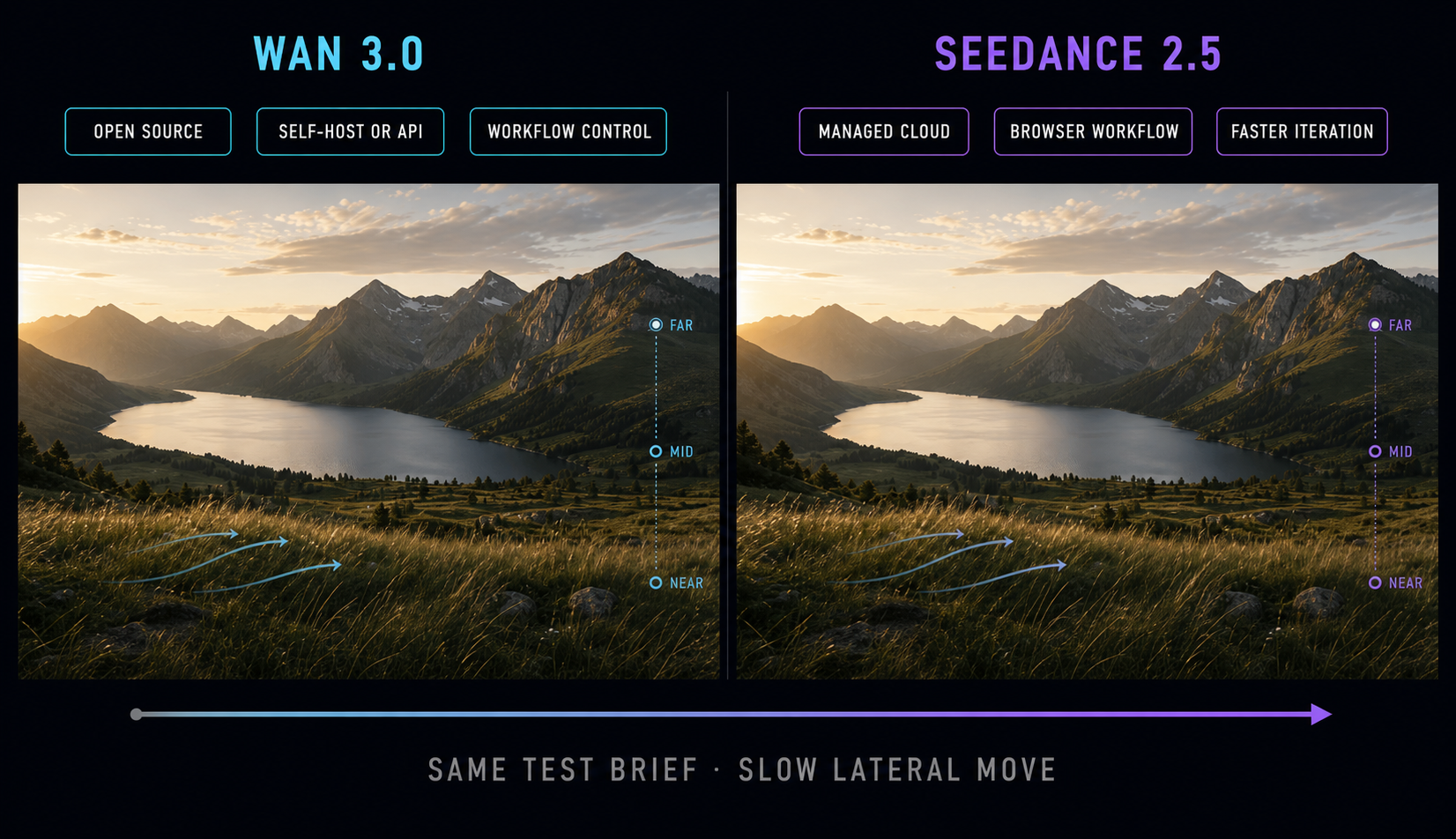
A controlled comparison keeps the landscape, lens, camera height, wind direction, depth planes, and lateral move identical before judging either model.
Test 3: Fast Action
Fast action stresses anatomy, occlusion, object permanence, and camera timing at once. The prompt should specify one dominant movement instead of stacking several actions into the same second. Seedance 2.5 is more reliable when the goal is a smooth, immediately usable clip; it generally needs fewer workflow decisions before review. Wan 3.0 remains viable when a technical team can tune the route or accept additional generations, but its openness does not automatically remove motion artifacts.
Test 4: Dense Text Prompt
The final test combines subject identity, a prop, lighting, camera direction, and a timed action. Seedance 2.5 follows this kind of creator brief more consistently when every clause has one clear job. Wan 3.0 benefits from the same disciplined structure, yet developers may need to translate the brief into task-specific inputs or reference controls. Neither model should be judged by decorative prompt length: a shorter hierarchy of locked identity, action, camera, environment, and exclusions is usually more repeatable.
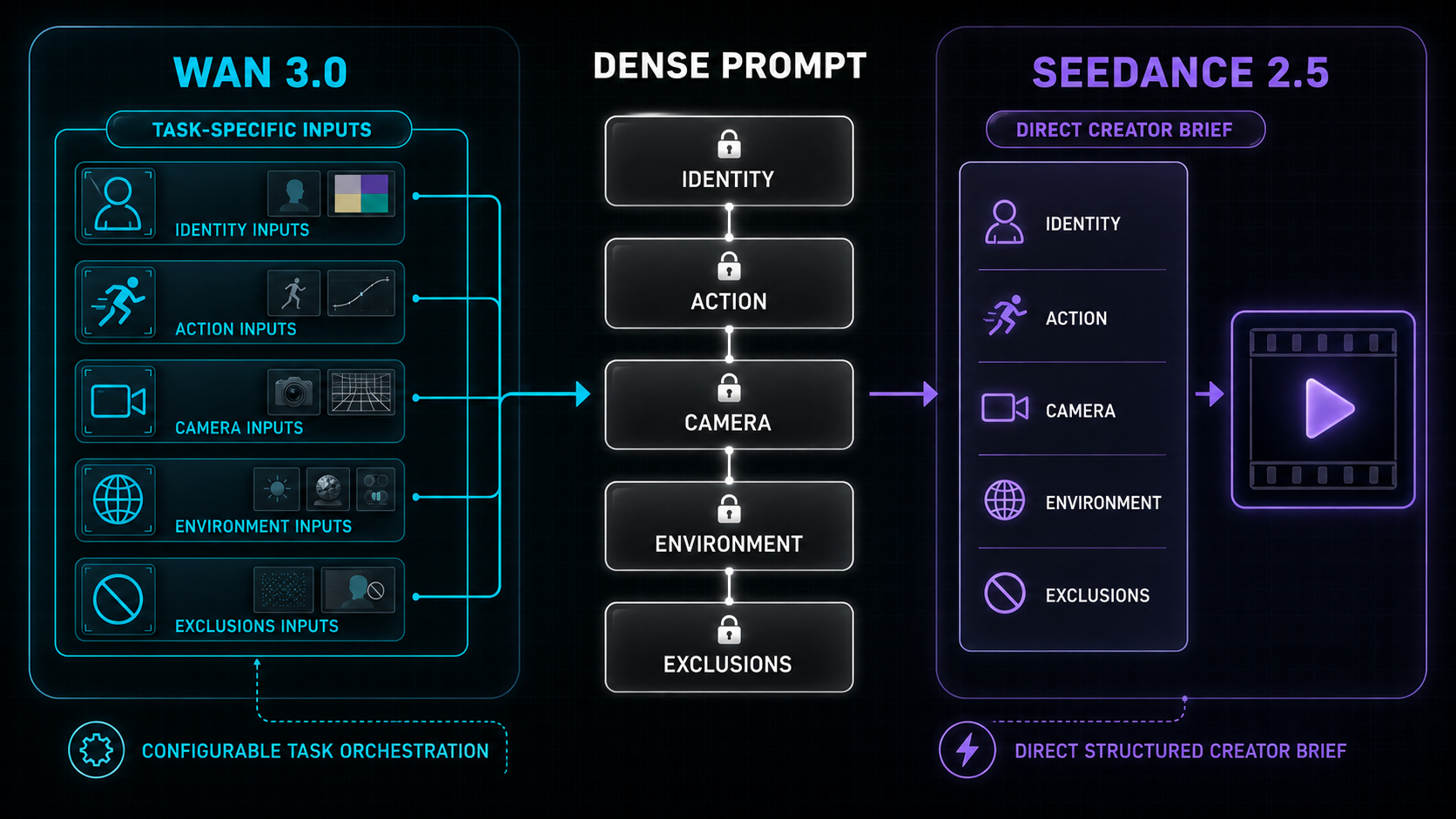
Both workflows benefit from the same five locked clauses; the difference is whether they are orchestrated as task-specific controls or submitted as one structured creator brief.
The overall result favors Seedance 2.5 for production readiness, not because Wan 3.0 lacks capability, but because creators evaluate the whole path from input to approved export. For a broader managed-platform benchmark, see Seedance vs Runway.
When to Use Wan 3.0
Choose Wan 3.0 when your team needs model-level access or wants video generation inside its own product and infrastructure. It is a sensible fit for private deployment, research, custom orchestration, batch pipelines, or workflows that require deeper integration than a creator interface exposes. Teams with GPU operations and machine-learning engineers can control versions, data flow, queues, and post-processing themselves.
That freedom is most valuable when it solves a real requirement. If the project needs only a handful of finished social clips, self-hosting can turn a creative task into an infrastructure task. Estimate storage, compute, maintenance, evaluation, and failure recovery before treating open-source access as zero cost.
When to Use Seedance 2.5
Choose Seedance 2.5 when the priority is high-quality output now: a product shot due today, a campaign concept that needs several visual directions, a music-video beat, or a short narrative that must survive client review. It suits creators, marketers, agencies, and small teams that want to direct the scene without maintaining a model stack.
It is also the stronger starting point for experimentation. You can test a short draft, examine motion and identity, refine one weak clause, and reserve longer or higher-quality generations for an approved concept. The result is a clearer creative loop and less operational overhead.
Verdict — Which Model Should You Choose?
Developers and researchers should choose Wan 3.0 when open-source access, deployment control, customization, or product integration defines success. Its value is the ability to build around the model and own the surrounding system.
Creators and marketers should choose Seedance 2.5 when the goal is a polished video rather than a model deployment. It shortens the distance between a reference, a prompt, and a reviewable clip, while keeping iteration inside a familiar browser workflow.
For most individual creators and production teams, Seedance 2.5 is the practical winner. Wan 3.0 wins the flexibility category; Seedance wins the ready-to-create category. The choice is less about which model can produce a beautiful frame and more about which workflow removes the bottleneck you actually have.
Conclusion
Wan 3.0 is an important open-source release with serious video, editing, reference, and audio capabilities. It gives technical teams a foundation they can inspect and integrate. Seedance 2.5 takes the other route: managed access, direct creative controls, and a faster path to consistent output for everyday production.
Choose Wan when owning the system is the objective. Choose Seedance when finishing the video is the objective. For the majority of creators comparing these two in 2026, Seedance 2.5 offers the more efficient balance of quality, control, and ease of use.
Ready to create your own AI video?
Turn ideas, text prompts, and images into polished videos with Seedance. If this article helped, the fastest next step is to try the product.
Free credits on signup. Plans from $28/month.
Related Articles
More posts in the same locale you may want to read next.
Seedance App Preview Video Generator 2026: Create App Store and Product Launch Clips
Use Seedance to turn app screenshots, feature copy, and launch goals into App Store previews, Google Play promo videos, and product launch clips.
Read article
Kling 4.0 vs Seedance 2.5: Full Comparison
Kling 4.0 vs Seedance 2.5 compared by spec: 30-second clips, keyframes vs 50 references, audio, 4K and 10-bit color, editing, and which model fits which job.
Read article
Kling 4.0 Keyframes & Omni Reference Guide
Learn how Kling 4.0 uses up to 10 keyframes and 15 Omni Reference assets in one 30-second video, with 3 worked plans, common mistakes, and Seedance 2.5 tips.
Read article