
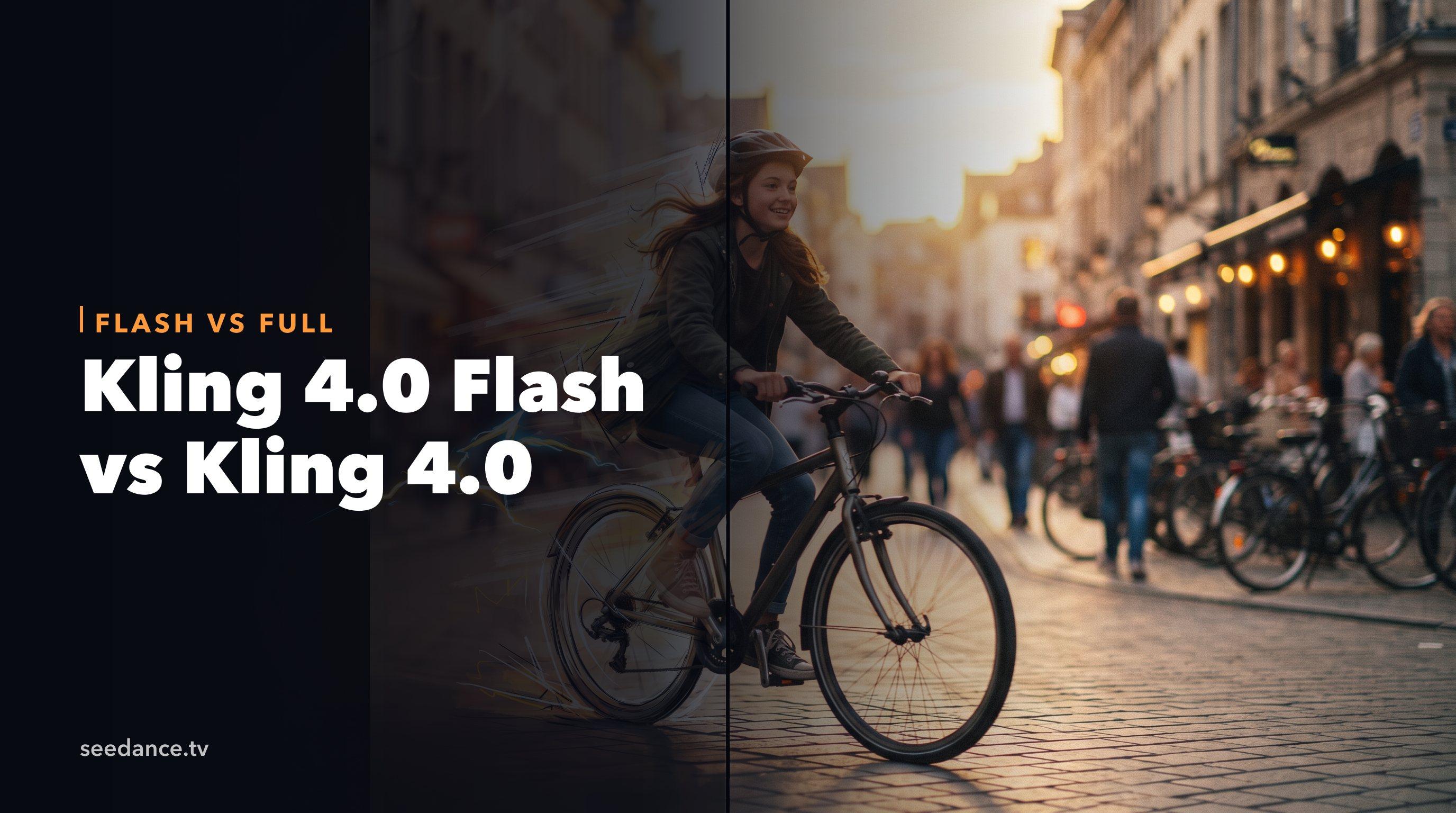
Quick Answer: Kling 4.0 Flash is the lighter, faster member of the Kling 4.0 family: 3–20 second clips at 720p in 8-bit SDR, with text-to-video, image-to-video, and Omni Reference. The full Kling 4.0 goes to 30 seconds, adds 1080p and 4K, and supports first & last frame plus up to 10 keyframes. Use Flash to test ideas and full 4.0 to finish.
Kling 4.0 arrived as two models, not one. Flash came first, to a small early-access group, and the full model follows. If you are choosing between them, the question is simple: are you exploring, or are you delivering?
This guide compares the two by published spec, explains when Flash is enough and when you need the full model, and lays out a draft-then-finish workflow you can plan today and put to work once Kling 4.0 lands on seedance.tv. We have not benchmarked either model, so there are no speed or quality scores here, only what Kling has published and how it maps to real jobs.
Timeline: How the Two Models Rolled Out
- September 28, 2026: Kuaishou's Kling AI announced Kling 4.0. On the same date, Kling 4.0 Flash opened in early access for a limited group: Kling Ultra yearly subscribers (also called "Black Gold" annual members).
- October 2026: Kling's release note says the full Kling 4.0 model "will officially launch in October". No exact day has been published.
Kling has not published credit pricing for either model. On seedance.tv, Kling 4.0 is not selectable yet: it's on its way, and the Kling 4.0 page is where to follow it and browse official examples. Its pricing here will be listed when it launches; pricing covers the models you can run today.
Spec Table: Kling 4.0 Flash vs Kling 4.0
| Kling 4.0 Flash | Kling 4.0 (full) | |
|---|---|---|
| Positioning | "Built for frequent creation": fast generation, good value | Full-feature model |
| Text-to-video | Yes | Yes |
| Image-to-video | Yes | Yes |
| Omni Reference | Yes | Yes, up to 15 assets per task |
| First & last frame | Not listed | Yes |
| Multiple keyframes | Not listed | Up to 10 keyframe images |
| Clip length | 3–20 seconds | 3–30 seconds |
| Resolution | 720p only | 720p, 1080p, 4K |
| Color | 8-bit SDR | SDR today; 10-bit HDR at 1080p/4K "coming soon" |
| Video editing | Not listed | Up to 5 input clips |
| Extension | Not listed | Up to 2 minutes, "coming soon" |
| Access | Early access from Sep 28, 2026 (limited group) | Official launch in October 2026 |
A note on "not listed": first & last frame, multi-keyframes, and editing do not appear in Kling's Flash spec table. That doesn't prove Flash can never do them, only that Kling hasn't listed them. Plan as if they aren't there.
Full Kling 4.0 details, including Omni Reference limits, stereo audio, and accents, are in our Kling 4.0 vs Seedance 2.5 comparison.
The Four Differences That Matter
1. Length: 20 seconds vs 30 seconds
Flash stops at 20 seconds. The full model goes to 30. For a 15-second TikTok or a 6-second bumper, Flash has more than enough room. For a full 30-second ad spot or a scene with five story beats, you need the full model, or you need to cut two Flash clips together.
2. Resolution and color: 720p SDR vs up to 4K
Flash renders at 720p only, in 8-bit SDR. The full model offers 720p, 1080p, and 4K. Its 10-bit HDR at 1080p and 4K is marked "coming soon", so today both models deliver SDR; the full model just gives you more pixels.
720p is fine for judging composition, motion, and timing. It is usually too soft for a final YouTube upload or a paid ad on a large screen. If a Flash take is the one you love, you can sharpen it with the Video Upscaler, but regenerating in the full model at 1080p or 4K will usually hold fine detail better. For what 4K and HDR actually change, see Kling 4.0 4K and 10-bit HDR explained.
3. Control: references only vs keyframes
Both models support Omni Reference, so you can keep a product or character consistent in either. The difference is timing control. The full model accepts first & last frame and up to 10 keyframe images, so you can lock what the frame looks like at specific moments. Flash, by its spec table, gives you text, an input image, and references, and leaves the timing to the prompt.
If your brief says "the product must be in the hero position at second 28", that is a keyframe job. Our Kling 4.0 keyframes and Omni Reference guide explains how to plan them.
4. Purpose: frequent creation vs final delivery
Kling describes Flash as built for frequent creation, with fast generation and good value. Read that as: the model for volume. Many prompts, many variations, quick feedback. The full model is the one you reach for when a specific shot has to be right.
When Flash Is Enough
- Idea testing. You have five concepts for an ad and want to see which one works in motion before investing in a polished version.
- Prompt drafting. You are learning how Kling 4.0 reads your prompt structure, camera language, and sound cues. Iterate cheaply at 720p.
- Short social drafts. Vertical clips under 20 seconds for TikTok, Reels, or Shorts, where you want to check pacing and the hook before finishing. Check Kling's listed aspect ratios on the Kling 4.0 page before you start.
- Storyboard previews. Rough motion versions of each shot so a client or teammate can approve the direction.
- Reference checks. Confirm that your Omni Reference images actually keep the product or face stable before you build keyframes around them.
When You Need the Full Kling 4.0
- Anything over 20 seconds in a single clip.
- Final delivery at 1080p or 4K, especially for YouTube, landing pages, or ads shown on larger screens.
- Exact beats. Product reveals, logo moments, or dialogue lines that must land at a specific second, using keyframes or first & last frame.
- Editing existing footage with the multi-clip editing mode.
- Cinematic framing like 21:9, which is listed for the full model.
Workflow: Draft in Flash, Finish in Full
This is the approach we'd suggest for most 30-second projects. Everything up to the final render can be prepared today, then run on Kling 4.0 as soon as it arrives.
- Write a timeline prompt. Break the clip into segments, for example 0–5 s, 5–12 s, 12–20 s, 20–27 s, 27–30 s. For the Flash draft, test the first 20 seconds, or compress the timeline to fit.
- Attach your references. Add the product or character images as Omni Reference assets. Use the same set in both stages so you are only changing the model, not the inputs.
- Generate three to five Flash drafts. Vary one thing at a time: the hook, the camera move, or the sound cue. Keep notes on what worked.
- Pick the winning direction. Choose the draft with the best pacing and the most stable product or face.
- Plan keyframes from the draft. Look at where the winning draft's visual state changes. Those are your keyframe positions. Kling's own advice: put keyframes where something must change, not at fixed intervals, and use only as many as the story needs.
- Generate the final in full Kling 4.0. Same references, same prompt order, now at 1080p or 4K and the full 30 seconds, with keyframes locking the important moments.
- Fix and finish. Use the editing mode for small changes, then export.
How Seedance Fits the Same Draft-to-Final Logic
The same two-stage habit works with Seedance models on this site, and you can use it right now:
- Draft with Seedance 2.0 Fast, the speed-focused version of Seedance 2.0. Seedance 2.0 generates 4–15 seconds with up to 9 images, 3 videos, and 3 audio references, which is enough to test a concept. Check the model page for Fast's current limits.
- Finish with Seedance 2.5: native 30-second clips, native 4K with 10-bit color available today, up to 50 multimodal references, motion reference, and timestamp-level edits.
When Kling 4.0 goes live here, you can also mix families: draft in Kling 4.0 Flash, then run the final brief on both full Kling 4.0 and Seedance 2.5 and keep the better take. Until then, finish on Seedance 2.5 and keep the brief ready for a Kling pass. If 10-bit color matters for your grade, Seedance 2.5 offers it now, while Kling's 10-bit HDR is still "coming soon". For the full head-to-head, read Kling 4.0 vs Seedance 2.5, and for the Seedance upgrade path, Seedance 2.5 vs Seedance 2.0.
Quick Decision Guide
| Your situation | Use |
|---|---|
| Testing 5+ concepts quickly | Kling 4.0 Flash |
| Clip under 20 s, final at 720p is acceptable | Kling 4.0 Flash |
| Clip of 21–30 s in one generation | Kling 4.0 |
| Final at 1080p or 4K | Kling 4.0 |
| Moments that must land at a precise second | Kling 4.0 (keyframes) |
| Many references or 10-bit color today | Seedance 2.5 |
FAQ
What is Kling 4.0 Flash?
It is the lighter model in the Kling 4.0 family, described by Kling as built for frequent creation. It supports text-to-video, image-to-video, and Omni Reference, at 3–20 seconds, 720p, 8-bit SDR.
Who can use Kling 4.0 Flash?
Kling opened early access on September 28, 2026 for a limited group: Kling Ultra yearly subscribers, also called "Black Gold" annual members.
Does Kling 4.0 Flash support keyframes?
First & last frame and multiple keyframes are not listed in Kling's Flash spec table. If you need keyframe control, use the full Kling 4.0, which supports up to 10 keyframe images.
Is Kling 4.0 Flash good enough for final videos?
For quick social posts at 720p, sometimes. For YouTube, paid ads, or anything over 20 seconds, the full Kling 4.0 at 1080p or 4K is the better choice.
How much does Kling 4.0 cost?
Kling has not published credit pricing for Kling 4.0 or Flash. We'll list Kling 4.0 pricing on seedance.tv when the model launches here; pricing shows current generation costs for the models already live.
Ready to create your own AI video?
Turn ideas, text prompts, and images into polished videos with Seedance. If this article helped, the fastest next step is to try the product.
Free credits on signup. Plans from $28/month.
Related Articles
More posts in the same locale you may want to read next.
Seedance App Preview Video Generator 2026: Create App Store and Product Launch Clips
Use Seedance to turn app screenshots, feature copy, and launch goals into App Store previews, Google Play promo videos, and product launch clips.
Read article
Kling 4.0 vs Seedance 2.5: Full Comparison
Kling 4.0 vs Seedance 2.5 compared by spec: 30-second clips, keyframes vs 50 references, audio, 4K and 10-bit color, editing, and which model fits which job.
Read article
Kling 4.0 Keyframes & Omni Reference Guide
Learn how Kling 4.0 uses up to 10 keyframes and 15 Omni Reference assets in one 30-second video, with 3 worked plans, common mistakes, and Seedance 2.5 tips.
Read article