
Seedance AI Video Workflow Tips: The Complete Guide for 2026

If you want consistent, high-quality results from Seedance, the difference almost always comes down to workflow — not luck. This guide covers proven Seedance workflow tips for 2026: how to set up projects efficiently, write prompts that actually work, iterate without wasting generations, and get your videos out the door ready to use. Whether you're making TikTok ads, product demos, or cinematic clips, these steps apply across every use case.
1. Project Setup: Start With a Clear Output Goal
The single biggest time-saver in any Seedance workflow is deciding what you need before you touch a prompt. Vague goals produce vague videos.
Define Format and Duration First
Before entering your first prompt in Seedance, lock down:
- Aspect ratio — 9:16 for Reels/TikTok, 16:9 for YouTube/landing pages, 1:1 for product ads
- Duration — 5–8 seconds for social hooks, 10–15 seconds for product demos
- Model — Seedance 2.0 for realism and motion physics; Sora 2 or Veo 3 for specific style or cinematic needs (all accessible from the Seedance model switcher)
Committing to these upfront means every generation you run is actually usable, not something you'll have to reshoot because the format was wrong.
Organize Assets Before You Generate
If you're using Seedance's image-to-video feature, collect and name your source images before you start. A consistent naming convention (product-front.jpg, product-angle.jpg) makes iteration much faster when you need to swap assets across runs.
For text-to-video workflows, keep a short reference doc with your brand keywords, color palette notes, and any visual references. You'll paste from it constantly.
2. Prompt Engineering: Write Prompts That Direct, Not Describe
Seedance's models respond best to prompts that specify action, camera, and environment — not just visual descriptions. Most failed generations come from prompts that describe what something looks like rather than what it does.
The Four-Part Prompt Structure
Use this structure for every Seedance text-to-video or image-to-video prompt:
[Subject + action] + [camera movement] + [environment/lighting] + [style/mood]
Example 1 — Product video:
A sleek white water bottle rotates slowly on a marble surface,
camera orbits 180 degrees, soft studio lighting, clean minimal aesthetic,
product photography style
Example 2 — TikTok hook:
A young woman opens a gift box with a surprised smile,
close-up to medium shot zoom out, warm morning light,
casual lifestyle, social media vertical format
Example 3 — Cinematic landscape:
Aerial drone shot flying over golden wheat fields at sunset,
slow forward push, volumetric light rays, cinematic 4K,
film grain, wide aspect ratio
Camera Movement Keywords That Work in Seedance
Seedance 2.0 responds reliably to these camera direction terms: slow zoom in, zoom out, orbit left/right, dolly forward, crane up, handheld shake, static locked shot, tilt up, pan left. Add one camera directive per prompt — multiple moves in a single prompt produce inconsistent results.
Avoid These Prompt Patterns
- Long lists of adjectives with no action ("beautiful, stunning, vibrant, colorful sunset")
- Contradictory styles ("photorealistic cartoon animation")
- Overloading with text instructions ("add text that says Sale 50% off" — use post-processing for text overlays)
3. Iteration Strategy: Generate Smart, Not Often
Random iteration burns credits and time. A structured Seedance workflow treats each generation as a data point, not a lottery ticket.
The 3-Version Rule
For any new concept, generate exactly 3 versions before making any prompt changes. Vary only one element between runs:
- Version A: original prompt
- Version B: change camera movement
- Version C: change lighting or environment description
Compare the three outputs. The version that works best tells you which variable mattered most — then you can optimize from there rather than guessing.
Use Seedance's Model Switcher for Style Comparison
When you're not sure which model fits your asset, run the same prompt through Seedance 2.0 and one of the available alternatives (Sora 2, Veo 3, or Kling) back-to-back. The Seedance interface lets you switch models without re-entering your prompt. This comparison step takes 2 minutes and often saves you 10 failed generations.
When to Stop Iterating
Set a hard limit: if a prompt hasn't produced a usable result in 5 generations, the prompt is the problem — not the model. Go back to the four-part structure, strip it down to subject + one action, and rebuild from scratch.
4. Image-to-Video Workflows: Getting Consistency Right
Seedance's image-to-video tool is one of its most powerful features — and the one most users underuse. The key is treating your source image as a starting frame, not a still that needs to stay frozen.
Prepare Source Images for Motion
Before uploading to Seedance image-to-video:
- Crop to your target aspect ratio — the model generates motion based on the full frame; unexpected edges cause drift
- Ensure subject is centered or clearly dominant — subjects at the edge of frame tend to exit frame during motion
- Remove busy backgrounds when possible — cluttered backgrounds compete with subject motion
Prompt Pairing for Image-to-Video
When using image-to-video in Seedance, your text prompt should describe only the motion and environment — not re-describe the image. The model already sees the image.
Example 4 — Coffee product image-to-video:
Steam rises gently from the cup, soft morning light shifts slowly,
subtle parallax background movement, calm and cozy atmosphere
Example 5 — Fashion product image-to-video:
Fabric moves gently in a soft breeze, model turns slightly toward camera,
golden hour outdoor light, editorial fashion style, slow motion
Maintaining Subject Consistency Across Clips
For multi-clip projects where you need the same character or product to appear consistently, use your best output as the source image for the next clip. Feed clip A's final frame back into Seedance image-to-video to start clip B. This chaining technique keeps visual continuity without any additional setup.
5. Music Video and Creative Workflows
Seedance supports music video creation workflows where visuals are synchronized with audio mood and tempo. This opens a distinct set of workflow tips compared to standard video generation.
Match Prompt Rhythm to Music Energy
For high-energy tracks (electronic, hip-hop, fast-tempo), use short punchy motion prompts: quick cut, rapid zoom, flash transitions, high contrast neon lighting, and generate shorter clips (4–6 seconds) to edit into a sequence.
For ambient or slow tracks, use long flowing motion: slow drift, gentle camera pull back, soft gradients, cinematic pace, and generate longer clips (8–10 seconds) with minimal cuts.
Build a Visual Storyboard First
Before generating any clips for a music video in Seedance, map out a basic storyboard: what happens in each 8-bar section. Even a simple text outline ("bars 1–8: product intro, bars 9–16: lifestyle shots, bars 17–24: logo/CTA") prevents you from generating clips that don't cut together.
6. Export, Format, and Quality Control
A Seedance workflow isn't complete until your video is in the right format for its destination. Export decisions made too late add unnecessary re-generation cycles.
Resolution and Format Checklist
| Destination | Resolution | Format | Notes |
|---|---|---|---|
| TikTok / Reels | 1080x1920 | MP4 H.264 | 9:16 required |
| YouTube | 1920x1080 | MP4 H.264 | 16:9 standard |
| 1920x1080 | MP4 | Square also works | |
| Website hero | 1920x1080 | MP4 or WebM | Keep under 8MB |
| Product ad | 1080x1080 | MP4 | 1:1 for feed ads |
Quality Check Before Download
Before downloading any Seedance output, run through this quick checklist:
- Subject stays in frame throughout the clip
- No visual artifacts or limb distortion at the midpoint
- Camera movement feels intentional, not drifting
- Lighting stays consistent from start to end frame
- The clip loops cleanly if you need a looping asset
If any of these fail, note which second the problem appears and add a constraint to your next prompt (e.g., keep subject centered throughout, maintain consistent indoor lighting).
Naming and Organizing Exports
Use a consistent naming convention when downloading: {project}-{scene}-{model}-{version}.mp4. For example: launch-hero-seedance2-v3.mp4. This saves significant time when handing clips off to an editor or uploading to an ad platform with multiple creative variants.
7. Advanced Workflow Tips for Power Users
Once you have the basics dialed in, these Seedance workflow optimizations make a measurable difference at scale.
Batch Similar Prompts Together
If you need 10 product clips with similar camera movements, write all 10 prompts before generating any of them. Run them back-to-back in a single session. You'll catch prompt inconsistencies when you review them side by side before generation, which is faster than discovering the mismatch after the fact.
Use Negative Constraints Strategically
Adding a short negative constraint to your prompt can significantly reduce unwanted artifacts:
A coffee shop scene, barista making espresso, dolly forward shot,
warm ambient lighting, natural and realistic,
avoid: text overlays, watermarks, blurry motion
The avoid: directive works reliably in Seedance 2.0 for common issues like unwanted text, over-saturated color, and motion blur.
Save Your Best Prompts as Templates
Keep a personal prompt library — even a simple text file — organized by use case: product-rotation.txt, lifestyle-hook.txt, cinematic-landscape.txt, talking-head-broll.txt. Reusing proven prompts as starting points dramatically cuts first-generation failures. The goal is to never start from a blank prompt for a category you've solved before.
Quick Reference: Model Selection by Use Case
| Use Case | Recommended Model | Notes |
|---|---|---|
| Product rotation, physical objects | Seedance 2.0 | Best motion physics |
| Cinematic landscape, nature | Veo 3 | Natural lighting quality |
| Character-driven, stylized | Kling | Strong character motion |
| Experimental, abstract | Sora 2 | Widest creative range |
| Music video visuals | Any — match to energy | Compare 2 models first |
A coffee shop scene, barista making espresso, dolly forward shot,
warm ambient lighting, natural and realistic,
avoid: text overlays, watermarks, blurry motion
The avoid: directive works reliably in Seedance 2.0 for common issues like unwanted text, over-saturated color, and motion blur.
Save Your Best Prompts as Templates
Keep a personal prompt library — even a simple text file — organized by use case: product-rotation.txt, lifestyle-hook.txt, cinematic-landscape.txt, talking-head-broll.txt. Reusing proven prompts as starting points cuts your first-generation success rate dramatically. The goal is to never start from a blank prompt for a category you've solved before.
How to Scale Your Seedance Workflow for Teams
If you're working on a team or producing video content at scale, these process additions make Seedance workflows repeatable across multiple contributors.
Establish a Shared Prompt Library
A shared prompt library is the fastest way to maintain consistency across a team. Store your proven templates in a shared document organized by use case (product, lifestyle, event, tutorial, social hook), by model (Seedance 2.0, Veo 3, Kling), and by platform (TikTok, YouTube, LinkedIn). Each entry should include the working prompt, the model it was tested on, and a note about expected output quality.
Define a QA Standard Before Production Starts
Before any team member generates clips for a project, agree on the QA standard upfront: what counts as approved versus needs revision. A simple rubric prevents back-and-forth: subject stays in frame (required), no visible artifacts (required for final deliverable), matches brand color reference (required for client-facing work), camera movement matches brief (required).
Teams that define this upfront spend significantly less time in review cycles.
Track Generation History
Keep a simple log of what prompts you ran, which model, and what outcome you got. After 2–3 weeks, patterns emerge: you'll see which prompt structures consistently perform, which models underperform for your specific content type, and where you're losing the most generations to failed iterations. This generation history is your single most valuable Seedance workflow asset over time — more valuable than any individual prompt.
FAQ: Seedance Workflow Tips
Q: How many versions should I generate before changing my Seedance prompt?
Generate 3 versions minimum before changing anything. If all 3 have the same problem in the same spot, the issue is structural — change the prompt. If results vary widely, run 1–2 more before deciding.
Q: What's the best model in Seedance for product videos?
Seedance 2.0 handles product motion and physical realism best — rotating objects, liquid pours, fabric movement. For more stylized or cinematic product work, try Veo 3 through the Seedance model switcher and compare outputs directly.
Q: Can I use Seedance for music videos without external audio sync tools?
Yes. Generate clips matched to the energy and mood of your track in Seedance, then sync them in a standard video editor (Premiere, DaVinci Resolve, or CapCut). Seedance handles the visual generation; external tools handle the sync. See the music video workflow for more detail.
Q: How do I maintain character consistency across multiple Seedance clips?
Use the last frame of your best clip as the source image for the next clip in Seedance image-to-video. This frame-chaining technique is the most reliable way to keep visual consistency without needing custom model training.
Q: What's the fastest way to improve a Seedance prompt that isn't working?
Strip it down. Remove everything except [subject] + [one action]. Generate one output. If that works, add back one element at a time. Most prompt failures come from too many competing instructions, not too few.
Conclusion: Build Your Seedance Workflow System
The best Seedance workflow tips aren't individual tricks — they're habits that compound. Define your output format first, write prompts that describe action and camera rather than appearance, iterate in controlled batches of three, and build a library of proven prompts you can reuse.
Seedance gives you access to multiple state-of-the-art models — Seedance 2.0, Sora 2, Veo 3, Kling — all in one platform, which means your workflow system transfers across every project type. The teams producing the most consistent AI video output in 2026 aren't the ones with the best individual prompts. They're the ones with the best repeatable process.
Start applying these Seedance workflow tips on your next project at seedance.tv.
Author: Emma Chen
Seedance Workflow Tips by Use Case
Different content types call for different Seedance workflow optimizations. Here's a use-case breakdown of the most important workflow adjustments for each major category.
E-commerce Product Videos
For product videos in Seedance, the workflow priority is motion quality over style creativity. Your customers need to see what the product actually looks like, so the video has to be credible and clean.
Key workflow adjustments:
- Always use Seedance 2.0 as your default model for physical product motion
- Generate at 16:9 for website use and a separate 9:16 version for social simultaneously — same prompt, different aspect ratio setting
- Run a color accuracy check: compare the generated video color to your product photo under neutral light
- For transparent or reflective products (glass, metal, liquids), add
studio lighting, controlled reflections, clean backgroundto reduce artifacts
For Seedance image-to-video product workflows specifically, start from your highest-quality product photo rather than a composite or mockup. The model's motion output quality correlates directly with source image quality.
Social Media Hooks and Ads
Social media content in Seedance requires a different mindset: you're optimizing for the first 2 seconds, not the overall clip quality.
Workflow approach:
- Generate 5-second clips, not longer
- Use motion that creates visual change in the first second:
zoom in from wide to close-up,subject enters frame from left,light burst opening effect - Always generate 9:16 vertical for TikTok, Reels, and Shorts
- Test your clip on mobile — what looks good on desktop often loses impact on a small screen
For Seedance ad workflows, the highest-performing structure is: hook (0–1s) + product reveal (1–3s) + result or context (3–5s). Write your prompt to match this arc, not just to generate a "nice video."
Tutorial and Educational Content
For tutorial or how-to video content in Seedance, motion should support clarity, not compete with it.
Workflow adjustments:
- Use
static or minimal camera movementfor sequences where the viewer needs to follow along - Generate close-up detail shots as separate clips, then cut them together in your editor
- For screen recording integrations, Seedance works best as the B-roll layer — generate lifestyle or contextual clips in Seedance, then cut to product screencasts for the instructional parts
- Export at 1920x1080 minimum; tutorial content gets watched at full size more often than social content
Real Estate and Interior Walkthroughs
Seedance's motion quality makes it well-suited for architectural and real estate video content, especially for property previews, design concept presentations, and interior mood videos.
Workflow tips:
- Use
slow dolly forwardorcrane upfor exterior establishing shots - For interior spaces,
slow pan leftorslow pan rightsimulates the walkthrough experience - Generate multiple time-of-day versions from the same scene prompt:
warm morning light,midday natural light,golden hour soft light,dusk ambient light - Aspect ratio: 16:9 for property listing embeds, 9:16 for social property highlights
This use-case also benefits from Seedance's image-to-video feature: start from an architectural rendering or interior design photo and animate it with a controlled camera move to create a compelling preview clip without a full production shoot.
Ready to try it yourself?
Put the steps from this guide into practice with Seedance and turn prompts or images into polished videos in minutes.
Free credits on signup. Plans from $28/month.
Related Articles
More posts in the same locale you may want to read next.
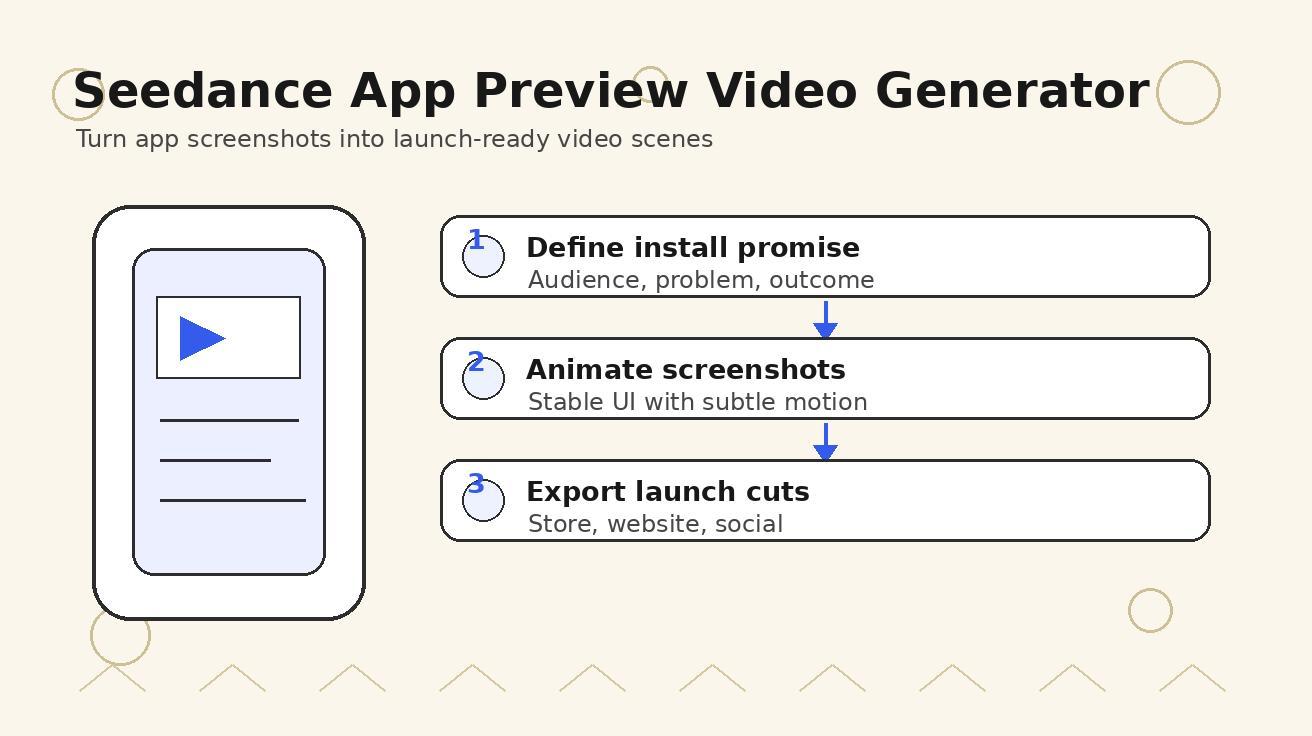
Seedance App Preview Video Generator 2026: Create App Store and Product Launch Clips
Use Seedance to turn app screenshots, feature copy, and launch goals into App Store previews, Google Play promo videos, and product launch clips.
Read article
How to Make a Talking AI Avatar You Can Reuse
Make a talking AI avatar with Seedance: design one consistent character, give it a voice, and make it speak in a talking photo or a full Seedance 2.5 scene, episode after episode.
Read article
Best AI Video-to-Video Models in 2026
The best AI video-to-video models in 2026 for editing footage you already shot: Higgsfield Genjutsu, Seedance 2.x, Runway Aleph, Luma Modify and Kling Omni compared.
Read article