
How to Use Seedance for Animation Videos: Complete Guide 2026
Animation has always been one of the most demanding forms of video production — requiring specialized software, artistic skill, and hours of painstaking frame-by-frame work. But in 2026, Seedance AI is changing that equation entirely. With its advanced text-to-video and image-to-video capabilities, Seedance lets creators produce stunning animation-style videos in minutes, not months.
Whether you want to create animated explainer videos, cartoon-style social content, or cinematic animated sequences, this guide covers everything you need to know about using Seedance for animation videos.
What Makes Seedance Great for Animation?
Seedance 2.0 was built with motion quality as a core priority. Unlike earlier AI video tools that produced jittery, unnatural movement, Seedance uses director-level motion modeling that understands how objects, characters, and scenes should move in relation to each other.
For animation specifically, this means:
- Consistent character motion — characters move fluidly without the "rubber limb" effect common in other AI tools
- Physics-aware movement — objects fall, bounce, and interact with realistic weight and momentum
- Style consistency — maintain a consistent visual style across multiple scenes
- Smooth transitions — scene changes feel intentional rather than abrupt
Seedance supports multiple animation styles, from realistic 3D-style renders to flat 2D cartoon aesthetics, watercolor illustrations, and pixel art. You control the style through your text prompts.
Getting Started: Seedance Animation Basics
Before diving into advanced techniques, let's cover the fundamentals of creating animation videos with Seedance.
Step 1: Choose Your Animation Style
The first decision is what visual style you want. Seedance responds well to specific style descriptors in your prompts. Here are the most popular animation styles and how to prompt for them:
2D Cartoon Style:
"2D cartoon animation style, flat colors, bold outlines, expressive characters, Saturday morning cartoon aesthetic"
3D Animated Film Style:
"3D animated movie style, Pixar-quality rendering, smooth surfaces, cinematic lighting, detailed textures"
Anime Style:
"anime animation style, cel-shaded, vibrant colors, dynamic action lines, Japanese animation aesthetic"
Whiteboard/Explainer Style:
"whiteboard animation style, hand-drawn illustrations appearing on white background, clean and professional"
Stop Motion Style:
"stop motion animation aesthetic, slightly jerky natural movement, handcrafted feel, textured surfaces"
Step 2: Write Effective Animation Prompts
Animation prompts for Seedance work best when they include four key elements:
- Subject — who or what is in the scene
- Action — what movement is happening
- Style — the visual aesthetic
- Camera — how the shot is framed
Example of a weak prompt:
"A cartoon character walking"
Example of a strong prompt:
"A cheerful cartoon robot character with round blue eyes walking through a colorful city street, 2D flat animation style, smooth looping walk cycle, medium shot, bright pastel colors"
The difference is dramatic. The stronger prompt gives Seedance enough context to generate something specific and usable.
Step 3: Use Image-to-Video for Character Consistency
One of the biggest challenges in animation is maintaining consistent character appearance across multiple scenes. Seedance's image-to-video feature solves this elegantly.
Here's the workflow:
- Create or find a reference image of your character
- Upload it to Seedance's image-to-video tool
- Add a motion prompt describing what you want the character to do
- Generate the animated clip
Because Seedance anchors the output to your reference image, your character maintains consistent proportions, colors, and design elements across every clip you generate.
Advanced Animation Techniques
Creating Looping Animations
Looping animations are essential for social media content, website backgrounds, and GIFs. To create a seamless loop with Seedance:
- Start with a prompt that describes a naturally cyclical action (walking, spinning, breathing, waving)
- Add "seamless loop" or "perfect loop animation" to your prompt
- Generate multiple variations and select the one with the smoothest loop point
- Use video editing software to trim the clip to the exact loop point
Best loop-friendly prompts:
- "A cartoon sun rising and setting in a continuous loop, 2D animation style"
- "Animated water ripples spreading outward in a seamless loop, watercolor style"
- "A cartoon character bouncing in place, looping walk cycle, flat animation"
Building Multi-Scene Animation Sequences
For longer animated content, you'll want to create multiple clips that cut together smoothly. Here's a professional workflow:
Scene Planning: Before generating anything, write out your scene list:
- Scene 1: Establishing shot (wide angle, sets the location)
- Scene 2: Character introduction (medium shot)
- Scene 3: Action sequence (close-up or dynamic angle)
- Scene 4: Resolution (wide or medium shot)
Maintaining Visual Consistency: Use the same style descriptors in every prompt. Create a "style template" you paste into each prompt:
"[Your scene description] — 2D cartoon animation, flat colors, bold black outlines, warm pastel palette, professional explainer video style"
Transition Planning: Generate clips that end and begin with similar compositions to make cuts feel natural. If Scene 1 ends with a character on the left side of frame, start Scene 2 with them in a similar position.
Text and Title Animations
Seedance can generate animated text sequences that work well for intros, lower thirds, and call-to-action overlays. Try prompts like:
"Animated text appearing letter by letter on screen, clean sans-serif font, white text on dark background, professional motion graphics style"
"Cartoon speech bubble appearing with bouncy animation, 2D style, colorful and playful"
Seedance Animation for Different Use Cases
Explainer Videos
Explainer videos are one of the highest-value animation use cases for businesses. A well-made explainer can increase conversion rates by 20-30% on landing pages.
With Seedance, you can create explainer video segments by:
- Breaking your script into 5-10 second visual segments
- Generating each segment as a separate clip
- Combining clips in your video editor with voiceover
Recommended style for explainers:
"Clean whiteboard animation style, simple illustrated characters, professional and friendly tone, clear visual metaphors"
Social Media Animation
Short animated clips perform exceptionally well on Instagram Reels, TikTok, and YouTube Shorts. The key is creating content that grabs attention in the first 2 seconds.
High-performing animation formats:
- Animated logos — your brand mark coming to life
- Product demonstrations — showing how something works through animation
- Animated quotes — text and illustration combinations
- Character reactions — expressive animated characters responding to situations
For social media, keep clips under 15 seconds and use bold, high-contrast visuals that read well on small screens.
Educational Content
Animation is uniquely powerful for explaining complex concepts. Teachers and course creators are using Seedance to create:
- Process visualizations — showing how biological, chemical, or mechanical processes work
- Historical recreations — bringing historical events to life
- Abstract concept illustrations — making invisible concepts visible
- Interactive-style content — animations that feel like they're responding to questions
Marketing and Advertising
Animated ads consistently outperform static image ads in click-through rates. With Seedance, you can produce professional-quality animated ad content without an animation studio budget.
Effective animated ad formats:
- 6-second bumper ads (YouTube)
- 15-second story ads (Instagram/Facebook)
- Animated product showcases
- Brand character animations
Seedance vs Traditional Animation Tools
| Feature | Seedance AI | Adobe Animate | Blender | Hiring Animator |
|---|---|---|---|---|
| Time to first clip | Minutes | Days-weeks | Days-weeks | Weeks-months |
| Cost | Free-$30/mo | $55/mo | Free | $500-5000+ |
| Skill required | Minimal | High | Very high | N/A |
| Style flexibility | High | High | Very high | Depends |
| Character consistency | Good | Excellent | Excellent | Excellent |
| Output quality | Very good | Excellent | Excellent | Varies |
| Iteration speed | Very fast | Slow | Slow | Very slow |
For most content creators, marketers, and small businesses, Seedance hits the sweet spot of quality, speed, and cost. Professional animation studios still have advantages for complex, character-driven narratives — but for the vast majority of animation use cases, Seedance delivers results that would have required a professional animator just two years ago.
Tips for Better Seedance Animation Results
Use Reference Images Strategically
The image-to-video feature is your most powerful tool for animation consistency. Build a library of reference images for:
- Your main characters
- Key locations/backgrounds
- Props and objects that appear repeatedly
- Brand elements (logos, color schemes)
Iterate Quickly
Don't spend too long perfecting a single prompt. Generate 3-5 variations of each scene, then select the best one. The iteration cost is low, and you'll often find that a variation you didn't expect turns out to be the best option.
Layer Your Prompts
Start with a basic prompt, generate a clip, then refine. Add more specific details with each iteration:
Round 1: "A cartoon cat walking through a forest" Round 2: "A cartoon orange tabby cat with big green eyes walking through a magical forest, 2D animation style, dappled light" Round 3: "A cartoon orange tabby cat with big green eyes walking confidently through a magical forest at golden hour, 2D flat animation style, warm colors, medium shot, smooth walk cycle"
Combine with Text-to-Video
For scenes without a specific character reference, use Seedance's text-to-video feature to generate background animations, establishing shots, and atmospheric sequences. Then use image-to-video for character-specific scenes. Combining both approaches gives you maximum creative flexibility.
Common Animation Mistakes to Avoid
Mistake 1: Prompts that are too vague "Make an animation" gives Seedance nothing to work with. Always specify style, subject, action, and mood.
Mistake 2: Ignoring camera direction Adding camera instructions (close-up, wide shot, tracking shot, overhead view) dramatically improves the cinematic quality of your animations.
Mistake 3: Inconsistent style descriptors If you use "2D cartoon style" in Scene 1 and "realistic 3D animation" in Scene 2, your final video will look disjointed. Lock in your style early and stick to it.
Mistake 4: Generating too long Seedance works best for clips under 10 seconds. For longer sequences, generate multiple short clips and edit them together. This also gives you more control over pacing.
Mistake 5: Skipping the reference image step If your animation features recurring characters, always use image-to-video with a reference image. The consistency improvement is significant.
Frequently Asked Questions
Can Seedance create full-length animated videos? Seedance generates clips typically ranging from 4-10 seconds. For longer animated content, you generate multiple clips and combine them in a video editor like CapCut, Premiere Pro, or DaVinci Resolve. Many creators produce 1-3 minute animated videos this way.
What animation styles does Seedance support? Seedance supports a wide range of styles including 2D cartoon, 3D animated film, anime, stop motion, whiteboard/explainer, watercolor, pixel art, and more. The style is controlled through your text prompts rather than preset options.
How do I keep characters consistent across multiple clips? Use Seedance's image-to-video feature with a reference image of your character. Upload the same reference image for each clip featuring that character, and Seedance will maintain consistent appearance across all generated clips.
Is Seedance good for professional animation projects? Seedance is excellent for marketing content, social media, explainer videos, and educational content. For complex narrative animation with detailed character acting, traditional animation tools still have advantages — but Seedance can dramatically accelerate the production process even for professional projects.
Can I use Seedance animations commercially? Yes. Content generated with Seedance can be used for commercial purposes including advertising, marketing materials, and client work. Check the current terms of service at seedance.tv for the most up-to-date licensing information.
How long does it take to generate an animation clip? Most clips generate in 30-90 seconds depending on complexity and current server load. This makes rapid iteration very practical — you can test dozens of variations in an hour.
Getting Started Today
Ready to create your first animation with Seedance? Here's a quick-start checklist:
- Visit seedance.tv and create a free account
- Choose your animation style (2D cartoon, 3D, anime, etc.)
- Write a detailed prompt including subject, action, style, and camera
- Generate 3-5 variations and select the best
- For character-driven content, use image-to-video with a reference image
- Combine clips in your video editor for longer sequences
The barrier to creating professional-quality animation has never been lower. With Seedance 2.0, what once required a team of animators and months of work can now be accomplished by a single creator in an afternoon.
Start experimenting today — your first animated video is just a few prompts away.
Seedance Animation Workflow: A Step-by-Step Production Guide
To help you understand the full production process, here's a complete walkthrough of creating a 60-second animated explainer video using Seedance.
Pre-Production (15 minutes)
Script Writing: Write a tight script for your video. For a 60-second video, aim for 120-150 words of narration. Break the script into visual segments — each segment will become one Seedance clip.
Example script breakdown:
- Segment 1 (0-8s): Problem introduction — "Every business struggles with..."
- Segment 2 (8-16s): Solution reveal — "Introducing our product..."
- Segment 3 (16-28s): Feature 1 demonstration
- Segment 4 (28-40s): Feature 2 demonstration
- Segment 5 (40-52s): Results/social proof
- Segment 6 (52-60s): Call to action
Style Guide Creation: Before generating anything, write your style template:
"2D flat animation, bold outlines, warm coral and blue color palette, friendly cartoon characters, clean professional explainer style, smooth motion"
You'll paste this into every prompt to maintain consistency.
Production (45-60 minutes)
Generating Background/Establishing Shots: Start with your establishing shots — these set the visual world of your video. Use text-to-video for these since they don't require specific characters.
Generating Character Scenes: For any scene featuring your main character, use image-to-video. Create or find a reference image that matches your style guide, then generate each character scene using that reference.
Quality Control: For each clip, generate 3 variations and evaluate:
- Does the motion look natural?
- Is the style consistent with your template?
- Does the clip start and end at good cut points?
- Is the composition clear and readable?
Post-Production (30-45 minutes)
Assembly: Import all clips into your video editor. Arrange them in sequence and trim to the exact cut points you want.
Audio: Add your voiceover narration, background music, and any sound effects. Seedance clips are generated without audio, so this step is essential.
Color Grading: Apply a consistent color grade across all clips to unify any slight variations in Seedance's output. A simple LUT or color correction layer works well.
Text and Graphics: Add any title cards, lower thirds, or call-to-action overlays in your video editor.
Export: Export at 1080p minimum. For social media, export platform-specific versions (vertical for Stories/Reels, square for feed posts, horizontal for YouTube).
Optimizing Seedance Animations for Different Platforms
YouTube
YouTube rewards longer, higher-quality content. For YouTube animations:
- Aim for 1080p or higher resolution
- Use horizontal (16:9) format
- Include animated thumbnails that match your video style
- Create animated intro/outro sequences for brand consistency
Instagram and TikTok
Short-form platforms favor vertical content and immediate visual impact:
- Use 9:16 vertical format
- Hook viewers in the first 2 seconds with dynamic motion
- Keep clips under 30 seconds for Reels
- Use bold, high-contrast visuals that read well on mobile
LinkedIn audiences respond to professional, informative animation:
- Square (1:1) or horizontal format works well
- Whiteboard and explainer styles perform strongly
- Keep videos under 2 minutes
- Add captions since many LinkedIn users watch without sound
Website Embedding
For website use, optimize for fast loading:
- Compress final videos to under 10MB when possible
- Use MP4 format with H.264 encoding
- Consider creating short looping animations (under 10 seconds) for hero sections
Measuring the Impact of Your Animation Content
Creating great animation is only half the battle — you also need to track whether it's working. Key metrics to monitor:
Engagement Metrics:
- View duration (are people watching to the end?)
- Click-through rate on CTAs
- Comments and shares
- Save/bookmark rate
Business Metrics:
- Conversion rate on pages featuring animation
- Lead generation from animated content
- Brand recall in surveys
SEO Metrics:
- Time on page for pages with embedded animation
- Bounce rate changes after adding animation
- Search ranking improvements for target keywords
Most creators see a 15-40% improvement in engagement metrics when they add high-quality animation to their content strategy. The key is consistency — one great animated video won't transform your metrics, but a steady stream of quality animation content compounds over time.
Ready to try it yourself?
Put the steps from this guide into practice with Seedance and turn prompts or images into polished videos in minutes.
Free credits on signup. Plans from $28/month.
Related Articles
More posts in the same locale you may want to read next.
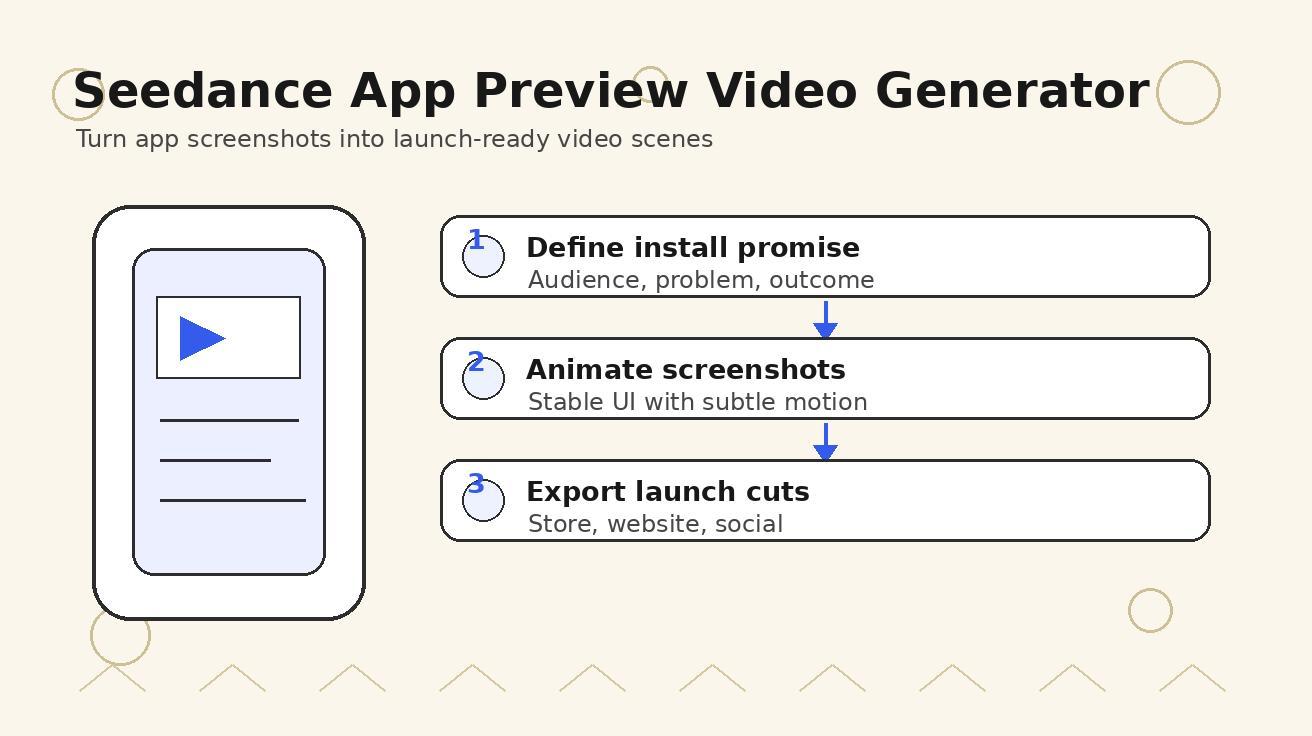
Seedance App Preview Video Generator 2026: Create App Store and Product Launch Clips
Use Seedance to turn app screenshots, feature copy, and launch goals into App Store previews, Google Play promo videos, and product launch clips.
Read article
How to Make a Talking AI Avatar You Can Reuse
Make a talking AI avatar with Seedance: design one consistent character, give it a voice, and make it speak in a talking photo or a full Seedance 2.5 scene, episode after episode.
Read article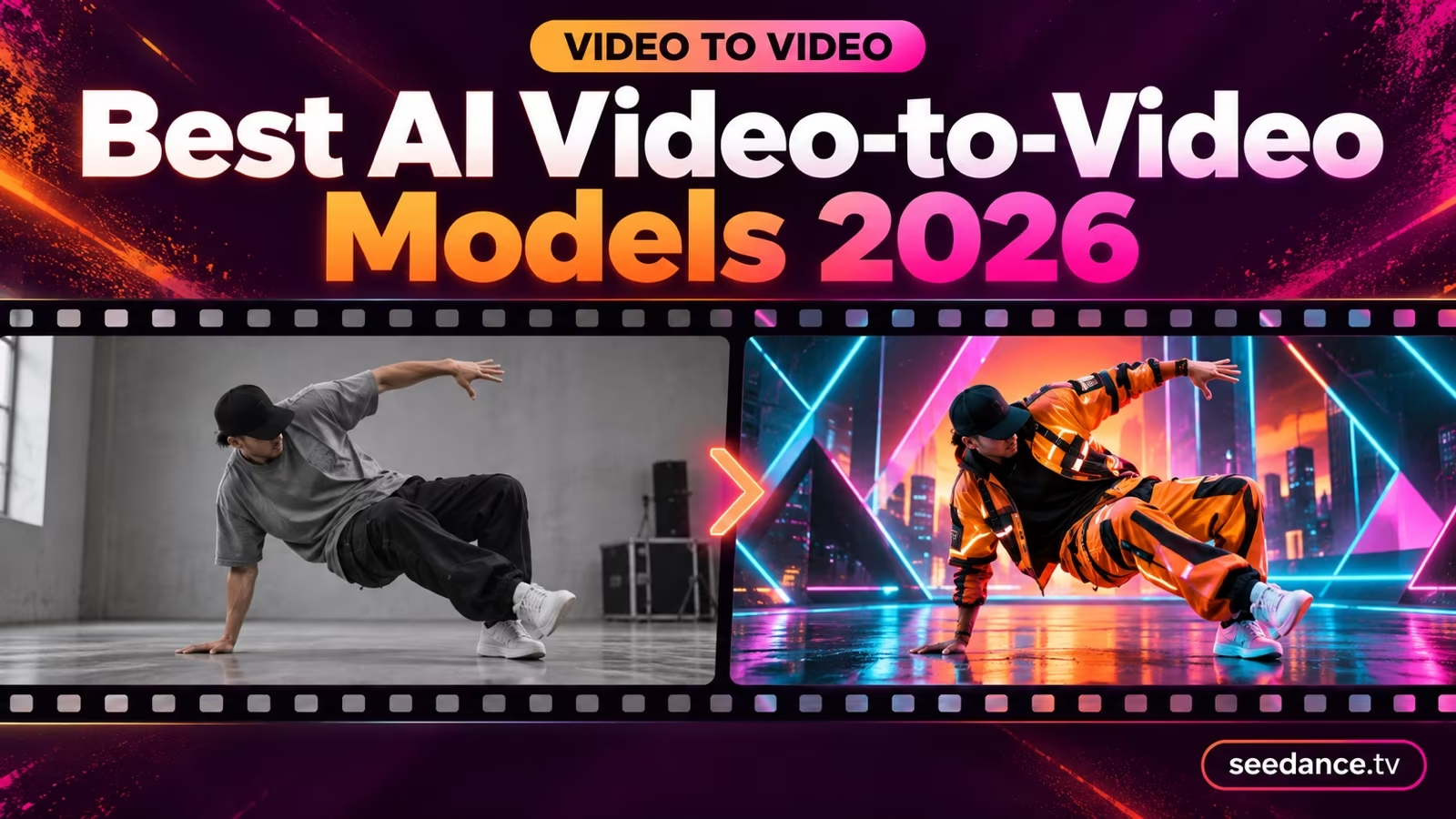
Best AI Video-to-Video Models in 2026
The best AI video-to-video models in 2026 for editing footage you already shot: Higgsfield Genjutsu, Seedance 2.x, Runway Aleph, Luma Modify and Kling Omni compared.
Read article