
AI Video Generator for Social Media Marketing: The 2026 Complete Guide

Social media marketing runs on video. In 2026, brands that fail to produce consistent, high-quality video content are invisible — but production costs have long been a barrier for small teams and independent marketers.
Quick Answer: AI video generation with Seedance lets you create stunning, professional-quality videos from text prompts or images in just minutes — no editing experience required.
AI video generators have eliminated this barrier. This guide shows social media marketers exactly how to use AI video tools to produce more content, faster, at a fraction of traditional production costs.
Why Social Media Marketing Needs AI Video Now
The numbers tell the story:
- Instagram Reels receive 22% more interaction than standard video posts
- TikTok users spend an average of 95 minutes per day on the platform — almost all video
- LinkedIn video generates 5x more engagement than other content types
- Twitter/X video gets 10x more engagement than text-only tweets
- YouTube Shorts has over 70 billion daily views globally
Social media algorithms across every platform now heavily favor video content. Organizations that can't produce video consistently are being systematically deprioritized.
The traditional response — hire a videographer, buy stock footage, pay a production company — doesn't scale for daily content calendars. AI video does.
Platform-by-Platform AI Video Strategy
Content types that perform best:
- Reels (9:16, 7-90 seconds)
- Stories (9:16, 15 seconds per segment)
- Feed video (4:5 or 1:1, up to 60 seconds)
AI video approach: Generate atmospheric, visually stunning clips that stop the scroll. Instagram rewards aesthetic quality — Veo 3 and Seedance both produce footage that performs exceptionally well here.
Winning prompt formula for Instagram:
"[Scene/subject], aesthetically pleasing, [color palette that matches your brand], professional social media quality, vibrant and eye-catching"
Output targets: 5-7 Reels per week, 15-20 Stories per week. AI generation makes this achievable with 1-2 hours of work daily.
TikTok
Content types that perform best:
- Short-form (7-30 seconds) with fast pacing
- Educational/informational with strong hook
- Trend-reactive content (speed matters)
AI video approach: TikTok requires fast cuts and dynamic content. Generate 3-4 second clips and cut rapidly between them. Pika 2.0's special effects are particularly effective for TikTok virality.
Speed is critical: TikTok's algorithm rewards accounts that post frequently. AI video generation enables 2-3x more posting frequency without increasing production time.
Winning approach: Generate 8-10 clips for one TikTok in 20 minutes, cut together in CapCut with trending audio.
Content types that perform best:
- Professional insights with B-roll (90 seconds - 3 minutes)
- Industry data visualization
- Company culture and team content
AI video approach: LinkedIn audiences are professional and detail-oriented. Quality over quantity — 3 high-quality pieces per week outperforms 15 low-quality ones.
Veo 3's cinematic quality is ideal for LinkedIn. Corporate environments, professional settings, and business-relevant visuals all generate well.
Winning prompt formula for LinkedIn:
"Professional corporate setting, [relevant business scene], polished and authoritative, modern office environment, LinkedIn-appropriate"
YouTube (Shorts and Long-form)
For Shorts (9:16, under 60 seconds):
- Same approach as TikTok but slightly less aggressive pacing
- YouTube Shorts algorithm favors completion rate — tighter editing wins
For Long-form (16:9, 8+ minutes):
- AI generates b-roll for 30-40% of video runtime
- Talking-head footage for the remaining 60-70%
- Results: professional production quality without a camera crew
Seedance has native aspect ratio presets for both YouTube formats, making format switching instant.
Twitter/X
Content types that perform best:
- Short, punchy clips (under 30 seconds)
- Reaction and commentary video with b-roll
- Event and news-adjacent visual content
AI video approach: Twitter/X moves fast. Generate quick clips that pair with text commentary. The visual doesn't need to be perfect — it needs to be timely and interesting.
Repurpose your TikTok and Instagram content here with minor format adjustments.
The Social Media Content Calendar with AI Video
A realistic weekly social media content calendar using AI video:
| Day | Platform | Content Type | AI Time | Total Time |
|---|---|---|---|---|
| Monday | Thought leadership with b-roll | 30 min | 60 min | |
| Tuesday | Reel (product/service) | 20 min | 40 min | |
| Tuesday | TikTok | Tutorial clip | 25 min | 45 min |
| Wednesday | YouTube | Shorts (2 pieces) | 40 min | 60 min |
| Thursday | Reel (educational) | 20 min | 40 min | |
| Thursday | Twitter/X | Short clip + text | 15 min | 20 min |
| Friday | Weekly recap | 20 min | 40 min | |
| Friday | Behind the scenes | 15 min | 30 min | |
| Saturday | TikTok | Trending content | 20 min | 35 min |
Total weekly production time with AI: ~7.5 hours. Without AI: 25-40 hours minimum.
This calendar produces 11 pieces of video content per week across 4 platforms — previously requiring a full-time video producer.
AI Video Tools for Social Media Marketers
Primary Tools
Seedance — Best All-Around
- Native social media format presets (9:16, 16:9, 1:1)
- Fast generation (90 seconds)
- Generous free tier
- Text-to-video and image-to-video
- Best for: Daily social media content production
Veo 3 — Best for Premium Content
- Highest quality output
- Native audio generation
- Best for: LinkedIn, YouTube, brand campaigns
- Access via Google AI Studio (limited free) or Gemini Advanced ($20/month)
Pika 2.0 — Best for Viral Effects
- Special effects (Pikaffects)
- Fast generation
- Best for: TikTok, Instagram Reels, viral-first content
- Free tier available
Supporting Tools
CapCut (free): The social media marketer's editing workhorse. Assemble AI clips, add music, captions, effects, and export in any format.
Canva (free/paid): Add text overlays, brand elements, and design to AI-generated clips. Excellent for branded content.
Adobe Premiere Rush (subscription): For marketers who need slightly more professional editing capability than CapCut.
Epidemic Sound ($15-25/month): Licensed music for all social platforms without copyright claims.
Developing Your Brand's AI Video Style
Consistency is what builds social media followings. Random visual styles confuse audiences — consistent aesthetics build recognition.
The Brand Style System
Develop 5-7 style descriptors that you add to every prompt:
Example — Sustainable Fashion Brand:
"...natural, earthy tones, warm golden light, organic textures, authentic and sustainable aesthetic, lifestyle photography feel"
Example — B2B SaaS Company:
"...clean minimalist aesthetic, blue and white color palette, professional and modern, corporate technology environment"
Example — Food and Beverage:
"...warm and inviting, natural lighting, rustic yet modern, food photography aesthetic, lifestyle and casual"
Example — Fitness Brand:
"...high energy, dynamic, vibrant colors, motivational atmosphere, modern gym or outdoor fitness setting"
Document your style system, share it with your team, and apply it to every AI video generation. Within 4-6 weeks, your social media feed will develop unmistakable visual consistency.
Content Repurposing Strategy
Maximum ROI from AI video comes from repurposing. One piece of source content → 8-12 social media assets:
From One Long-Form Video (10 minutes):
- Extract 5 clips (30 seconds each) → 5 YouTube Shorts
- Reformat 3 of those → 3 Instagram Reels
- Further condense 2 → 2 TikToks
- Take 1 educational segment → 1 LinkedIn post
- Pull best quote → 1 Twitter/X clip
Result: 12 social assets from 1 production session.
From One AI-Generated Clip Library (50 clips):
Generate thematically consistent clips once per month, then deploy across your content calendar throughout the month. One 3-4 hour generation session powers an entire month of visual assets.
Measuring Social Media AI Video Performance
Track these metrics weekly to optimize your AI video strategy:
Engagement Rate (Likes + Comments + Shares / Reach):
- Instagram Reels benchmark: 3-6%
- TikTok benchmark: 5-12%
- LinkedIn benchmark: 2-4%
Video Completion Rate:
- Under 15 seconds: target 70%+
- 15-60 seconds: target 50%+
- 60+ seconds: target 35%+
Follower Growth Rate: Are video-heavy weeks driving faster growth than non-video weeks?
Reach Amplification: What percentage of your video views come from non-followers (algorithm distribution)?
Review these weekly and adjust your content approach based on what the data shows.
Common Mistakes Social Media Marketers Make with AI Video
Mistake 1: Inconsistent Visual Style
Generating clips with completely different aesthetics creates a confusing feed. Develop and stick to your style system from Day 1.
Mistake 2: Ignoring Caption Optimization
AI video generates visually — but social media discovery depends heavily on text. Optimize your captions, hashtags, and descriptions as carefully as you optimize the video.
Mistake 3: Not Testing Formats
Every platform changes its algorithm preferences. What worked 6 months ago may be less effective today. Continuously test different content formats (talking head vs. pure b-roll, landscape vs. vertical, short vs. medium length).
Mistake 4: Quantity Without Quality Floor
AI makes it easy to generate lots of content — but low-quality, repetitive content hurts engagement rates and algorithmic distribution. Maintain a quality floor: if a generated clip isn't visually compelling, regenerate it.
Mistake 5: Forgetting Audio
Social media content increasingly relies on audio (music, voiceover, sound effects). AI video generators like Veo 3 now generate ambient audio — use it. For other tools, add appropriate audio in post.
Frequently Asked Questions
How many social media videos can I create per day with AI tools?
With practice, 10-15 short social media clips per day is achievable with Seedance. This is sufficient for comprehensive coverage across 4-5 platforms.
Do I need to disclose AI-generated social media content?
Platform requirements vary and are evolving. Best practice: include "#AIgenerated" or "#AIcontent" in captions for fully AI-generated content. Consult each platform's current guidelines.
Can I use AI video for paid social media advertising?
Yes — most AI video tools include commercial use rights on paid plans. Always verify your specific tool's license before using generated content in paid campaigns.
How do I maintain authentic brand voice with AI-generated video?
Authentic brand voice comes primarily from the text, captions, and voiceover — not the visual alone. AI provides the visual canvas; your messaging provides the authenticity.
What's the minimum budget for a solid AI video social media setup?
Seedance free tier: $0. For more volume, Seedance paid starts around $15/month. Add Pika at $8/month for effects. Total: $23/month for a comprehensive AI video social media toolkit.
Conclusion
Social media marketing without consistent video content is increasingly ineffective. AI video generators have removed the last remaining excuse for not producing video: cost and production time.
With Seedance, a solo marketer or small team can produce the video content that previously required a dedicated production department. The competitive advantage for early adopters is significant and available right now.
Start your free Seedance account, build your brand style system, and publish your first AI-assisted social media video this week. Your feed transformation starts with one clip.
Last updated: April 2026 | Author: Emma Chen
Advanced Social Media AI Video Tactics
The "Trend Hijacking" Framework
Social media rewards timeliness. When a trend emerges on TikTok or Twitter, the accounts that produce on-trend content first get algorithmic amplification.
AI video makes trend hijacking achievable in under 30 minutes:
- Identify the trend — scrolling TikTok/Twitter, identify what's getting traction
- Prompt immediately — generate 5-8 clips relevant to the trend + your brand
- Cut in CapCut — 10-15 minutes of assembly
- Post with trend hashtags — publish while the trend is still growing
Without AI video, this workflow takes a minimum of 4-6 hours (find b-roll, edit, optimize). By the time traditional production is done, the trend window has often closed.
The "Content Pillar" Library Approach
Instead of generating new content for each post, build pillar libraries:
- Pillar 1: Product/Service — 20 clips showing your product in use
- Pillar 2: Lifestyle — 30 clips showing your target customer's world
- Pillar 3: Education — 20 clips illustrating concepts in your niche
- Pillar 4: Emotion — 20 clips evoking the feelings your brand creates
Once built, each pillar library lasts 4-6 weeks. Deployment is pulling from the library + writing new captions — no new generation required.
Seasonal Content Planning
Generate seasonal b-roll libraries 4-6 weeks before each season:
- Spring: fresh starts, renewal, outdoor energy
- Summer: warmth, travel, active lifestyle
- Fall: coziness, harvest, back-to-business
- Winter: celebration, reflection, community
Pre-generating seasonal content eliminates last-minute scrambles and ensures your social media stays timely and relevant throughout the year.
The A/B Testing Protocol
AI video's low cost enables systematic A/B testing that was previously impossible:
For any important campaign:
- Generate 2-3 visually different approaches
- Post each as separate content on the same platform
- Wait 48 hours to measure early engagement signals
- Double down on the winning approach for the remainder of the campaign
This data-driven approach to visual content improves campaign performance by 20-40% on average, according to social media managers who've adopted it.
Integration with Your Broader Marketing Stack
AI video doesn't replace your other marketing tools — it amplifies them:
With email marketing: AI-generated video thumbnails in emails increase click-through rates significantly. Generate a relevant clip, upload it to YouTube (unlisted), embed the thumbnail in your email.
With landing pages: Landing pages with video show 80% higher conversion rates. AI video makes adding video to every landing page economically viable.
With advertising: A/B test multiple AI-generated visual approaches in paid social campaigns. The testing cost is negligible; the performance insight is valuable.
With content marketing: Long-form blog posts repurposed with AI video perform significantly better in social distribution. Generate 2-3 clips that illustrate your article's key points and share them with links back to the full article.
With PR and media: Pitch journalists with AI-generated video assets. A pitch that includes a compelling visual clip gets more attention than one that's purely text.
The brands winning on social media in 2026 aren't just using AI video in isolation — they're integrating it throughout their marketing operations.
Building Your Team's AI Video Capability
If you manage a marketing team, these principles accelerate adoption:
Start with a Champion
Identify one person on your team who's naturally curious about new tools. Give them dedicated time to learn Seedance and Veo 3 over 2-3 weeks. When they come back with results, adoption spreads organically.
Create a Shared Prompt Library
Collaborative prompt libraries prevent each team member from reinventing the wheel. Create a shared document with:
- Brand style modifiers (your visual identity prompts)
- Content type templates (product, lifestyle, educational, etc.)
- Seasonal prompt banks
- Successful past prompts with their outputs
Shared libraries also enforce brand consistency across team members with different aesthetic sensibilities.
Establish Quality Standards
Define minimum standards for AI video before publishing:
- No visual artifacts or clearly AI-generated anomalies in foreground subjects
- Consistent color palette with brand guidelines
- Appropriate aspect ratio for the destination platform
- Caption/audio appropriateness reviewed before publishing
These standards prevent the most common AI video quality issues from reaching audiences.
Measure and Celebrate Wins
When AI-assisted video outperforms traditional content (it usually does), document it and celebrate it publicly within your team. Nothing accelerates adoption like clear evidence of results.
Future Developments to Watch
Social media and AI video are evolving rapidly. Watch for:
Personalized video feeds: Social platforms are building AI systems that personalize video content style preferences. Visual quality and consistency will matter even more.
Interactive video formats: Multiple platforms are testing interactive video features. AI-generated branching narratives will become possible.
Real-time generation: Live AI video generation during streams and broadcasts is coming within 24 months.
Platform-native AI: TikTok, Instagram, and YouTube are all building AI video generation natively into their platforms. Understanding how to use third-party tools now positions you to leverage platform-native tools as they launch.
Social media marketers who build AI video fluency now will be well-positioned for all of these developments — and ahead of the vast majority of competitors who are still debating whether to adopt AI tools at all.
The competitive advantage window is open. Start with Seedance's free tier today.
Last updated: April 2026 | Author: Emma Chen
Advanced Applications and Use Cases
Scaling Content Production Across Teams
Organizations that successfully scale AI video production share common practices. They establish a centralized prompt library that captures successful prompt templates for different content types. They create role-based workflows where content strategists write briefs, practitioners execute generations, and editors review quality before publication.
For teams producing video at scale, batch generation sessions are more efficient than one-at-a-time production. Scheduling weekly two-hour generation sessions where multiple creators work simultaneously through a prompt list produces more consistent output than ad-hoc generation throughout the week.
Quality Control Systems
The organizations getting the best results from AI video have implemented quality checkpoints:
Pre-generation: Does this prompt align with brand guidelines? Is the intended use case clear? Has this topic been covered recently?
Post-generation review: Does the output accurately represent our brand? Is the motion natural and free of obvious artifacts? Does the audio (if generated) match the visual content?
Pre-publication: Is the file properly compressed for web delivery? Have captions been added for accessibility? Are UTM tracking parameters in any links?
Establishing these checkpoints as lightweight process habits, rather than bureaucratic approvals, maintains quality without slowing production.
Integration with Content Management Systems
AI video integrates with modern content management through straightforward workflows. Videos generated by AI tools export as standard MP4 files compatible with any CMS. Best practice is to upload to a CDN (Cloudflare R2, AWS S3, or similar) and embed via URL rather than hosting videos directly in the CMS database.
For WordPress sites, the WP Video Popup and Video Embed plugins accept external URLs. For Webflow, custom embed blocks accept MP4 sources. For Shopify, video sections accept external CDN URLs.
The Technical Foundation: How AI Video Generation Works
Understanding the basic mechanics helps creators write better prompts and set realistic expectations.
Diffusion Models and Video Generation
Modern AI video generators use diffusion-based architectures — the same core technology behind image generation tools like Midjourney and DALL-E. The model learns to progressively remove noise from a starting random state, guided by the text prompt, until a coherent video emerges.
Video generation is substantially more computationally demanding than image generation because temporal consistency must be maintained across dozens of frames. A 6-second video at 24fps requires 144 individual frames, each of which must be coherent both visually and in relation to the frames before and after it.
This is why AI video generation takes 1-5 minutes rather than the seconds required for AI image generation, and why "temporal consistency" — maintaining stable appearance of subjects and objects across the entire clip — remains the primary technical challenge the field is working to solve.
Why Prompts Matter So Much
The prompt is your primary lever for controlling output quality. The model's learned representations of every concept in your prompt combine to create the final output. Highly specific, well-structured prompts narrow the model's search space and guide it toward more predictable outputs.
Vague prompts ("a person walking") leave vast ambiguity — what does the person look like? Where are they walking? What's the mood? The model fills these gaps with whatever its training data most commonly associates with each concept, often producing generic results.
Specific prompts ("a middle-aged man in a dark suit walking purposefully down a rain-slicked city street at night, wide angle, cinematic neon reflections, film noir aesthetic") give the model clear constraints that produce targeted, intentional output.
Handling Common Generation Artifacts
Even the best AI video tools occasionally produce artifacts. Understanding common failure modes helps creators diagnose and fix them:
Morphing/melting faces: Occurs when face generation is pushed beyond training distribution. Fix: simplify the scene, reduce number of faces, add "stable face generation" to prompt.
Unnatural limb movement: Occurs in complex human motion scenes. Fix: Use Kling AI for human-heavy scenes, simplify the requested motion, or use image-to-video with a reference pose.
Flickering backgrounds: Occurs in detailed texture-heavy backgrounds. Fix: Specify "static background" or "stable camera" in prompt, or choose simpler background environments.
Audio-visual mismatch: In tools with audio generation, the sound may not precisely match the visual. Fix: Be very explicit about both visual and audio elements separately in the prompt.
Platform-Specific Optimization Strategies
For Seedance AI Users
Seedance AI's daily credit system rewards consistent practice. Build a daily habit: spend 15-20 minutes each morning generating content for the day. This compounds over time — after 30 days of daily practice, you'll have a prompt library of 100+ tested formulas and produce higher quality output 5-10x faster than when you started.
The image-to-video feature in Seedance AI is particularly powerful for brand consistency. Upload your product images, brand photos, or custom-illustrated graphics and animate them — this produces more brand-aligned output than pure text-to-video since the visual foundation is already established.
For best results with Seedance's text-to-video feature, focus prompts on single-subject scenes with clear environmental context. Multi-subject, multi-action scenes are better decomposed into separate generations that can be edited together.
Cross-Platform Workflow Optimization
Using multiple free-tier AI video platforms strategically:
Morning session (Seedance AI): Generate the bulk of daily social media content using daily credit reset. Focus on volume and variety.
Key piece generation (Veo 3): Use your limited monthly credits on highest-priority content — campaign heroes, website videos, pitch materials.
Specialist tasks (Kling): Route human-motion-heavy scenes to Kling for better natural movement.
Overflow and speed (Hailuo): When Seedance daily credits are spent and you need quick iteration, use Hailuo's fast generation.
This multi-platform approach maximizes output quality and volume without spending money.
ROI Measurement Framework
Calculating the True Value of AI Video
To justify AI video investment (even at zero cost) in terms of time, calculate:
Time cost per video:
- Prompt writing: 5-10 minutes
- Generation wait: 2-5 minutes
- Review and selection: 3-5 minutes
- Light editing/captioning: 5-15 minutes
- Total: 15-35 minutes per publishable video
At $50/hour, each video costs $12-29 in time. At $100/hour, $25-58.
Value created per video: Track the specific outcomes attributable to each video type:
- Social media videos → follower growth, engagement, traffic
- Website videos → dwell time increase, conversion rate
- Email videos → open rate, click rate improvement
- Ad videos → cost per click, conversion rate
Even conservative attribution typically shows 3-10x ROI on time invested for creators who post consistently.
Building the Business Case for AI Video
For teams that need to justify AI video tooling to leadership:
Benchmark your current costs: What do you spend on video production today? Include agency fees, freelancer costs, stock footage licenses, and employee time.
Calculate displacement potential: What percentage of that spending could AI video replace or reduce? Even 20-30% displacement typically justifies subscription costs.
Pilot and measure: Run a 30-day pilot with one creator using free-tier tools. Document time saved, content volume produced, and any measurable outcome improvements.
Present the data: Most approval processes respond better to measured results from a real pilot than to projections from a pitch deck.
FAQ
How quickly can I learn to produce good AI video?
Most people produce competent AI video within their first two hours of practice. Producing consistently excellent output typically takes 2-4 weeks of regular practice. The learning curve is primarily about prompt writing — the platforms themselves are designed to be intuitive.
What computer specs do I need for AI video generation?
AI video generation happens on the platform's servers, not your computer. Any device with a modern web browser and stable internet connection works — including older laptops, tablets, and even smartphones for web-based platforms.
Can I generate AI video in languages other than English?
The generation process responds to English prompts most reliably. The video output itself is language-independent — a prompt describing a scene in English produces visual content accessible to any audience. Overlay text, subtitles, and voiceover can be in any language as a post-production step.
How do I handle copyright with AI-generated video?
AI-generated video output, in most jurisdictions, is owned by the user who created it (subject to each platform's terms of service). The platforms themselves hold intellectual property in their models, not in the generated outputs. Commercial use rights vary by platform tier — free tiers often have restrictions while paid tiers provide clear commercial licensing.
What's the difference between text-to-video and image-to-video?
Text-to-video generates a completely new video from a text description. Image-to-video animates an existing still image into motion. Image-to-video typically produces more predictable, brand-consistent results since the visual foundation is predetermined. Text-to-video offers more creative freedom but requires more prompt precision to achieve targeted results.
Ready to try it yourself?
Put the steps from this guide into practice with Seedance and turn prompts or images into polished videos in minutes.
Free credits on signup. Plans from $28/month.
Related Articles
More posts in the same locale you may want to read next.
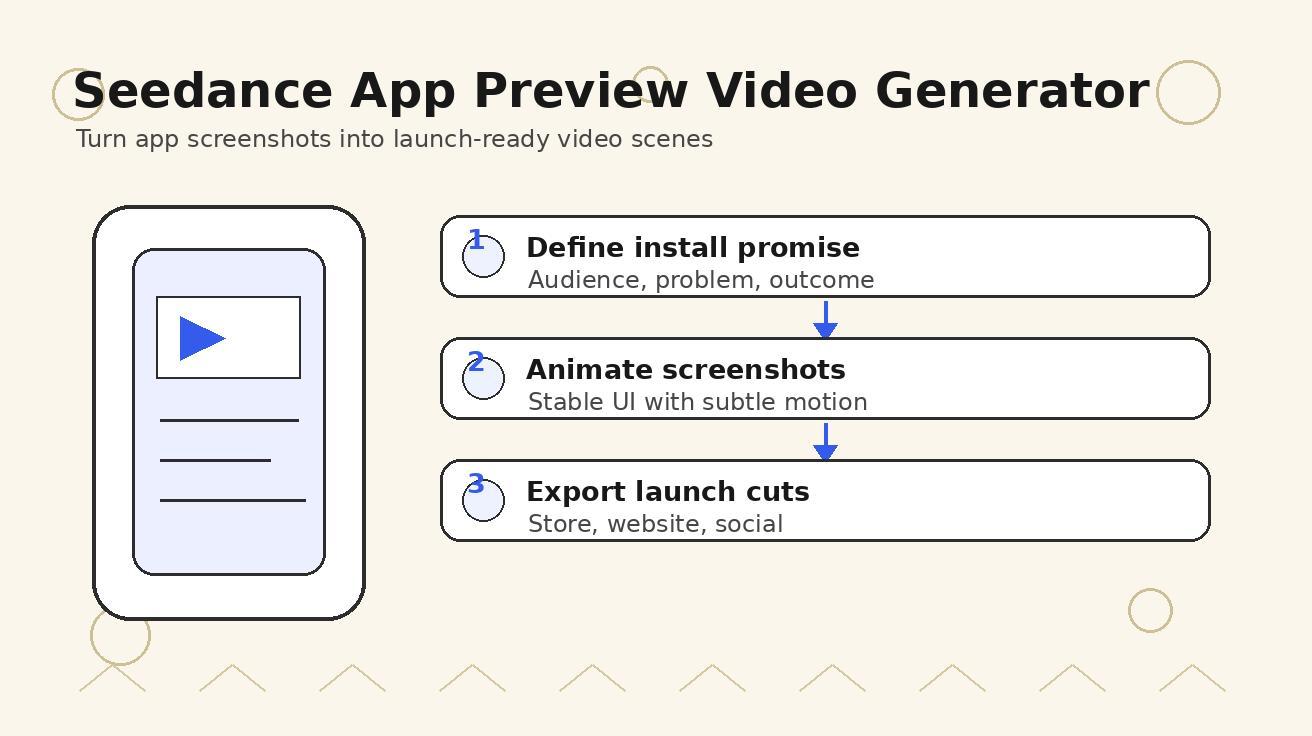
Seedance App Preview Video Generator 2026: Create App Store and Product Launch Clips
Use Seedance to turn app screenshots, feature copy, and launch goals into App Store previews, Google Play promo videos, and product launch clips.
Read article
Gemini AI Video Prompt Examples: Copy-Ready Veo Scenes and a Better Prompt Formula
Copy Gemini AI video prompt examples for cinematic motion, product ads, dialogue, and vertical clips, then adapt them with a practical Veo prompt formula.
Read article
How to Keep Product Shape Consistent in AI Video Ads
Lock product geometry, packaging, labels, references, camera angles, and approval checks so AI video ads preserve the real SKU across every shot.
Read article