
AI Video Generator for Facebook Ads 2026: The Complete Guide
Facebook video ads are the single most powerful format in Meta's advertising ecosystem. In 2026, with over 3.2 billion monthly active users and an average user spending 34 minutes per day watching video content on the platform, brands that master AI-generated video ads are pulling ahead of competitors still relying on expensive production studios. This guide walks you through everything you need to know about using an AI video generator for Facebook ads — from understanding Meta's ad formats and aspect ratios to building automated A/B testing pipelines that continuously improve your ROI. Whether you're a solo entrepreneur or a performance marketing team, this is your definitive playbook for Facebook video advertising in 2026.
Quick Answer: AI video generation with Seedance lets you create stunning, professional-quality videos from text prompts or images in just minutes — no editing experience required.
Quick Reference: Facebook Video Ad Specs & AI Tools
| Spec | Recommended Value | Notes |
|---|---|---|
| Feed Video | 1:1 or 4:5 | Maximizes mobile screen real estate |
| Stories / Reels | 9:16 | Full-screen vertical format |
| In-Stream | 16:9 | Desktop-friendly horizontal |
| Max File Size | 4 GB | MP4 or MOV preferred |
| Min Resolution | 1080×1080 | Higher is better |
| Caption Requirement | Yes | 85% of videos watched without sound |
| Optimal Duration (Feed) | 15–30 seconds | Attention window for cold audiences |
| Optimal Duration (Retargeting) | 60–90 seconds | Warmer audiences accept longer content |
| Top AI Tool 2026 | Seedance | Text-to-video + image-to-video, instant render |
Why AI Video Generators Are Dominating Facebook Ad Production in 2026
The cost of video production has been the number-one barrier to entry for small and medium businesses running Facebook ads. A traditionally produced 30-second ad spot costs between $5,000 and $50,000 when you factor in scriptwriting, filming, editing, and post-production. AI video generators have collapsed this cost to almost zero.
More importantly, speed is now a competitive advantage. Consumer trends shift quickly, and brands that can create, test, and iterate on video ad creatives within hours — not weeks — consistently outperform slower competitors. AI video tools allow marketing teams to generate dozens of creative variations from a single concept, test them simultaneously, and let performance data guide the next round of production.
The Meta algorithm rewards engagement above all else. AI-generated videos can be optimized specifically for engagement: fast hooks, dynamic visuals, text overlays timed to key moments, and music that matches the emotional tone of your offer. In 2026, the top-performing Facebook video ads share one common trait — they were produced or iterated using AI tools.
The Three Core Advantages of AI Video for Facebook Ads
Speed of iteration: Traditional video production locks you into a single creative for weeks or months. AI video generators let you create 10 to 20 variations of an ad in an afternoon, each testing a different hook, visual style, or call to action. This compressed feedback loop is worth more than any individual creative improvement.
Cost-per-creative reduction: When a single AI-generated video ad costs $0 to $5 in compute time versus $10,000 for a studio production, your creative budget stretches infinitely further. This enables the high-volume testing that consistently drives down cost per acquisition.
Consistency at scale: International campaigns need localized creatives. Seasonal promotions need fresh assets every week. Product launches need dozens of angles. AI video generators produce consistent quality across all these needs without the coordination overhead of human production teams.
Understanding Facebook Video Ad Formats in 2026
Meta offers six primary video ad placements, each with distinct specifications and audience behaviors. Understanding which format suits your campaign objective is the first step in effective AI video ad production.
In-Feed Video Ads
The most common format, appearing in the Facebook News Feed on both mobile and desktop. These videos autoplay silently, which means your first three seconds must deliver visual impact without relying on audio. The 4:5 aspect ratio performs best on mobile because it takes up more vertical screen space, increasing the likelihood of a user stopping their scroll.
Optimal in-feed video length is 15 to 30 seconds for cold audiences. Use the first three seconds to show the problem or the result, not a logo or brand intro. AI video generators excel at creating visually striking openings because they can synthesize compelling imagery that would be impossible or prohibitively expensive to capture on camera.
Facebook Stories Ads
Stories ads appear between organic stories in full-screen 9:16 format. Users tap through stories quickly, so you have roughly 1.5 seconds to capture attention. Stories ads perform best when they feel native to the format — casual, direct, and visually raw rather than polished.
AI video generators can create Stories-format content that mimics the aesthetic of user-generated content, which performs significantly better than obviously branded ad content in this placement.
Facebook Reels Ads
Reels have become Meta's fastest-growing placement. Short-form vertical video (9:16, under 60 seconds) earns the highest organic reach multiplier of any Facebook format in 2026. Reels ads benefit from the same AI video production approaches as Stories but with more room for creative storytelling.
In-Stream Video Ads
These 5-to-15-second ads appear within longer video content and cannot be skipped. Because viewers are already in a video-watching mindset, in-stream ads achieve higher completion rates than feed ads. Use AI video generators to create punchy, benefit-focused in-stream ads that deliver one clear message in 15 seconds or less.
Carousel Video Ads
Carousel ads combine multiple video clips in a swipeable format. Each card can tell part of a story or showcase different product features. AI video generators make it trivial to create thematically consistent carousel cards from a single prompt, maintaining visual cohesion across all cards while varying content.
Collection Ads
Collection ads feature a hero video above a grid of product images. The video draws attention and the product grid drives clicks. AI-generated hero videos for collection ads perform best when they show the product in use, creating context and desire before the viewer sees the product grid.
How to Use Seedance for Facebook Video Ad Production
Seedance is the leading AI video generator for performance marketers in 2026. Its text-to-video and image-to-video capabilities are purpose-built for the kind of rapid creative iteration that Facebook advertising demands. Here's the complete workflow for producing Facebook video ads with Seedance.
Step 1: Define Your Creative Brief as a Text Prompt
The quality of your AI-generated video ad starts with the quality of your prompt. A vague prompt produces generic results. A specific prompt produces targeted, conversion-ready creative. Structure your Seedance prompts with these four components:
- Visual description: What does the viewer see? Be specific about setting, lighting, subjects, and action.
- Emotional tone: What feeling should the video evoke? Excitement, relief, aspiration, urgency?
- Pacing and motion: Fast cuts for urgency, slow motion for premium products, dynamic camera movement for energy.
- Brand alignment: Colors, aesthetic references, or style descriptors that align with your brand identity.
Example prompt for a fitness supplement brand: "Fast-paced dynamic video, person finishing an intense workout in a modern gym, dramatic overhead lighting, sweat and energy, triumphant expression, quick cuts between lifting, running, and stretching, vibrant high-contrast colors, cinematic handheld feel."
Step 2: Generate Multiple Variations
Use Seedance's image-to-video feature to animate your product images or existing marketing materials. This is particularly powerful for e-commerce brands that have product photography but lack video content. A static product photo becomes a dynamic, eye-catching ad in seconds.
Generate at minimum five to ten variations per ad concept. Vary the visual style, pacing, and opening frame. Each variation becomes a separate creative for A/B testing.
Step 3: Apply Facebook-Specific Optimizations
After generating your base videos in Seedance, apply these Facebook-specific adjustments:
- Crop to the correct aspect ratio for your target placement (4:5 for feed, 9:16 for Stories/Reels)
- Add captions — 85% of Facebook videos are watched without sound
- Overlay your key message in the first three seconds
- Add a visible call-to-action in the final five seconds
- Ensure minimum 1080×1080 resolution (Seedance outputs at high resolution by default)
Step 4: Set Up Your A/B Testing Pipeline
Upload your variations to Meta Ads Manager and create an A/B test campaign. Test one variable at a time: the opening hook, the visual style, the call-to-action text, or the voiceover. Let each test run for at minimum 7 days and $500 in spend before drawing conclusions.
The winning creative from each test becomes the baseline for the next round of AI video generation. This creates a flywheel effect where your ads continuously improve based on real performance data.
Facebook Video Ad Best Practices for AI-Generated Content in 2026
The 3-Second Hook Rule
Facebook's algorithm measures "3-second video views" as a primary engagement signal. If viewers skip your ad in the first three seconds, Meta will decrease its delivery to similar audiences. If they watch past three seconds, delivery expands.
AI video generators allow you to test dozens of different opening frames without production overhead. Test hooks that show:
- The end result (before/after)
- A surprising or counter-intuitive visual
- Text on screen stating the core benefit
- A question that creates curiosity
- A recognizable problem moment
Sound-Off Optimization
Design your AI video ads to communicate effectively without sound. This means:
- Clear, large text overlays that convey your key messages
- Visual storytelling that makes sense without narration
- Action and movement that creates engagement without audio cues
- Captions burned into the video or added as SRT files in Meta Ads Manager
When you add sound, ensure it enhances rather than replaces the visual communication. Music should match the emotional tone and pace of the visuals. AI music generation tools can create custom tracks that sync perfectly with your AI-generated video.
Mobile-First Production
Over 94% of Facebook ad impressions in 2026 occur on mobile devices. Every AI video ad you produce should be viewed and evaluated on a mobile screen before publishing. The 4:5 aspect ratio fills the mobile screen far more effectively than 16:9 and consistently outperforms wider formats in direct response campaigns.
Seedance allows you to specify output aspect ratios directly in your generation prompt, making mobile-first production the default rather than an afterthought.
Pattern Interrupts and Visual Novelty
The Facebook feed is a relentlessly competitive attention environment. Your AI video ad is competing against posts from friends, other ads, news content, and viral videos. Pattern interrupts — visual elements that break the predictable scrolling experience — are your most powerful tool for capturing attention.
AI video generators can create visually novel content that would be impossible or extremely expensive to produce traditionally: surreal transformations, impossible camera angles, seamless style transitions, and synthetic environments that are striking precisely because they don't look like typical video content.
What Is Ai Video Generator Facebook Ads 2026 and Why Does It Matter?
Ai Video Generator Facebook Ads 2026 is an essential capability for modern content creators and marketers. The best tools for ai video generator facebook ads 2026 combine AI-powered automation with professional-quality outputs — saving hours of manual work while delivering results that meet commercial standards.
In 2025, platforms like Veo 3 and Seedance have made ai video generator facebook ads 2026 more accessible than ever, offering free-tier access alongside professional plans.
How Do You Get Started with Ai Video Generator Facebook Ads 2026?
Getting started with ai video generator facebook ads 2026 requires just a few steps:
- Choose the right tool for your needs (see comparison above)
- Sign up for a free account — no payment required to start
- Follow the step-by-step guide in this article
- Test with simple examples first, then scale up
Most users can produce their first professional result within 30 minutes of starting.
What Are the Best Tools for Ai Video Generator Facebook Ads 2026 in 2025?
The top tools for ai video generator facebook ads 2026 in 2025 are:
- Veo 3 — best overall quality, free via Google Gemini
- Kling AI — best mobile experience and free tier generosity
- Runway Gen-4 — best for artistic and cinematic styles
- Pika 2.1 — best for beginners with simple interface
Each tool has strengths in different areas — the best choice depends on your specific use case, volume requirements, and budget.
A/B Testing AI Video Ads: A Data-Driven Framework
Systematic A/B testing transforms AI video production from creative guesswork into a performance optimization system. Here is a proven testing framework for Facebook video ads.
Testing Tier 1: Hook Variations
Your ad hook is the highest-leverage testing variable. Create five versions of the same ad with five different opening three-second sequences. Keep everything else identical. Run each hook for five to seven days with equal budget distribution. The winning hook becomes your control creative.
Variables to test at the hook level:
- Text-overlay hook vs. pure visual hook
- Problem-focused hook vs. solution-focused hook
- Question hook vs. statement hook
- Emotional hook vs. logical hook
- Slow reveal vs. immediate impact
Testing Tier 2: Visual Style
Once you have a winning hook, test visual styles. AI video generators like Seedance make this easy because the same script or concept can be rendered in completely different visual styles: cinematic realism, animated/illustrated style, text-motion, lifestyle footage style, or product-focused close-ups.
Different audiences respond to different visual styles. Young audiences on Reels respond well to raw, authentic-looking content. Decision-makers on desktop respond better to polished, professional visuals. Let data tell you which style converts for your specific audience.
Testing Tier 3: Call-to-Action
The final five seconds of your video ad should feature a clear call to action. Test variations including:
- "Shop Now" vs. "Learn More" vs. "Get Started"
- Urgency-based CTAs ("Limited time offer") vs. benefit-based CTAs ("Start saving today")
- CTA with voiceover vs. text-only CTA
- Animated CTA vs. static CTA
Testing Tier 4: Duration
Test 15-second, 30-second, and 60-second versions of your top-performing creative. Shorter ads typically win for cold audiences and awareness objectives. Longer ads often outperform for retargeting and conversion campaigns where the audience already has some brand familiarity.
ROI Examples: AI Video Ads vs. Traditional Video Production
E-Commerce Brand Case Study
A direct-to-consumer skincare brand replaced their monthly studio production shoots (average cost: $12,000 per shoot, producing 3-4 ads) with a Seedance-powered creative pipeline.
Before AI video: 4 new creatives per month, $3,000 cost per creative, 6-week production cycle After AI video: 40+ new creatives per month, $15 cost per creative (compute + tool cost), 2-hour production cycle
The increase in creative volume allowed for continuous A/B testing that reduced their cost per purchase by 47% over six months. The reduced production cost freed budget for additional ad spend, further accelerating results.
SaaS Company Lead Generation
A B2B software company used AI video ads to generate demo request leads on Facebook. Traditional video production had limited their creative testing to quarterly cycles, meaning poor-performing ads ran for months before being replaced.
With AI video generation, they moved to weekly creative refreshes. Within three months, their cost per qualified lead decreased from $140 to $67 — a 52% improvement attributable almost entirely to faster creative iteration and better audience-matched messaging.
Local Service Business
A home renovation company with no previous video production experience used Seedance to create their first Facebook video ad campaign. Starting with a monthly budget of $1,500 and AI-generated video ads showing before-and-after renovation projects, they achieved a 4.2x return on ad spend in the first 90 days. The ability to create location-specific and season-specific creatives without production overhead was the key differentiator.
Advanced Strategies: Personalization and Dynamic Creative
Dynamic Creative Optimization (DCO) with AI Video
Meta's Dynamic Creative Optimization feature allows you to upload multiple creative assets — video clips, images, headlines, descriptions, CTAs — and let the algorithm assemble and test combinations automatically. AI video generators amplify DCO effectiveness by dramatically increasing the number of video assets you can produce for testing.
Create a library of:
- 5-10 opening video hooks (3-5 seconds each)
- 3-5 middle sections showing different product benefits
- 5-7 closing CTAs with different messages
Let Meta's DCO engine combine these elements and identify the highest-performing combinations. This approach has produced 30-60% improvements in campaign performance compared to single-creative campaigns in multiple independent studies.
Audience-Specific Creative
Different audience segments respond to different creative approaches. AI video generators make it practical to create audience-specific versions of your ads:
- Cold audiences: Focus on problem identification and social proof
- Warm audiences (website visitors): Focus on benefits and differentiation
- Hot audiences (cart abandoners): Focus on urgency and removing objections
- Existing customers: Focus on upsells and loyalty benefits
Using Seedance's text-to-video capabilities, you can create these audience-specific variations in minutes by adjusting the narrative focus of your prompt while maintaining visual consistency.
Common Mistakes to Avoid with AI Facebook Video Ads
Mistake 1: Generic prompts producing generic creative. The quality of AI video output is directly proportional to the specificity of your input. Invest time in crafting detailed prompts that reflect your brand, audience, and conversion goal.
Mistake 2: Ignoring the sound-off experience. More than 8 in 10 Facebook videos are watched without sound. Test every AI video ad in silent mode before publishing. If the message isn't clear without sound, add text overlays.
Mistake 3: Testing too many variables simultaneously. A/B testing works when you isolate one variable at a time. Testing multiple elements in the same experiment produces uninterpretable results.
Mistake 4: Stopping tests too early. Algorithmic variations in early campaign performance can produce misleading signals. Run tests for at least seven days and 1,000 impressions before drawing conclusions.
Mistake 5: Never refreshing winning creatives. Even the best-performing AI video ad will experience creative fatigue as audiences see it repeatedly. Monitor frequency metrics and refresh creatives when frequency exceeds 3-4 per week for the same audience.
Frequently Asked Questions
Q: How long should a Facebook video ad be in 2026? A: For cold audiences in the News Feed, 15-30 seconds performs best. For retargeting campaigns, 30-90 seconds works well. Stories and Reels ads should be 6-15 seconds. The most important factor is that your first three seconds deliver clear value — length matters less than front-loading your hook.
Q: Can AI-generated Facebook video ads comply with Meta's advertising policies? A: Yes. Seedance and other AI video generators produce original content that complies with Meta's advertising policies. The key compliance requirements — accuracy of claims, no misleading visual representations, appropriate content for all audiences — are the advertiser's responsibility regardless of how the video was produced.
Q: What is the best aspect ratio for Facebook video ads? A: 4:5 (vertical, nearly square) performs best for News Feed on mobile devices, which account for over 94% of impressions. 9:16 is optimal for Stories and Reels placements. 1:1 (square) is a safe universal format if you're running ads across multiple placements with a single creative.
Q: How many AI video ad variations should I test? A: Start with five to ten variations testing different hooks for your first campaign. Once you identify a winning hook, expand to test visual styles and CTAs. Advanced advertisers run 20-50 simultaneous creative tests using AI video generation to feed a continuous optimization pipeline.
Q: Does AI-generated video perform as well as human-produced video on Facebook? A: In direct response and performance marketing contexts, AI-generated video consistently matches or outperforms traditionally produced video because the volume advantage of AI production enables more testing iterations. Brand awareness campaigns requiring specific talent or locations may still benefit from human production for certain elements, though AI is rapidly closing this gap.
Get Started with AI Video Ads Today
The gap between brands using AI video generation for Facebook ads and those still relying on traditional production is widening every month. The performance marketers winning in 2026 are those who have built systematic AI video creation and testing pipelines that produce more creative variations, iterate faster, and consistently lower their cost per acquisition.
Seedance is built specifically for this workflow. With industry-leading text-to-video generation and powerful image-to-video capabilities, you can go from brief to published Facebook video ad in under an hour. Start with your highest-priority campaign, generate ten variations, launch your first AI-powered A/B test, and let the data guide every creative decision from that point forward.
The brands that build this capability today will have compounding advantages in creative performance, production speed, and cost efficiency that their competitors will struggle to match. Start building your AI video ad pipeline now.
Conclusion: Our Final Recommendation on Ai Video Generator Facebook Ads 2026
After reviewing all available options and strategies, our verdict is clear: the best approach to ai video generator facebook ads 2026 in 2025 combines AI-powered tools like Veo 3 with proven content strategies.
We recommend:
- Start with free tools to test and learn
- Focus on quality and consistency over volume
- Use AI to accelerate production, not replace creative direction
Bottom line: Ai Video Generator Facebook Ads 2026 is more accessible than ever in 2025. The tools and strategies in this guide are tested and proven — start applying them today for immediate results.
Ready to create your own AI video?
Turn ideas, text prompts, and images into polished videos with Seedance. If this article helped, the fastest next step is to try the product.
Free credits on signup. Plans from $28/month.
Related Articles
More posts in the same locale you may want to read next.
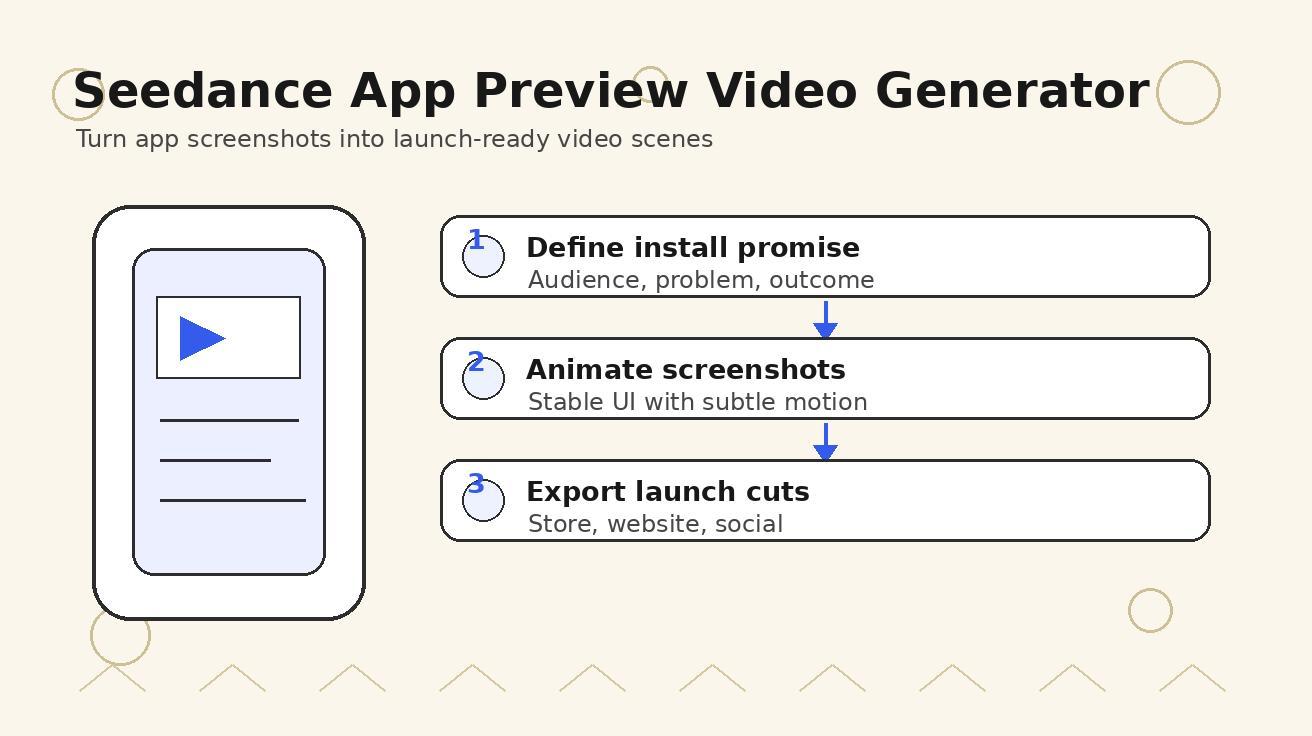
Seedance App Preview Video Generator 2026: Create App Store and Product Launch Clips
Use Seedance to turn app screenshots, feature copy, and launch goals into App Store previews, Google Play promo videos, and product launch clips.
Read article
Gemini AI Video Prompt Examples: Copy-Ready Veo Scenes and a Better Prompt Formula
Copy Gemini AI video prompt examples for cinematic motion, product ads, dialogue, and vertical clips, then adapt them with a practical Veo prompt formula.
Read article
How to Keep Product Shape Consistent in AI Video Ads
Lock product geometry, packaging, labels, references, camera angles, and approval checks so AI video ads preserve the real SKU across every shot.
Read article