
You've probably had this happen already. The source clip is good. The camera move feels right, the framing works, and the timing suits the edit. But the look is wrong, the wardrobe is off-brand, the location needs a different mood, or the whole thing has to be repurposed for a new campaign without losing the original motion.
That's where most AI video workflows become wasteful. Prompt-only generation can produce interesting clips, but it often breaks the one thing you wanted to keep, which is the structure of the shot. For practical work, especially short-form content that has to go out fast, its key value is not novelty. It's controlled transformation.
Beyond Text Prompts The Power of Video to Video
A familiar production problem: the shot already works, but the surface details do not. The walk cycle is usable. The framing is right. The pacing fits the edit. What needs to change is the setting, styling, wardrobe, colour treatment, or brand feel. Seedance 2.0 video to video is built for that kind of job because it starts from a real clip and applies direction to something that already has motion logic.
That changes how control works in practice. A text prompt can suggest mood and subject matter, but a source video gives Seedance stronger anchors for camera path, timing, rough blocking, and shot energy. In my tests, those are the parts it tends to preserve best. The parts that drift more often are fine facial detail, small wardrobe features, background signage, hand geometry, and exact object textures. Knowing that split saves time. You stop asking the model to hold everything equally and start protecting the few variables your brief depends on.
For brand work, that distinction is the whole game. If the campaign needs the same push-in, the same presenter rhythm, and the same product reveal timing across multiple variants, video to video gives you a repeatable base. If the campaign also needs an exact logo lockup, precise typography, or a specific line of copy visible in frame, expect some drift and plan around it with cleaner source footage, tighter references, or finishing work in post. Our reference-first Seedance workflow for consistent video transformations covers that setup in more detail.
Seedance also supports a short-form, modular input structure with multiple image, video, and audio references, and 1080p output for compact clips, as noted earlier in the article. That fits the way commercial teams produce variations. They are not trying to generate a whole film in one pass. They are trying to keep one shot structure stable while swapping context.
Video to video works best when the movement is already approved and the brief is about controlled change.
Audio follows the same logic. If the source clip has useful rhythm cues but messy location sound, separate the track before generation so the model is not inheriting noise you plan to remove later. A practical option is AI-powered video audio separation.
A key advantage is predictability. You are no longer hoping the model invents a good shot from scratch. You are defining what must stay fixed, what can change, and where Seedance is likely to improvise anyway. That is the difference between getting one attractive result and building a workflow that can deliver consistent output on demand.
Preparing Your Foundation for Flawless Transformation
The biggest mistake people make is treating reference inputs as decoration. They upload a source clip, throw in a few stylish images, maybe add audio, then hope the model sorts out the hierarchy. That's how you get drift.
The stronger method is a reference-driven pipeline. Public guidance around Seedance 2.0 recommends this approach because the model supports controlled multimodal editing and can take up to 12 assets in one generation, including up to 9 images, 3 video clips, and 3 audio clips, but fewer, better references usually give cleaner results, as noted in Morphic's Seedance 2 guide.

Start with the source clip, not the prompt
If the source video is messy, Seedance has to guess what you wanted to keep. That's where output quality falls apart.
Choose clips with these traits:
- Stable subject placement. A person or object should stay readable in frame. Heavy occlusion makes identity and shape harder to hold.
- Clear camera intention. A smooth pan, push-in, handheld walk, or locked-off shot works better than indecisive movement.
- Simple temporal logic. One action per clip is better than several overlapping beats.
- Limited overlays. Captions, lower-thirds, watermarks, and tiny interface details tend to confuse transformation models.
Avoid footage with strobing lights, very fast subject rotation, dense crowds crossing the frame, or sudden focus shifts. Those aren't impossible, but they create more variables than you want during your first pass.
A good source clip gives the model a stable spine. You can stylise the skin, wardrobe, set dressing, even the era. But if the skeleton of the shot is weak, the transformed output usually looks weak in the same places.
Build a hierarchy for image references
Most users add too many style images and too few control images. Those are not the same thing.
Use image references by role:
| Reference type | What it should control | What to avoid |
|---|---|---|
| Character image | Face, hair, outfit silhouette, key accessories | Mixed poses, inconsistent lighting, changing wardrobe |
| Style image | Palette, texture, rendering language, atmosphere | Multiple conflicting art directions |
| Environment image | Architecture, set dressing, surface mood | Busy scenes with no obvious focal point |
If you have three beautiful references but each says something different, the model has to negotiate between them. That usually shows up as wardrobe changes, background drift, or a style that starts strong then softens halfway through the clip.
Practical rule: one reference should own identity, one should own style, and one should own environment. Anything beyond that needs a clear reason.
This is also where cropping matters. Don't feed the model a wide character reference if the face is tiny in frame. Crop for the feature you want it to preserve.
Clean your audio before you use it
Audio references can help with mood and pacing, but they become a liability when they carry unwanted ambience, chatter, or inconsistent levels. If you're working from recorded footage, it's worth separating dialogue, music, or background noise before the generation step. A solid primer on AI-powered video audio separation is useful here because cleaner audio references give the model a simpler signal to follow.
You don't need to overcomplicate this. If the audio exists only to guide pacing or emotional tone, strip away what isn't relevant.
Prepare assets as a set, not individually
The references have to agree with each other. That means checking them as a pack before you upload anything.
Run this quick pre-flight:
- Look for contradictions. If the source clip is overcast but your style image screams warm sunset, decide whether you want a full mood swap or a softer grade shift.
- Match subject intent. If the source actor is facing three-quarters left, don't use a dead-on portrait as your only identity reference unless you're happy with reinterpretation.
- Reduce clutter. Remove weak references that don't add control.
- Name assets by function. Even if the interface labels them automatically, think of them as motion reference, identity reference, style reference, and audio reference.
A lot of revision pain comes from vague preparation, not bad generation. Teams that want cleaner outputs usually get there by removing ambiguity before they hit render.
For a more structured workflow, I'd review a practical Seedance reference video workflow guide and adapt its asset-labelling logic to your own process. The exact interface matters less than the discipline of assigning each input a job.
What a strong asset pack looks like
Here's a practical example for a product ad variation.
- Source video: a smooth tabletop push-in on a skincare bottle.
- Image reference 1: the exact product label and bottle finish you need preserved.
- Image reference 2: a clean style board showing the desired luxury palette and lighting mood.
- Image reference 3: a bathroom environment still with the right stone texture and shelf styling.
- Audio reference: a soft branded sting or clean ambient bed for pacing.
What doesn't belong in that pack? A random fashion editorial, a second bottle angle with different branding, or a noisy room-tone recording. Those inputs don't add control. They add negotiation.
Mastering the Prompt for Precise Creative Direction
A good Seedance 2.0 video-to-video prompt does one job above all: it tells the model what must survive the transformation and what is allowed to change. That is the difference between a clip you can approve in two passes and a clip that keeps drifting away from brand.
Seedance responds best when the prompt reads like shot direction, not marketing copy. The model can blend multiple reference types in one generation, but that flexibility creates a trade-off. If motion, identity, and style are all described loosely, the model will negotiate between them and invent details you never asked for. For brand work, that is usually where consistency starts to break.

Give every asset a job
The prompt needs to answer four production questions:
- Which asset controls motion?
- Which asset controls identity?
- Which asset controls style?
- Which parts of the source must stay fixed?
If those roles are not assigned, Seedance will still produce something usable. It just may preserve the wrong thing. I see this often with branded clips. The camera path holds, but wardrobe shifts. Or the face stays close enough, but the product label softens and the background architecture changes.
A weak prompt:
woman walking through a futuristic city, cinematic, neon lights, high detail
A controlled prompt:
Use video_1 for camera movement and body motion. Use image_1 for face, hairstyle, and clothing silhouette. Use image_2 for lighting palette, reflections, and environment styling. Preserve walking pace and original framing from video_1. Keep the subject centred and maintain the same shot scale. Cinematic night mood, crisp detail, 1080p.
The improvement comes from role assignment. Not better adjectives.
Prompt for preservation first
In practice, the safest prompt order is structure first, style second. That matters because Seedance usually preserves broad motion and rough composition more reliably than fine details. Small logos, exact facial features, typography, jewellery, and edge-of-frame objects are more likely to drift unless you call them out directly.
Use this sequence:
- Line 1: motion anchor
- Line 2: identity anchor
- Line 3: style or environment change
- Line 4: preservation rules
- Line 5: finish and output cues
This order reduces avoidable variation. It also makes prompt debugging easier because you can see which instruction caused the change.
For an education explainer, the difference looks like this:
| Goal | Weak wording | Better wording |
|---|---|---|
| Keep gestures | “teacher explaining in animated classroom” | “Use video_1 for hand gestures, body posture, and speaking rhythm” |
| Preserve person | “same teacher” | “Use image_1 as the identity reference for face, hair, glasses, and blazer colour” |
| Change setting | “make it more modern” | “Use image_2 for a bright illustrated classroom style with simplified educational graphics” |
| Avoid drift | “consistent output” | “Preserve shot framing, keep the presenter in the same screen position, do not alter gesture timing” |
Use explicit constraint language
Control in video to video comes from limits. A lot of failed generations happen because the prompt asks for a new look but never protects the original shot logic.
Useful constraints include:
- Keep the original camera path
- Maintain subject scale
- Do not introduce extra characters
- Keep background geometry stable
- Avoid text overlays
- Preserve left-to-right movement direction
- Keep logo position unchanged
- Do not redesign the product silhouette
These instructions matter because Seedance often treats unstated details as flexible. If your source clip already solved blocking, pacing, and composition, preserve them on purpose.
For teams building repeatable ad variants, I recommend documenting which phrases consistently hold shot grammar across projects. A useful starting point is this guide to multi-camera storytelling and native audio workflows in Seedance, then adapting the wording to your own asset naming system.
Write for the parts that usually drift
This is the practical rule that saves time: prompt hard for the details that break first.
In Seedance 2.0 video to video, these elements are usually more stable:
- broad camera motion
- subject placement
- general body movement
- rough lighting direction
- overall shot scale
These elements usually need stricter language:
- exact face likeness
- logo clarity
- text on packaging
- accessories and small props
- background edge details
- precise fabric patterns
- hand-object interaction
So instead of writing “keep the product the same,” write the actual risk out:
Preserve bottle shape, cap proportion, label placement, and gold accent band. Do not alter front label text area. Keep bottle centred at the same scale.
That level of instruction gives the model fewer places to improvise.
One example for a brand-safe ad variant
Suppose the source clip shows a runner moving through an ordinary park, but the campaign needs a premium dawn treatment and approved wardrobe colours.
Use a prompt like this:
Use video_1 as the primary motion and camera reference. Preserve the runner's route, stride rhythm, and framing from video_1. Use image_1 for outfit colours and shoe design. Use image_2 for dawn lighting, soft mist, and premium commercial grading. Keep a single runner only. Maintain realistic park layout and stable path geometry. No text on screen. No extra people entering frame. Cinematic sports advert finish, 1080p.
That prompt works because each instruction has one owner. Motion comes from the video. Identity and wardrobe come from one image. Look and grade come from another. The preservation rules close off common failure points.
<iframe width="100%" style="aspect-ratio: 16 / 9;" src="https://www.youtube.com/embed/lkL8mlpVScY" frameborder="0" allow="autoplay; encrypted-media" allowfullscreen></iframe>
What not to do in prompts
Three habits cause the most rework:
- Stacking synonyms. “cinematic, filmic, beautiful, stunning, professional” adds mood, not control.
- Assigning one attribute to multiple references. If two images both define wardrobe or face, expect compromise.
- Hinting instead of directing. “inspired by image_2” is weaker than “use image_2 for palette, texture, and set styling.”
The prompt should read like instructions to an editor who cannot ask follow-up questions. Clear ownership of motion, identity, style, and preservation is what gets predictable output.
Achieving Multi-Shot Continuity and Storytelling
A single polished clip is useful. A sequence that holds together is where AI video starts to feel production-ready.
The main challenge with Seedance 2.0 video to video is not whether it can make something attractive. It's whether it preserves the right things from shot to shot. Public commentary around the workflow points to the primary tension: users need to know what survives reliably, such as identity, logo placement, or camera motion, and what tends to drift. That's why video to video is most effective as a controlled transformation tool for scenes with stable compositions, as discussed in OpenArt's Seedance 2.0 workflow article.

What usually holds and what usually drifts
In practice, some elements are easier to preserve than others.
| Element | Usually more stable | Usually more fragile |
|---|---|---|
| Motion | Broad camera path, walk direction, pace | Fast rotations, complex interactions |
| Composition | Subject position, shot scale, rough blocking | Precise edge alignment, crowded frames |
| Identity | General face type, hair shape, outfit silhouette | Fine facial features across angle changes |
| Brand details | Large product shape, simple design language | Small logos, labels, text, captions |
| Environment | Overall mood, architecture category, palette | Specific background geography and tiny props |
That doesn't mean fragile elements are impossible. It means you shouldn't trust them without checking frame by frame.
If you're producing branded content, this distinction matters more than almost anything else. A clip can look cinematic and still fail the brief if the logo shifts, the product label mutates, or the presenter's face subtly changes between cuts.
Continuity starts before generation
Most shot-to-shot inconsistency comes from changing too many variables between clips. If you want a sequence to feel unified, keep your reference set stable across the whole run.
For a three-shot narrative, I'd usually keep:
- The same identity references for the main person or product
- The same style reference for colour and rendering language
- A consistent wording block in every prompt for preservation rules
- Only one changing variable per shot, usually camera setup or scene action
That creates a continuity spine. The model can reinterpret each shot without inventing a different visual universe every time.
Treat continuity as a system. Don't rebuild the system for each shot.
Use output chaining carefully
One reliable way to create progression is to feed one generated result back in as the source for the next shot. This can help when you want the transformed look to carry forward rather than restarting from the original footage each time.
It works well for:
- slow scene development
- style evolution within one environment
- sequential movement where the end of one clip leads naturally into the next
It works less well when the first output already contains minor errors. If you chain a clip with facial drift or warped branding, the next generation often amplifies those flaws rather than correcting them.
So use chaining selectively. If a shot lands well on mood but not identity, go back to the clean source and regenerate. Don't build on a compromised middle step.
A simple continuity workflow for short campaigns
For short-form marketing or education content, a practical continuity workflow looks like this:
-
Lock your reference pack once Use one identity set, one style set, one environment logic.
-
Generate anchor shots first Start with the widest or most descriptive scenes. They establish the visual language.
-
Match medium shots to those anchors Reuse prompt language for subject description and colour handling.
-
Leave close-ups until last Fine facial consistency is harder. Once the broader world is stable, close-ups are easier to tune.
-
Check transitions for intent, not just beauty The cut should feel motivated. Similar motion direction or matching composition helps more than flashy detail.
A deeper production-oriented discussion of sequence planning and sound-aware shot design is worth reviewing in this multi-camera storytelling and native audio guide.
Where creators lose time
The endless trial-and-error loop usually comes from expecting video to video to act like a frame-accurate editor. It isn't that. It's better viewed as a transformation engine with strong respect for motion and broad composition, but weaker reliability around tiny typography, exact logos, or highly specific facial detail across multiple angles.
That's not a flaw so much as a planning constraint.
If the campaign depends on exact text, exact labels, or legal graphics, keep those as post-production elements. Let Seedance handle motion, atmosphere, continuity, and visual reinterpretation. Add the fragile brand elements later in a conventional editor.
That split gives you the best of both worlds. You use AI where it's strong, and you protect the details that can't drift.
Advanced Settings and Output Optimisation for 1080p
Once the structure is working, the next question is whether the output is worth the render cost. Many teams waste budget here. They jump straight to final-quality generations before they've stabilised motion, identity, or style behaviour.
Independent platform listings put Seedance 2.0 video generation at about $0.682 per second for 1080p output, which means a 10-second clip could cost around $6.82 in compute alone on that listed model, according to the fal.ai Seedance 2.0 listing. That's a useful planning number when you're producing multiple variants.

Draft low, finish high
The cleanest workflow is to separate decision renders from delivery renders.
Use early passes to answer only these questions:
- Is the motion anchor behaving properly?
- Is the style reference taking hold?
- Is the subject recognisable enough?
- Is the scene transformation aligned with the brief?
Don't chase polish yet. If the concept is still unstable, 1080p just gives you a sharper version of the wrong result.
Adjust for adherence, not drama
Most advanced controls in video models boil down to a tension between source adherence and creative reinterpretation. Even when labels differ by interface, the practical choice is the same. Do you want more fidelity to the original motion and composition, or more freedom for the model to stylise aggressively?
Use this decision logic:
| If you want | Bias the settings toward |
|---|---|
| Brand-safe adaptation | Stronger adherence to source video and references |
| Stylised reinterpretation | More freedom for style influence |
| Cleaner continuity | Lower conflict between references |
| Bolder visual change | Fewer preservation constraints |
For professional work, I usually push toward preservation first. A clip that keeps the shot architecture but feels slightly conservative is easier to improve than a beautiful output that abandons the brief.
Higher resolution doesn't fix weak control. It only makes weak control more expensive.
Optimise for the destination platform
A lot of 1080p complaints are really delivery problems. The render may be fine, but the exported file then gets crushed by the social platform, messaging app, or client review tool.
Before delivery, check:
- whether the platform prefers a particular aspect ratio
- whether compression will soften gradients or motion detail
- whether captions or logos will be added later
- whether the final audience sees the clip on mobile first
If you're handing off to clients or collaborators, these SendPhoto tips for video delivery are useful because the last mile often affects perceived quality as much as the generation itself.
Know when 1080p is justified
Use full-resolution output when:
- the clip is client-facing
- product surfaces or wardrobe textures matter
- the footage will be cut into a polished ad or deck
- you've already validated the shot in draft form
Use lighter drafts when:
- you're testing prompt hierarchy
- you're comparing style references
- you're checking continuity across several shot options
If your team also produces non-reference clips, a broader Seedance 2.0 image-to-video workflow can help you decide when a shot should start from stills and when it should start from video instead. That choice affects cost discipline as much as aesthetics.
A practical output routine
A solid finishing pass usually looks like this:
-
Approve one stable draft Don't upscale five uncertain versions.
-
Run the high-resolution output only after prompt lock Small prompt tweaks at this stage are expensive.
-
Inspect the fragile areas Face, hands, labels, and background geometry.
-
Export with the final delivery context in mind Social post, ad cutdown, internal explainer, or pitch reel all have different tolerances.
The technical side of Seedance 2.0 video to video isn't glamorous, but it's where professional results separate themselves from endless expensive experiments.
Troubleshooting Common Video to Video Issues
Even with a clean workflow, some outputs miss the mark in very predictable ways. The useful part is that most failures point back to one controllable cause. If you diagnose the symptom properly, the fix is usually straightforward.
The face changes during the shot
Symptom
The character starts correctly, then the face subtly shifts, especially during turns or changes in lighting.
Fix
Use a clearer identity reference and reduce competing visual instructions. A tightly framed face image with stable lighting usually works better than a full-body image if facial consistency is the priority. In the prompt, state plainly that the identity reference controls face, hair, and key wardrobe cues.
Also check the source clip. If the head rotates quickly or gets partly obscured, the model has less consistent information to hold onto.
The motion feels jittery or synthetic
Symptom
The output keeps the general idea of the shot, but movement feels uneven, sticky, or oddly elastic.
Fix
Start with a smoother source clip. Video to video can reinterpret motion, but it usually won't rescue awkward original movement. If the source has micro-shake, abrupt framing changes, or unstable pacing, those problems often survive the transformation.
A simpler prompt helps too. When motion is unstable, remove unnecessary style language and prioritise preservation instructions until the shot feels mechanically right.
Cleaner motion references usually outperform more descriptive prompts.
The style reference isn't taking properly
Symptom The output keeps the original clip too closely and only applies a weak version of the desired look.
Fix
Choose a style image with a stronger visual signal. Mood boards full of mixed ideas often underperform compared with one decisive frame. Then tighten the prompt so the style reference owns specific attributes such as palette, lighting behaviour, material texture, or rendering language.
If you've uploaded too many references, remove the ones that don't clearly contribute. Style drift often comes from reference crowding.
Logos, labels, or on-screen text warp
Symptom
Brand details become soft, mutate, or reposition themselves between frames.
Fix
Treat tiny text and exact brand marks as post-production elements whenever possible. Video to video is much more dependable with large shapes and broad design language than with precise typography. If the label absolutely must appear during generation, make it large, front-facing, and visually simple in the source and reference images.
For important commercial work, it's safer to generate the motion and environment first, then composite the exact logo or caption afterward.
The background changes when it should stay stable
Symptom
The subject remains mostly consistent, but walls, windows, shelves, or geography shift from frame to frame.
Fix
This usually means the environment reference is too vague or the shot composition is too busy. Use a single environment image that clearly defines the spatial mood, and add a preservation line to the prompt such as keeping background layout stable and avoiding new objects entering frame.
Stable compositions help here. If the shot contains too many moving background elements, simplify the source or crop tighter.
The result looks good but not usable
Symptom
Nothing is obviously broken, yet the clip still doesn't feel campaign-ready.
Fix
This is often a brief problem, not a rendering problem. Ask what the clip had to preserve that the generation treated as optional. Was it the product silhouette, the presenter's recognisability, the route of the camera, or the exact mood? Then rewrite the prompt so those are explicit requirements rather than implied preferences.
The more commercial the use case, the less you should rely on the model to infer priorities.
Conclusion From Concept to Cinematic Clip
Good Seedance 2.0 video to video work comes from control, not luck. The strongest results start with a source clip that already solves motion and composition, then add a small set of references that each have a clear job. After that, the prompt acts like direction, not decoration.
A key shift is knowing what to protect. Broad camera movement, pacing, and visual structure are often the most reliable anchors. Fine text, exact logos, and delicate facial detail need more caution. Once you work with that reality instead of against it, revision cycles shrink and outputs become much more predictable.
Used this way, video to video stops being a novelty feature. It becomes a practical production method for turning existing footage into consistent, stylised, campaign-ready clips.
If you want to put this workflow into practice, Seedance is a practical place to test reference-led video generation with text, image, video, and audio inputs, especially when you need short, controlled clips rather than prompt-only experiments.
Ready to create your own AI video?
Turn ideas, text prompts, and images into polished videos with Seedance. If this article helped, the fastest next step is to try the product.
Free credits on signup. Plans from $20/month.
Related Articles
More posts in the same locale you may want to read next.
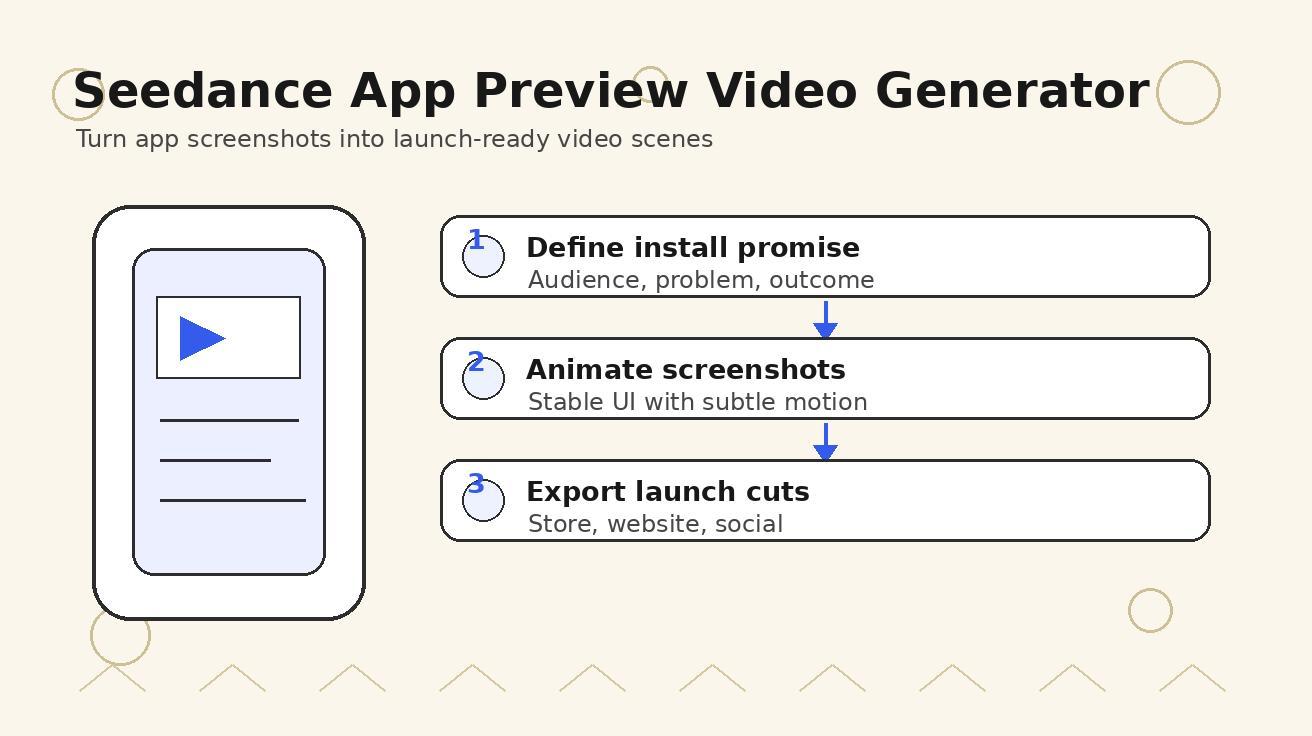
Seedance App Preview Video Generator 2026: Create App Store and Product Launch Clips
Use Seedance to turn app screenshots, feature copy, and launch goals into App Store previews, Google Play promo videos, and product launch clips.
Read article
VEED Auto Subtitles Free: A Practical Guide to Captions You Can Publish
Use VEED auto subtitles on a free plan, correct caption timing and style, understand watermark and SRT limits, and prepare a caption-ready video with Seedance.
Read article
Firefly Video Transparent Background Tutorial: Generate, Export, and Composite Clean Overlays
Generate a transparent-background video in Adobe Firefly, understand its foreground and alpha files, test edge quality, and composite a usable overlay.
Read article