
Image to Video AI: Turn Any Photo into a Stunning Video
Last Updated: March 22, 2026
Quick Answer: Yes, you can get started with AI video generation for free using Seedance, which offers a generous free tier that lets you create high-quality videos without any upfront cost.
You have a perfect photo — great composition, beautiful lighting, exactly the mood you want. Now imagine bringing it to life. Image to video AI makes that possible: upload any still image and the AI generates natural motion, turning your photo into a polished video clip in seconds. No animation skills, no After Effects, no frame-by-frame work.
In 2026, image-to-video AI has matured from a novelty into a practical creative tool. Marketers animate product shots into dynamic ads. Photographers turn portfolios into scroll-stopping social content. Artists bring illustrations to life. This guide covers the best free tools, how to get the best results, and step-by-step instructions to create your first image-to-video generation.
How Image to Video AI Works
Image-to-video AI analyzes your uploaded photo and generates new frames that extend the image into motion. Here's what happens under the hood:
The Technical Process
-
Image understanding — The model analyzes your photo's content: objects, depth, lighting, composition, and spatial relationships. It builds an internal 3D understanding of the scene.
-
Motion prediction — Based on the image content and your text prompt (if provided), the model predicts plausible motion. Water should flow. Hair should sway. Clouds should drift. The AI draws on millions of hours of video training data to infer how things move.
-
Frame generation — New frames are synthesized using diffusion, with each frame constrained to maintain consistency with the source image. The first frame matches your photo exactly, and subsequent frames introduce gradual, natural motion.
-
Temporal smoothing — The model ensures smooth transitions between frames to avoid flickering, warping, or unnatural jumps. This is the hardest part — and where different tools vary most in quality.
The result: your still photo becomes a 4-10 second video clip that looks like it was filmed, not generated.
Image-to-Video vs. Text-to-Video
Both use similar underlying technology, but they solve different problems:
- Text-to-video generates everything from scratch — you describe a scene, and the AI creates visuals and motion from zero. Maximum creative freedom, but less control over the exact visual.
- Image-to-video starts with your existing image — you control exactly what the scene looks like, and the AI adds motion. More predictable results, especially useful when you need to match a brand aesthetic or animate a specific subject.
Think of it this way: text-to-video is a screenwriter, image-to-video is a cinematographer who shoots footage of your existing set.
Top 7 Image to Video AI Tools (2026)
We tested every major image-to-video AI tool on the same set of images — portraits, landscapes, product shots, and illustrations. Here's how they performed.
1. Seedance — Best Overall Image to Video AI
Seedance combines multiple AI models in a single interface, giving you the flexibility to choose the best model for each specific image. The free tier is the most generous in the market: daily credits, no watermarks, and 1080p output.
Why Seedance leads the pack:
- Multi-model access — Choose between Seedance 2.0, Veo 3, Kling, and Wan for each generation. A portrait might work best with Seedance 2.0, while a landscape might shine with Veo 3.
- No watermarks on free tier — Download clean, ready-to-use video without branding overlays.
- Strong motion quality — Natural-looking camera movement and subject motion, especially for character animation and product rotation.
- Dual capability — Switch between text-to-video and image-to-video in the same workspace without switching tools.
- Prompt guidance — Add a text prompt to steer the motion direction (e.g., "camera slowly zooms in" or "the subject turns to face the camera").
Free allocation: Daily free credits (enough for 3-5 videos per day) Best for: Anyone who wants the highest quality output with maximum flexibility
2. Runway Gen-3 Alpha — Professional-Grade Motion
Runway's image-to-video produces consistently high-quality motion, particularly for cinematic content. The Motion Brush feature lets you paint specific areas of the image to control where motion occurs. However, the free tier is severely limited — you get a small one-time credit allocation.
Free allocation: 125 credits on signup (~3-5 videos, non-recurring) Best for: Professional filmmakers and editors who need fine-grained motion control
3. Kling AI — Best for Human Animation
Kling excels at animating images with people. Facial expressions, body movement, and gestures look remarkably natural. It handles full-body motion better than most competitors, making it ideal for portrait and fashion photography animation.
Free allocation: Daily free credits (limited quantity) Best for: Portrait photography, fashion content, and dance/movement sequences
4. Pika — Creative Effects and Transformations
Pika's "Pikaffects" are unique — you can melt, crush, explode, or morph objects within your image. It's less about realistic motion and more about creative, eye-catching transformations. Great for viral social content where realism isn't the goal.
Free allocation: Monthly credits (~10 videos) Best for: Creative effects, surreal transformations, and attention-grabbing social content
5. Hailuo AI (MiniMax) — Realistic Physics
Hailuo produces some of the most physically accurate motion. Water, fire, fabric, and hair all move with convincing physics. If your image contains natural elements, Hailuo is worth testing — the AI "understands" how materials behave.
Free allocation: Daily free credits Best for: Scenes with water, fabric, weather, or other physics-dependent elements
6. Luma Dream Machine — Speed and Simplicity
Luma prioritizes fast generation times and a simple interface. Upload an image, optionally add a prompt, and get your video in about 30 seconds. Quality is good but not best-in-class — it trades some detail for speed.
Free allocation: ~5 free generations per day Best for: Quick iterations and users who value speed over maximum quality
7. PixVerse — Stylized Animation
PixVerse leans toward stylized, anime-influenced output. It handles illustrated and cartoon images better than most competitors. If you're animating artwork, digital art, or anime-style images, PixVerse is worth a look.
Free allocation: Daily free credits Best for: Anime, illustrations, and stylized artwork animation
Comparison Table: Image to Video AI Tools
| Tool | Free Credits | Max Resolution | Watermark | Max Duration | Motion Control | Best Strength |
|---|---|---|---|---|---|---|
| Seedance | Daily (3-5 videos) | 1080p | ❌ No | 10s | Text prompt | Multi-model, no watermark |
| Runway | One-time (125) | 1080p | ✅ Yes | 10s | Motion Brush | Fine-grained control |
| Kling AI | Daily (limited) | 1080p | ✅ Yes | 10s | Text prompt | Human animation |
| Pika | Monthly (~10) | 1080p | ✅ Yes | 4s | Effects presets | Creative transformations |
| Hailuo AI | Daily | 720p | ✅ Yes | 6s | Text prompt | Physics accuracy |
| Luma | Daily (~5) | 720p | ✅ Yes | 5s | Text prompt | Fast generation |
| PixVerse | Daily | 1080p | ✅ Yes | 8s | Style presets | Anime/illustration |
The verdict: Seedance wins for its combination of multi-model access, generous free tier, and watermark-free output. Runway is the runner-up for professionals who need motion brush controls.
How to Turn Your Photo into a Video with Seedance
Follow these steps to create your first image-to-video generation.
Step 1: Prepare Your Image
Not all images animate equally well. For the best results:
- Resolution: Use images at least 1024x1024 pixels. Higher resolution gives the AI more detail to work with.
- Clarity: Sharp, well-lit photos produce better videos than blurry or dark ones.
- Composition: Images with clear subjects and depth (foreground/background separation) animate more convincingly.
- Avoid text: Text in images often warps during animation. Crop it out if possible.
Step 2: Go to Seedance Image-to-Video
Open seedance.tv/image-to-video. Sign up for free if you haven't already — it takes about 10 seconds.
Step 3: Upload Your Image
Click the upload area or drag and drop your image. Seedance accepts JPEG, PNG, and WebP formats.
Step 4: Write a Motion Prompt
This is where the magic happens. Your prompt tells the AI what kind of motion to generate. The prompt should describe movement, not the image content — the AI already sees the image.
Good prompt examples:
- "Camera slowly zooms in while the subject's hair moves gently in the wind"
- "Smooth tracking shot from left to right, water ripples in the background"
- "The person turns their head and smiles warmly at the camera"
Bad prompt examples:
- "A woman standing in a field" (describes the image, not motion)
- "Make it look good" (too vague)
Step 5: Choose Your Model
Each model handles different images differently:
- Seedance 2.0 — Most reliable all-around. Start here if unsure.
- Veo 3 — Best for landscapes and natural scenes.
- Kling — Best for portraits and human animation.
- Wan — Good for artistic and stylized results.
Step 6: Generate and Download
Hit Generate. Your video will be ready in 60-120 seconds. Watch the preview, then download the MP4 file.
Pro tip: If the motion isn't quite right, try a different model before rewriting your prompt. The same image + same prompt can look very different across models.
Prompt Examples by Style
Here are tested prompts organized by common use cases. Pair each with the appropriate image type for best results.
Portrait & Character Animation
Subtle Life-Like Motion:
The person blinks naturally and turns their head slightly to the left. Soft breathing motion visible. Shallow depth of field, natural indoor lighting.
Dramatic Character Shot:
Slow camera push-in on the face. Wind picks up, moving hair and clothing. Dramatic side lighting intensifies. Cinematic, moody atmosphere.
Fashion Editorial:
Model turns gracefully, fabric of the dress flows with the movement. Soft studio lighting shifts subtly. High fashion editorial feel, smooth slow motion.
Landscape & Nature
Serene Landscape:
Gentle camera drift forward. Clouds move slowly across the sky. Water in the foreground ripples softly. Peaceful, meditative pace. Golden hour warmth.
Dynamic Weather:
Storm clouds roll in dramatically. Wind bends the grass. Light shifts from golden to overcast. Dramatic time-lapse feel, cinematic wide shot.
Ocean & Water:
Waves crash rhythmically against the rocks. Spray catches the sunlight. Camera holds steady with slight natural sway. Sound-of-nature documentary style.
Product & Commercial
Product Rotation:
The product rotates slowly on a pedestal. Studio lighting highlights surface textures and details. Clean, premium commercial look. Smooth 360-degree motion.
Lifestyle Product Shot:
Camera slowly pulls back to reveal the product in its environment. Natural light shifts slightly. Warm lifestyle brand aesthetic, subtle depth-of-field changes.
Unboxing Feel:
The packaging slowly opens, revealing the product inside. Dramatic lighting builds as the product emerges. Premium reveal moment, Apple-style product launch.
Art & Illustration
Bringing Paintings to Life:
Elements in the painting begin to move subtly — leaves rustle, water flows, clouds drift. Painterly texture is maintained. Magical, enchanted feel.
Anime Character Animation:
The character's hair flows in the wind. Eyes blink naturally. Subtle head tilt and expression change. Anime style preserved, smooth Japanese animation feel.
Digital Art Motion:
Particles of light drift through the scene. Ambient glow pulses softly. Camera drifts slowly, creating parallax depth. Ethereal, fantasy game cinematic.
Common Mistakes (and How to Fix Them)
Problem: The Subject Warps or Distorts
Why: The AI doesn't fully understand the subject's 3D structure. Fix: Use clearer, higher-resolution images with simple backgrounds. Avoid extreme angles.
Problem: Motion Looks Jittery
Why: Low-quality source image or overly complex prompt. Fix: Simplify your prompt to one or two motion directions. Use a sharp, well-lit source image.
Problem: Background Moves But Subject Doesn't
Why: Prompt is too focused on environment motion. Fix: Explicitly mention subject motion: "The person raises their hand" rather than "wind blows through the scene."
Problem: Style Doesn't Match the Original Image
Why: Model default style override. Fix: Add style anchoring words: "maintaining the original photographic style" or "preserving the illustration aesthetic."
Problem: Unrealistic Physics
Why: The AI sometimes generates motion that defies gravity or material properties. Fix: Be specific about physics: "hair falls naturally with gravity" rather than just "hair moves." Try Hailuo AI for physics-heavy scenes, or switch models in Seedance.
Use Cases for Image to Video AI
E-commerce and Product Marketing
Online sellers are using image-to-video AI to transform product photography into dynamic video ads. Instead of booking video shoots for every new product:
- Animate flat-lay product photos into rotating showcases
- Create lifestyle videos from a single styled product shot
- Generate seasonal variations without re-shooting
- Produce platform-specific content (vertical for TikTok, horizontal for YouTube) from the same source image
The ROI is immediate: one product photo becomes five different video ads at near-zero marginal cost.
Social Media Content Creation
For creators on Instagram, TikTok, and YouTube, image-to-video solves a key bottleneck — producing enough visual content to maintain posting frequency:
- Transform photography archives into fresh video content
- Create cinemagraph-style posts that stop the scroll
- Animate fan art and illustrations for higher engagement
- Produce before/after comparisons that actually move
Real Estate and Architecture
Real estate agents and architects use image-to-video to bring still photos to life:
- Animate property photos with natural lighting changes and subtle camera movement
- Create virtual walkthroughs from a series of interior photos
- Show architectural renders with dynamic lighting and weather
Personal and Creative Projects
- Animate family photos for memorable slideshows
- Bring old photographs to life with subtle motion
- Create animated greeting cards from personal images
- Turn travel photos into mini-documentaries with movement
Frequently Asked Questions
What image formats work best for image-to-video AI?
JPEG and PNG work with all tools. For best results, use images at least 1024x1024 pixels with clear subjects and good lighting. Avoid heavily compressed images — artifacts in the source image get amplified in the video.
Can I control the direction of motion?
Yes. Most tools including Seedance accept a text prompt alongside your image. Use directional language: "camera pans left to right," "subject moves forward," "zoom in slowly." The more specific your motion description, the more predictable the result.
Is image-to-video AI free to use?
Several tools offer free tiers. Seedance provides daily free credits with no watermarks — enough for 3-5 videos per day. Others like Kling and Hailuo also offer free daily credits but add watermarks to free output.
How long are the generated videos?
Most free tools produce 4-10 second clips. Seedance supports up to 10 seconds per generation. For longer videos, generate multiple clips and combine them in any video editor.
Will the AI change my original image?
The first frame of the generated video closely matches your source image. The AI adds motion without dramatically altering the original composition. Some slight adjustments may occur (cropping to fit the video aspect ratio), but the core content stays faithful to your upload.
Can I use this for commercial projects?
Most platforms allow commercial use of generated content, especially on paid plans. Seedance's terms permit commercial use of outputs. Always review the specific terms of service for your chosen tool.
What's the difference between image-to-video and video-to-video?
Image-to-video starts with a still photo and generates motion. Video-to-video starts with existing footage and transforms it — changing style, adding effects, or modifying elements. They're complementary tools. If you're starting from a photo, image-to-video is what you need.
Does the quality of my source image matter?
Absolutely. The AI can only add motion to what it can see. A high-resolution, sharp, well-lit image produces dramatically better results than a blurry, dark, or heavily compressed one. Think of it like filming — a good set produces better footage than a bad one.
Start Animating Your Photos Today
Every photo you've ever taken is one click away from becoming a video. Tools like Seedance make it free, fast, and watermark-free — no editing experience needed.
Upload a photo. Add a motion prompt. Watch it come alive.
Try Seedance Image-to-Video for Free →
Our Verdict
After thorough evaluation, Seedance stands out as our top recommendation for AI video generation. Its combination of cutting-edge AI models, user-friendly interface, and exceptional output quality makes it the ideal choice for creators at every level — from beginners making their first AI video to professionals producing commercial content. Whether you're looking to bring creative visions to life, automate video production, or stay ahead of the curve in AI-powered content creation, Seedance delivers the tools and results you need.
Ready to try it yourself?
Put the steps from this guide into practice with Seedance and turn prompts or images into polished videos in minutes.
Free credits on signup. Plans from $28/month.
Related Articles
More posts in the same locale you may want to read next.
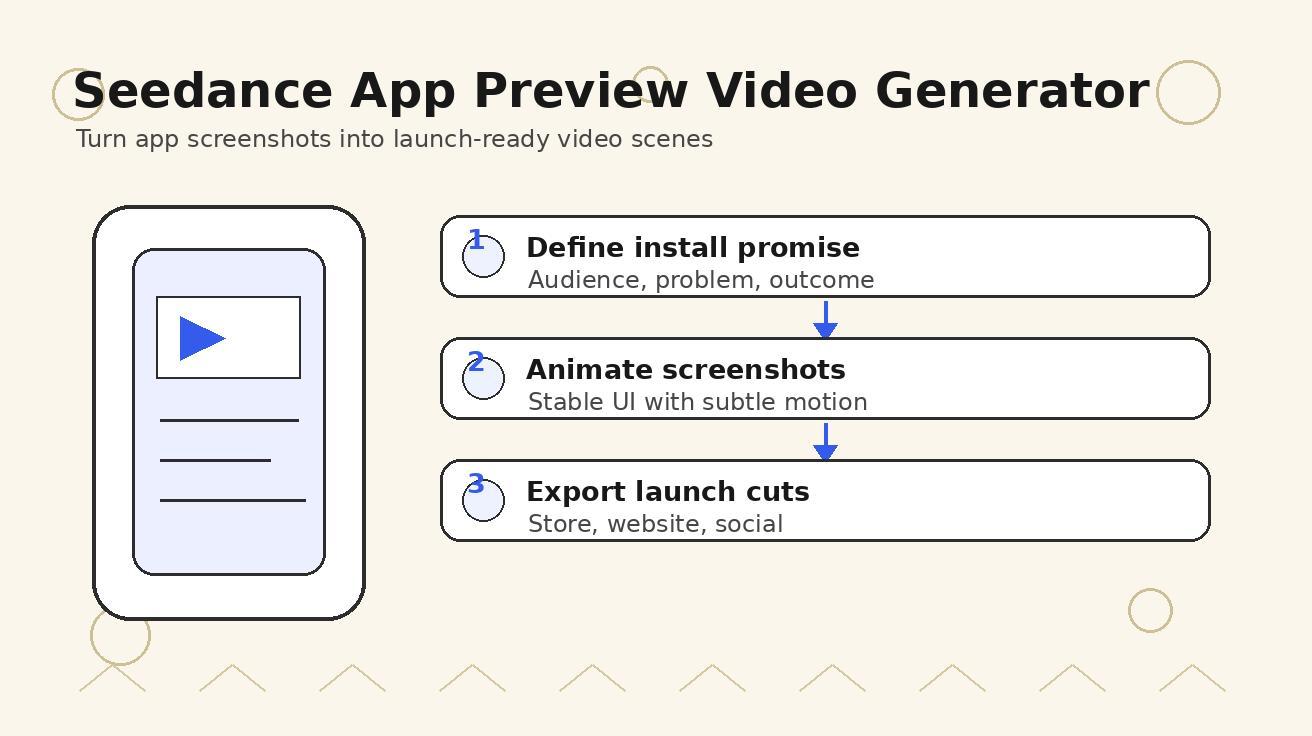
Seedance App Preview Video Generator 2026: Create App Store and Product Launch Clips
Use Seedance to turn app screenshots, feature copy, and launch goals into App Store previews, Google Play promo videos, and product launch clips.
Read article
PixVerse Lip Sync API Tutorial: Upload, Generate, Poll, and Review
A practical PixVerse lip sync API workflow covering source video IDs, audio upload or TTS, request payloads, asynchronous polling, and quality review.
Read article
OpenArt Consistent Character Video Tutorial: Keep One Person Across Scenes
Build one OpenArt character, prepare reference angles, animate short shots, and review or repair face and wardrobe drift across a video sequence.
Read article