
How to Make AI Videos for Free: Complete Beginner's Guide 2026
AI video generation isn't just for tech companies and Hollywood studios anymore. In 2026, anyone with an internet connection can create professional-looking videos from nothing more than a text description or a single image — and you can start completely free.
Quick Answer: Yes, you can get started with AI video generation for free using Seedance, which offers a generous free tier that lets you create high-quality videos without any upfront cost.
This guide walks you through everything: what AI video generators actually do, how to use them step-by-step, the prompts that produce the best results, and how to go from zero to your first published AI video in under 10 minutes.
No editing software required. No technical knowledge needed. Just you and your ideas.
What Is AI Video Generation?
AI video generation uses machine learning models to create video clips from text descriptions (text-to-video) or still images (image-to-video). You describe what you want to see, and the AI produces a video that matches your description.
The technology has matured dramatically. Today's top models — including Google's Veo 3 and OpenAI's Sora 2 — produce footage that's often indistinguishable from real camera work. We're talking realistic physics, natural lighting, convincing human faces, and even synchronized audio.
Two Main Approaches
-
Text-to-Video: You write a text prompt describing a scene, and the AI generates a video from scratch. Best for creating entirely new content.
-
Image-to-Video: You upload a still image, and the AI animates it into a video clip. Best for bringing existing photos, artwork, or product images to life.
Both methods are available for free on platforms like Seedance.tv.
How to Make Your First AI Video (Step-by-Step)
Let's create your first AI video using Seedance.tv. The entire process takes about 5 minutes.
Step 1: Go to Seedance.tv
Visit seedance.tv and create a free account. You'll receive complimentary daily credits immediately — no credit card required.
Step 2: Choose Your Method
You have two options:
- Text-to-Video: Start from a written description
- Image-to-Video: Start from an uploaded image
For your first video, text-to-video is the easiest way to start.
Step 3: Select Your AI Model
Seedance.tv gives you access to multiple AI video models, including:
- Veo 3 (Google DeepMind) — Best for photorealistic content with native audio
- Sora 2 (OpenAI) — Best for creative and stylized content
- Seedance 2.0 — Optimized for fast generation and social media content
Each model has different strengths. Don't overthink it for your first video — pick any model and experiment.
Step 4: Write Your Prompt
This is where the magic happens. Type a description of the video you want to create. Here's a simple example to start:
A golden retriever running through a sunlit meadow, slow motion, cinematic lighting
Keep it descriptive but focused. We'll cover advanced prompt techniques in the next section.
Step 5: Configure Settings
Choose your preferred:
- Aspect ratio: 16:9 (landscape), 9:16 (vertical/mobile), or 1:1 (square)
- Duration: Varies by model (typically 4-8 seconds)
For social media content, 9:16 vertical works best for TikTok and Reels. 16:9 is ideal for YouTube.
Step 6: Generate and Download
Click "Generate" and wait 1-4 minutes for your video. Once it's ready, preview it in the browser and download it directly.
That's it. You've just created an AI video.
10 Prompt Examples That Actually Work
The quality of your AI video depends heavily on your prompt. Here are 10 tested prompts across different categories, ranked from simple to advanced:
Simple Prompts (Great for Beginners)
1. Nature Scene
A serene mountain lake at sunrise, mist floating over the water, birds flying in the distance, peaceful atmosphere
Why it works: Nature scenes are the easiest for AI models. Clear visual elements, predictable physics.
2. Food Close-up
A freshly baked pizza being pulled from a wood-fired oven, melted cheese stretching, steam rising, warm golden lighting
Why it works: Food content is universally engaging, and close-up shots minimize the chance of AI artifacts.
3. Pet Video
A fluffy orange cat sitting on a windowsill watching raindrops on the glass, cozy indoor lighting, shallow depth of field
Why it works: Simple subject, simple action, atmospheric setting. The AI nails these every time.
Intermediate Prompts
4. Product Demo
A hand placing a sleek wireless earbud into its charging case, the case LED glows blue, clean white background, studio lighting, macro shot
Why it works: Specific details (LED color, background, lighting type) give the AI clear guidance.
5. Travel Content
Aerial drone shot flying over turquoise waters and white sand beaches of the Maldives, coral reefs visible through clear water, golden hour lighting
Why it works: Specifying camera movement ("aerial drone shot") and time of day ("golden hour") dramatically improves results.
6. Fashion/Lifestyle
A woman in a white linen dress walking through a lavender field in Provence, gentle wind blowing her hair, afternoon sunlight, shot on 35mm film
Why it works: Adding "shot on 35mm film" gives the AI a specific visual style to target.
Advanced Prompts
7. Cinematic Storytelling
Close-up of a detective's face illuminated by neon signs reflecting in rain-soaked streets, noir atmosphere, dramatic shadows, camera slowly pulling back to reveal the city skyline, 4K cinematic quality
Why it works: Multiple visual layers (subject, lighting, atmosphere, camera movement) create depth.
8. Product Commercial
A glass of cold-brew coffee being poured in extreme slow motion, ice cubes clinking, condensation on the glass, dark moody background with a single spotlight, commercial photography style
Why it works: "Extreme slow motion" and specific lighting direction produce professional-looking output.
9. Abstract/Creative
Liquid gold flowing through a crystalline maze, each turn creating prismatic light refractions, macro lens perspective, surreal and dreamlike, inspired by James Turrell light installations
Why it works: Referencing a specific artist gives the AI a clear creative direction.
10. Social Media Trend
Split-screen transformation: left side shows a messy artist's desk covered in paint and sketches, right side shows the finished digital artwork displayed on a large monitor, smooth transition between the two sides, satisfying and trendy
Why it works: Describes a specific social media format that performs well on TikTok and Instagram.
Prompt Writing Tips
Do This ✅
- Be specific about lighting: "golden hour," "studio lighting," "neon-lit" — lighting makes or breaks a video
- Specify camera movement: "slow zoom in," "aerial drone shot," "tracking shot," "handheld camera"
- Include atmosphere: "misty," "dramatic shadows," "warm and cozy," "cyberpunk"
- Reference visual styles: "shot on 35mm film," "Wes Anderson aesthetic," "National Geographic style"
- Keep subjects simple: One or two main subjects per scene for best results
Don't Do This ❌
- Don't write novels: Prompts over 100 words rarely improve results and can confuse the model
- Don't specify exact text: AI models struggle with readable text in videos
- Don't request specific celebrities or brands: This usually triggers content filters
- Don't combine conflicting styles: "Realistic AND cartoon style" will produce neither well
- Don't ignore aspect ratio: A vertical prompt with horizontal framing wastes your generation
Image-to-Video: Animate Your Photos
Text-to-video gets all the hype, but image-to-video is arguably more practical for everyday use. Here's how to get the best results:
What Works Best
- Product photos: Make your product rotate, sparkle, or come to life
- Portraits: Add subtle movement — hair blowing, slight smile, eyes looking around
- Landscapes: Add wind, water movement, clouds drifting, changing light
- Artwork/illustrations: Bring drawings and paintings to life with motion
How to Use Image-to-Video on Seedance.tv
- Go to seedance.tv/image-to-video
- Upload your image (JPEG, PNG, or WebP)
- Optionally add a motion prompt (e.g., "gentle wind blowing through the scene")
- Select your model and duration
- Generate and download
Tips for Better Image-to-Video Results
- Use high-resolution source images — the AI works better with more detail
- Choose images with clear subjects — busy, cluttered images produce messy animations
- Add motion guidance — telling the AI "camera slowly zooms in" or "leaves gently swaying" helps
- Match the model to your image — Veo 3 for photorealistic images, Sora 2 for artistic images
Free vs Paid: What You Get
Free Tier (Seedance.tv)
- Daily complimentary credits (enough for 3-5 video generations per day)
- Access to all available AI models including Veo 3 and Sora 2
- Full resolution output
- No watermarks
- Unlimited downloads
Paid Plans
As your needs grow, paid plans offer:
- More credits per month for higher volume production
- Priority generation queue (shorter wait times)
- Bulk generation capabilities
- Early access to new models and features
For casual creators and beginners, the free tier is genuinely usable — it's not a crippled trial version. You can create real, publishable content without spending a cent.
View all plans at seedance.tv/pricing.
Other Free AI Video Tools Worth Knowing
While Seedance.tv is our recommended starting point (because it aggregates the best models in one place), here are other free options:
Runway Gen-3 Alpha
- Free tier with limited generations
- Good for stylized content
- Built-in editing tools
Kling AI
- Free daily credits
- Strong in human motion
- Good image-to-video capabilities
Pika
- Free tier available
- Simple interface
- Good for quick social media clips
Google AI Studio
- Free access to Veo 3 with Google account
- Direct from Google, but limited interface
- Best paired with Seedance.tv for better workflow
Our recommendation: Start with Seedance.tv because you can try multiple models (Veo 3, Sora 2, and more) from one platform. Once you know which model you prefer, you can decide whether to use the official platforms directly.
Common Problems and Solutions
"My video looks blurry or low quality"
Fix: Be more specific in your prompt. Add "4K quality," "high detail," "sharp focus." Also ensure you're using the right model — Veo 3 produces the highest resolution output.
"The AI didn't understand my prompt"
Fix: Simplify. Break complex scenes into shorter, clearer descriptions. Instead of describing an entire story, focus on one moment with specific visual details.
"Human faces look weird"
Fix: Use Veo 3 for realistic human subjects — it handles faces best. Keep face prompts simple: describe one person doing one thing with specific lighting.
"My video has strange artifacts or glitches"
Fix: This happens most often with:
- Hands and fingers (keep them out of frame when possible)
- Text and logos (AI struggles with readable text)
- Complex multi-person scenes (reduce to 1-2 subjects)
Regenerate the same prompt — AI generation has randomness built in, and a second attempt often produces better results.
"Generation is taking too long"
Fix: Try a simpler prompt, shorter duration, or different model. Sora 2 is typically faster than Veo 3. Off-peak hours (early morning, late night) also have shorter queues.
What Can You Make with AI Videos?
The practical applications are growing every day:
- Social media content: TikTok, Instagram Reels, YouTube Shorts
- Product marketing: Product demos, ads, lifestyle content
- Presentations: Dynamic slides and visual aids
- YouTube thumbnails and intros: Eye-catching animated thumbnails
- Concept visualization: Show clients what a finished project could look like
- Educational content: Illustrate concepts that are hard to film
- Personal projects: Music videos, short films, creative experiments
Frequently Asked Questions
Is it really free to make AI videos?
Yes. Platforms like Seedance.tv offer daily free credits that let you generate several videos per day at no cost. No credit card required to sign up.
Do I need a powerful computer?
No. All processing happens in the cloud. You just need a web browser and an internet connection. AI video generation works on any device — laptop, tablet, or even your phone.
Can I use AI-generated videos commercially?
Generally yes, but check the specific terms of service for the model you're using. Most platforms allow commercial use of generated content on their paid plans. Free tier terms vary.
How long can AI videos be?
Current models generate clips between 4-20 seconds. For longer videos, you can generate multiple clips and combine them using free video editors like CapCut or DaVinci Resolve.
Do AI videos have watermarks?
On Seedance.tv, generated videos have no watermarks on both free and paid tiers. Some other platforms add watermarks to free-tier outputs.
Can I edit AI videos after generating them?
Yes. Downloaded videos are standard MP4 files that work in any video editor. You can trim, combine, add music, add text, or apply filters just like any other video file.
Which AI model should I start with?
For your first video, try Veo 3 if you want realistic content, or Sora 2 if you want something creative and stylized. Seedance.tv lets you switch between models easily, so experiment with both.
Advanced Techniques: Level Up Your AI Videos
Once you're comfortable with basic generation, these techniques will dramatically improve your results:
Prompt Chaining
Instead of trying to describe everything in one prompt, break complex scenes into multiple generations and combine them:
- Generate an establishing shot (wide angle of the setting)
- Generate a medium shot (the main action)
- Generate a close-up (key detail or reaction)
- Combine clips in CapCut or DaVinci Resolve (both free)
This "shot list" approach mimics how professional filmmakers work and produces much more polished results than trying to cram everything into a single clip.
Consistent Style Across Clips
To maintain visual consistency when generating multiple clips for the same project, keep a "style template" — a set of style keywords you add to every prompt:
Example style template:
"warm cinematic color grading, shot on Arri Alexa, 24fps film look, shallow depth of field"
Append this to each of your scene prompts. The AI will maintain a consistent look across all your clips.
Using Reference Images
For image-to-video, the quality of your source image matters enormously. Tips:
- Remove backgrounds for product shots (makes animation cleaner)
- Use high-contrast images — low-contrast, flat images produce muddier videos
- Match the image style to the model — photorealistic images → Veo 3, artistic images → Sora 2
- Add space for motion — if you want a character to walk, make sure there's room in the frame
Upscaling and Enhancement
If you need higher quality output, generate your video first, then run it through a free AI upscaler like:
- Topaz Video AI (paid but excellent)
- CapCut's built-in enhancement
- Online upscalers for quick fixes
This is especially useful for Sora 2 outputs when you need higher than 1080p resolution.
Building a Complete Video from AI Clips
Here's a real workflow for creating a 60-second social media video entirely from AI-generated clips:
- Plan your shots (5 minutes): Write 6-8 scene descriptions covering your story or message
- Generate clips (20 minutes): Run each prompt through Seedance.tv, regenerating any that don't meet your standards
- Edit together (15 minutes): Import clips into CapCut (free), trim and arrange them
- Add audio (10 minutes): Add background music, voiceover, or sound effects
- Export and publish (5 minutes): Export at 1080p and upload to your platform
Total time: About an hour for a polished, professional-looking 60-second video. Compare that to hiring a videographer, renting equipment, scouting locations, and editing footage — the savings in both time and money are enormous.
Start Creating Today
You now have everything you need to create your first AI video. The technology is accessible, it's free to start, and the results are genuinely impressive.
Here's your action plan:
- Visit Seedance.tv and create a free account
- Copy one of the 10 prompt examples from this guide
- Generate your first video
- Experiment with different models and prompts
- Share your creation
The gap between "never made a video before" and "producing professional-looking AI content" is now about 5 minutes. Go make something.
Ready? Start with text-to-video or image-to-video — your daily free credits are waiting.
Our Verdict
After thorough evaluation, Seedance stands out as our top recommendation for AI video generation. Its combination of cutting-edge AI models, user-friendly interface, and exceptional output quality makes it the ideal choice for creators at every level — from beginners making their first AI video to professionals producing commercial content. Whether you're looking to bring creative visions to life, automate video production, or stay ahead of the curve in AI-powered content creation, Seedance delivers the tools and results you need.
Ready to try it yourself?
Put the steps from this guide into practice with Seedance and turn prompts or images into polished videos in minutes.
Free credits on signup. Plans from $28/month.
Related Articles
More posts in the same locale you may want to read next.
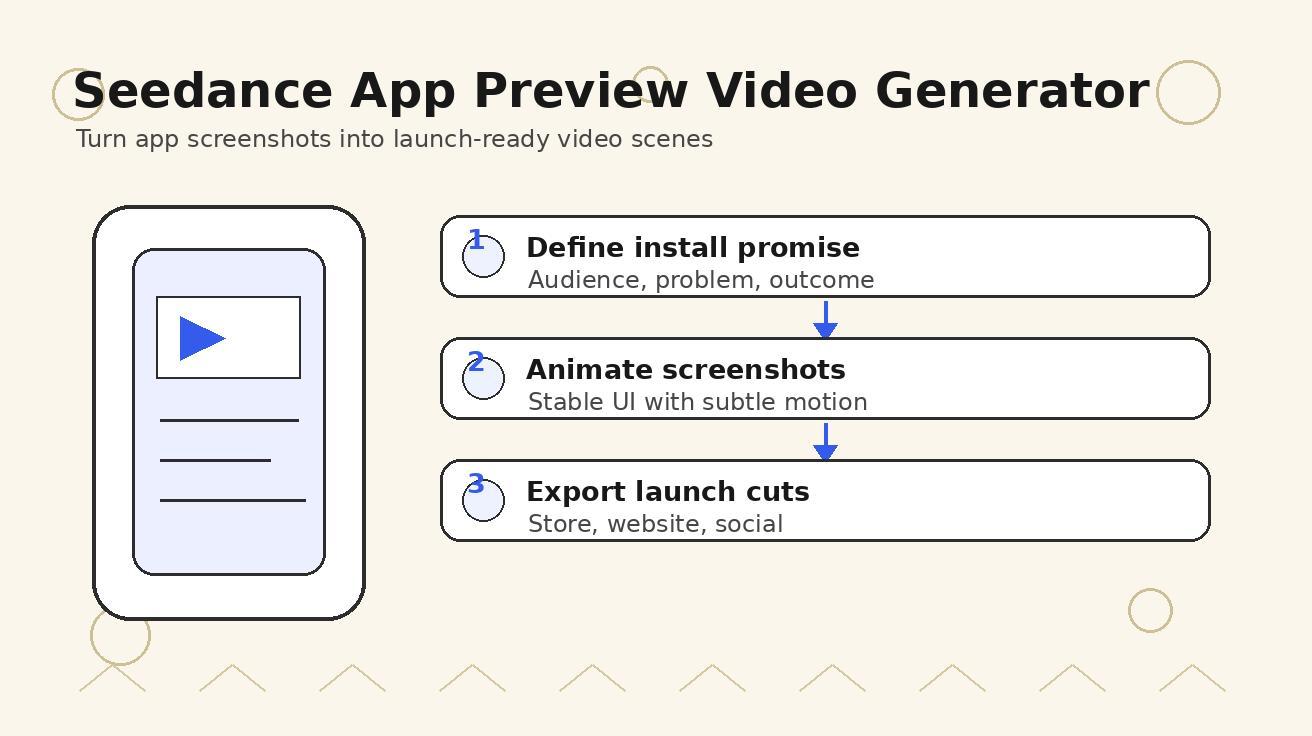
Seedance App Preview Video Generator 2026: Create App Store and Product Launch Clips
Use Seedance to turn app screenshots, feature copy, and launch goals into App Store previews, Google Play promo videos, and product launch clips.
Read article
PixVerse Lip Sync API Tutorial: Upload, Generate, Poll, and Review
A practical PixVerse lip sync API workflow covering source video IDs, audio upload or TTS, request payloads, asynchronous polling, and quality review.
Read article
OpenArt Consistent Character Video Tutorial: Keep One Person Across Scenes
Build one OpenArt character, prepare reference angles, animate short shots, and review or repair face and wardrobe drift across a video sequence.
Read article