
You've probably already had this happen. The first shot looks great. Your character walks into frame with the right clothes, the right mood, the right lighting. Then the next shot lands and the face shifts, the wardrobe mutates, the background changes, and the whole thing stops feeling like a story.
That's the line between a neat demo and usable AI video.
Seedance 2.0 multi-shot matters because it pushes the model from clip generation towards sequence generation. The goal isn't “make a longer video”. The goal is “make connected shots that behave like they belong to the same scene, same character, same editorial intention”. If you treat multi-shot like a longer image prompt, it usually falls apart. If you treat it like direction, it gets much better.
The difference comes down to prompt structure, consistency control, and knowing when not to force a multi-shot sequence at all. Most creators learn the first part. Fewer learn the second. Almost nobody talks enough about the third.
From Glitches to Narrative The Power of Multi-Shot Video
The biggest frustration in AI video isn't bad rendering. It's broken continuity.
A detective enters a wet alley in a trench coat. Cut to the next generated shot and the coat becomes leather. The hair changes length. The alley turns into a different street with different lighting. Each clip might look individually strong, but the sequence doesn't survive contact with narrative. Viewers don't need to know why it feels wrong. They just feel the break.
Multi-shot generation solves a specific storytelling problem. It lets you prompt for a connected run of scenes instead of a single isolated moment. That means you can build cause and effect, not just atmosphere. A character can arrive, react, move, and resolve. A product can be introduced, demonstrated, and framed as the takeaway. A lesson clip can establish context, show an event, and land the explanation.
That shift matters more than the novelty.
Most AI video tools look impressive when they generate one striking image-in-motion. Real production asks for more. You need visual continuity, scene logic, and transitions that don't feel accidental. You also need something you can revise. A useful multi-shot workflow gives you control over where one shot ends, how the next begins, and which details must stay locked across the sequence.
Practical rule: If the viewer should remember one subject across multiple beats, you're no longer writing a scene description. You're writing editorial instructions.
That's why the best results don't come from lush prose. They come from a shot-minded prompt that behaves more like a storyboard than a paragraph. Once you accept that, the tool becomes far more predictable.
Understanding the Multi-Shot Framework in Seedance 2.0
Multi-shot works best when you stop thinking in terms of “one prompt equals one video” and start thinking in terms of one prompt equals a sequence plan.
A single-shot prompt asks the model to sustain one visual idea. A multi-shot prompt asks it to manage changes in framing, action, and scene progression without losing the thread. Those are very different jobs. The first is descriptive. The second is editorial.

What multi-shot is actually for
Use multi-shot when the sequence needs clear progression. Common examples:
- A character journey across beats where the subject enters, notices something, then reacts
- A product sequence where the first shot establishes, the second demonstrates, and the third lands branding or mood
- A mini story with a beginning, middle, and end
- An environment reveal where each cut adds context rather than repeating the same angle
Don't use it just because you can. If your idea is one uninterrupted movement, one take often produces a cleaner result than forcing multiple internal transitions.
The storyteller's mindset
Most failed generations start with the wrong mental model. Creators often write what they want to see, but not how they want it broken into shots.
A better approach is to answer three questions before you touch the prompt box:
- What changes from shot to shot
- What must stay identical
- Where should the transition feel hard, soft, or invisible
That gives the model a job it can perform.
If the subject, wardrobe, location cues, and lighting are supposed to persist, keep those stable. If camera position, action, and emphasis are supposed to change, isolate those by shot. This sounds simple, but it's the main difference between a sequence with narrative intent and a muddled montage.
Why control matters more in UK-facing production
This isn't just a creative issue. It's a workflow issue.
The strongest UK-relevant framing comes from the fact that Ofcom's 2025 update to its Online Safety framework covered large platforms serving UK users and set out that risk assessments and safety duties were already coming into force across services with very large UK reach, which makes reliable content control commercially important for UK creators and brands, as summarised in this Seedance 2.0 overview focused on the UK context. The same source also notes the practical implication: for UK users, compliance, provenance, and editorial control aren't optional extras for marketing teams, educators, and filmmakers.
That matters because multi-shot output is closer to publishable content than a one-off experiment. Once you're making ads, explainer videos, or educational sequences, you need the generation to obey structure. You need to know whether a scene change was intentional, whether a character stayed recognisable, and whether the final output can survive internal review.
Reliable multi-shot generation isn't just about cinematic polish. It's about having enough control to use the output in a real production workflow.
A simple comparison
| Format | Best use | Typical failure |
|---|---|---|
| Single shot | One uninterrupted take, one dominant action, one camera idea | The model invents extra scene changes you didn't want |
| Multi-shot | Sequences with deliberate cuts, contrast in framing, narrative beats | Continuity drift across character, lighting, or setting |
The practical takeaway is straightforward. If the sequence depends on shot relationships, multi-shot is the right framework. If the sequence depends on unbroken spatial continuity, a single shot is often safer.
Crafting Your Narrative A Practical Prompting Workflow
The strongest Seedance 2.0 multi-shot prompts are built like a shot list, not written like a paragraph. That's the core rule.
Expert workflow guidance recommends a prompt hierarchy of Subject Anchor → Kinetic Action → Camera Logic → Style/Lighting → Shot Transitions, with explicit tags like [Cut to] or [Dissolve] to control scene boundaries and reduce continuity breaks, as described in this Seedance 2.0 prompting guide.
That hierarchy works because it separates stable information from changing information. The model needs to know what to preserve before it knows what to vary.

Start with the subject anchor
Your subject anchor is the essential identity block. This should appear early and stay stable across the sequence.
Good anchor details include:
- age impression
- wardrobe
- hair
- defining accessories
- setting baseline
- any visual identifiers the model can keep reusing
Weak anchor:
- “a stylish detective in the city”
Stronger anchor:
- “female detective, dark trench coat, short black bob haircut, pale skin, black gloves, silver badge chain at belt, rain-slick brick alley at night”
The goal isn't literary elegance. The goal is repeatability.
Add kinetic action second
Once the subject is locked, define what happens. Action should be specific and visual.
Weak action:
- “she moves through the alley looking tense”
Stronger action:
- “she steps cautiously into the alley, pauses beneath a flickering sign, turns as distant footsteps echo behind her”
Often, prompts become bloated. Don't stack six actions into one shot. Give each shot one dominant motion or beat. If too much happens at once, the model compresses or ignores part of it.
Then direct the camera
Camera logic tells the model how the viewer should experience the beat.
Useful directions:
- wide shot
- medium shot
- close-up
- low angle
- over-the-shoulder
- slow push in
- track left
- static frame
Weak camera instruction:
- “cinematic camera”
Useful camera instruction:
- “wide shot, static frame”
- “medium tracking shot from behind”
- “close-up, slow push in”
If the camera changes with no reason, the sequence feels random. If each camera choice follows the story beat, the sequence starts reading like editing.
A lot of creators also benefit from borrowing scene logic from traditional storytelling. If you already outline ads or shorts using novel writing frameworks, the same beat thinking helps here. You're still managing setup, escalation, and payoff. You're just doing it in shots rather than chapters.
Lock style and lighting near the end
Style and lighting should unify the sequence, not compete with it.
Useful style block:
- “photorealistic, moody noir lighting, cold blue reflections, wet pavement, soft fog, high contrast”
Bad habit: changing the style vocabulary every shot
Better habit: set one visual language and keep it consistent unless the story explicitly needs a shift
Use transition tags deliberately
This is the most practical multi-shot trick. Mark transitions clearly.
- [Cut to] for a clean editorial break
- [Dissolve] for a softer passage of time or mood shift
Use hard cuts when the next shot changes framing or emphasis sharply. Use dissolves when the scene should feel connected, dreamy, or temporally softened.
Don't overdo transitions. If every shot has a fancy handoff, the structure becomes noisy.
Here's a compact reference table you can keep next to your prompt window.
| Component | Purpose | Example Syntax |
|---|---|---|
| Subject Anchor | Locks who and what must remain consistent | “Female detective, dark trench coat, short black bob haircut, black gloves, silver badge chain” |
| Kinetic Action | Defines the visible beat in the shot | “She steps into the alley, pauses, then turns toward distant footsteps” |
| Camera Logic | Controls framing and viewer perspective | “Medium shot from behind, slow push in” |
| Style/Lighting | Holds the sequence together visually | “Noir lighting, wet reflections, cool blue tones, light fog” |
| Shot Transitions | Separates shots cleanly | “[Cut to]” or “[Dissolve]” |
A practical three-shot example
Below is the kind of structure that usually works better than descriptive prose:
Prompt example
Female detective, dark trench coat, short black bob haircut, black gloves, silver badge chain, rain-slick brick alley at night, wet pavement reflections, noir lighting, cool blue tones, light fog.
Shot 1. Wide shot, static frame. She enters the alley slowly, looking ahead, shoulders tense, distant neon reflecting in puddles.
[Cut to]
Shot 2. Medium shot from behind, slow push in. She pauses beneath a flickering sign, turns her head as footsteps echo behind her, trench coat moving slightly in the wind.
[Cut to]
Shot 3. Close-up. Her eyes narrow, rain catching on her fringe, blue neon edge light on her face, tense expression, background softly blurred.
That example is simple on purpose. Simplicity often survives generation better than ambition.
Later, if you want to extend the workflow into projects that combine visuals with platform-native sound planning, it's worth reviewing this guide to generate video with audio.
A useful demo sits below. Watch how much cleaner structured prompting feels than one dense block of prose.
<iframe width="100%" style="aspect-ratio: 16 / 9;" src="https://www.youtube.com/embed/rWzIiSnkuEE" frameborder="0" allow="autoplay; encrypted-media" allowfullscreen></iframe>
What usually works and what usually fails
Works well
- Short shot descriptions
- Repeated subject wording
- One key action per shot
- Explicit transitions
- One visual style for the whole sequence
Breaks easily
- poetic prose with no shot boundaries
- inconsistent naming of the same character
- style changes every shot
- several camera moves stacked together
- trying to fit too many beats into one generation
Achieving Unbreakable Consistency Across Your Shots
A good multi-shot sequence doesn't just look nice. It holds together under scrutiny.
Consistency problems usually show up in three places first. Character identity, environmental drift, and transition behaviour. If you fix those three, most “AI weirdness” becomes manageable instead of fatal.

Build a master character sheet
Expert workflow guidance recommends locking consistency inputs across shots by reusing a master character sheet or multi-angle reference set, and by keeping wardrobe, lighting, and background tokens identical in each prompt to reduce identity drift and mismatched scenes, as outlined in this Seedance 2.0 workflow guide.
In practice, that means you should prepare a stable identity block before you write any shots.
A solid master character sheet includes:
- Core appearance such as hair, age impression, build, facial markers
- Wardrobe lock such as coat, shoes, jewellery, hat
- Permanent props such as a notebook, umbrella, headset, cup
- Do-not-change details such as “same black trench coat in every shot”
You can place this block at the top of the prompt, then repeat only the critical tokens within each shot when needed.
Field note: If the outfit matters to the story, repeat it more often than feels natural. The model forgets faster than a human editor.
Keep the environment pinned down
Creators often focus on the face and forget the room. Then the room changes.
Background drift usually starts when the prompt treats the location as atmosphere rather than a concrete set of repeated tokens. “Moody café” can become several cafés. “Victorian classroom” can become multiple classrooms. If the location must persist, keep key location language identical across the shots.
Use recurring environmental tokens like:
- rain-slick brick alley
- flickering red neon sign
- wet cobblestones
- blue edge light
- light ground fog
Don't paraphrase these every time. Reuse them.
Control transitions with intent
Transitions create continuity or destroy it.
Use [Cut to] when:
- the shot angle changes clearly
- you want pace
- you want the viewer to read a new emphasis immediately
Use [Dissolve] when:
- time is passing gently
- memory or dream logic is intended
- you want to smooth a mood shift
Here's the mistake I see often. People use a dissolve because it sounds cinematic, even when the underlying visual change is abrupt. The result feels mushy rather than elegant. Hard cuts usually read cleaner in AI sequences.
A quick consistency checklist
Before you regenerate, check these in order:
| Continuity area | What to inspect | Fast fix |
|---|---|---|
| Character identity | Face, hair, clothing, accessories | Strengthen the master sheet and repeat key tokens |
| Setting | Background features, weather, props | Reuse the exact same environment wording |
| Lighting | Colour temperature, direction, contrast | Keep one lighting phrase across all shots |
| Transitions | Does the shift feel earned or random | Replace vague joins with [Cut to] or [Dissolve] |
| Action logic | Does motion continue naturally | Simplify the beat and reduce competing actions |
Use references consistently, not creatively
A lot of prompts fail because the creator improvises new descriptive details in every shot. That feels creative at the writing stage but destructive at the generation stage.
Treat continuity tokens like production notes, not prose flourishes. The more a detail must remain constant, the less you should rewrite it. This is one area where repetition is useful.
If your project lives or dies on subject stability, this deeper guide on character consistency is worth keeping in your workflow stack.
What not to change mid-sequence
Avoid changing these unless the story explicitly calls for it:
- Wardrobe descriptors
- Hair language
- Lighting vocabulary
- Background identity tokens
- The subject noun itself
Calling the same person “the detective”, then “the woman”, then “the officer” can introduce drift. It's safer to pick one label and stay with it.
Troubleshooting Common Failures and Advanced Fixes
Multi-shot isn't always the right answer. That's the part many guides skip.
Most tutorials teach you how to make more shots. They don't spend enough time on recognising when the sequence should have been a continuous take, or when a flawed generation needs a full rerun versus a quick post fix. One practical guide specifically notes that users may need to switch to a continuous single shot if they want one unbroken take, and recommends re-generating for identity or motion failures while fixing smaller lighting or colour mismatches in editing, as discussed in this practical Seedance 2.0 tutorial.

When to abandon multi-shot
Use a single continuous shot when:
- the scene depends on one unbroken movement
- the emotional effect comes from sustained presence
- the camera should behave like one take rather than edited coverage
- transitions keep causing damage to identity or space
Examples:
- a character walking steadily through a hallway
- a POV movement shot
- a product hero shot with one continuous orbit
- a monologue-style setup
If your prompt keeps generating accidental scene changes, stop fighting it with more transition tags. Rewrite the concept as one take.
What deserves a rerun
Not every flaw deserves another generation. Some do.
Rerun when you see:
- Identity failure such as a changed face, changed clothing, missing key accessory
- Motion failure such as broken anatomy, impossible movement, unreadable action
- Transition failure where the sequence becomes nonsensical rather than merely imperfect
Fix in post when you see:
- small colour mismatch
- mild lighting inconsistency
- slight contrast difference
- minor timing awkwardness between otherwise usable shots
That distinction saves time. If the character stops being the same person, editing won't rescue it. If the scene is right but the colour shifts a little, editing usually can.
Don't rerun a usable sequence because one shadow got warmer. Rerun the sequence when the story logic breaks.
A practical diagnostic checklist
Run through this quickly after each generation:
- Does the same person appear in every shot
- Does each cut feel intentional
- Do actions connect from one shot to the next
- Did the location remain recognisable
- Is the failure structural or cosmetic
If the failure is structural, regenerate. If it's cosmetic, edit.
Common failure patterns
The character mutates across shots
Cause: weak anchor or inconsistent labels.
Fix: tighten the identity block and repeat critical wardrobe tokens.
The sequence feels random
Cause: shots don't have a clear editorial relationship.
Fix: simplify each shot to one beat and define transitions explicitly.
The background changes too much
Cause: location wasn't locked strongly enough.
Fix: repeat exact setting tokens in every shot.
The model keeps inventing extra scenes
Cause: the prompt asks for too many beats or implies a longer passage of time.
Fix: cut the shot count down or rewrite as a continuous single shot.
Real-World Use Cases for Marketers and Creators
The commercial question isn't “can it make something cinematic”. It's whether the sequence is usable for a real job.
That question is especially relevant in UK-facing work. Existing guidance often focuses on prompting technique but rarely settles whether multi-shot AI video is ready for regulated or conversion-focused use cases like ads or education. A UK-facing review of this gap notes that marketers still need evidence on performance and workflow efficiency, not just novelty, and that each shot should be purpose-built for a funnel stage, as discussed in this Seedance 2.0 marketing video guide.
For marketers
A strong social ad structure is usually simple.
Shot one introduces the product in context. Shot two shows the benefit or use case. Shot three lands the brand impression or call to action. Don't ask the model for a mini film if the job is a paid ad. Ask it for editorial clarity.
Example structure:
- product on kitchen counter
- hand using product in one clear moment
- finished result with pack shot mood
For indie filmmakers
Multi-shot is excellent for rapid visual storyboarding.
A filmmaker can block a tense scene, test framing ideas, and see whether a sequence reads before moving into heavier production. It's also useful for proof-of-concept trailers, pitch decks, and festival short experiments where the key question is whether the visual progression works.
For educators
Education benefits when the sequence is linear and concrete.
A short historical vignette can work as:
- establishing a classroom-era setting
- showing one central event
- landing on a reaction or explanatory beat
That structure makes the output easier to review, easier to narrate over, and easier to adapt for age-appropriate use.
For small businesses
The practical value often comes from speed and reuse.
A local brand can build one repeatable prompt template for product intros, service explainers, or seasonal promotions, then swap only the subject and offer details. If you're exploring campaign-friendly sequence design, this guide to multi-camera storytelling and native audio gives a useful adjacent workflow.
This is the trade-off. Multi-shot adds value when the story benefits from shot progression. If the message works in one clean scene, simpler often wins.
Frequently Asked Questions about Seedance 2.0 Multi-Shot
How many shots can you reliably generate in one go
There isn't a universal reliable shot count I'd treat as a hard rule. In practice, shorter and simpler sequences tend to hold together better than crowded ones. If continuity matters, start with a compact sequence and only expand once the structure is stable.
Can you control the length of each shot precisely
You can guide pacing through shot order, action density, and transition logic, but you shouldn't expect frame-accurate editorial timing from prompt text alone. If timing must be exact, generate the cleanest sequence possible and refine the rhythm in editing.
Does multi-shot work across different visual styles
Yes, but some styles are less forgiving than others. Photorealistic and grounded cinematic prompts tend to make continuity errors easier to spot. Stylised looks can still work well, but they need the same discipline around subject anchor, repeated tokens, and transition clarity.
Should you always use multi-shot for storytelling
No. If the scene depends on one unbroken take, a continuous single-shot prompt is often the better choice. Multi-shot is strongest when the cuts themselves carry meaning.
What about audio
Audio planning should be treated as a separate layer of control. Visual coherence comes first. Once the sequence reads properly, you can decide whether to add voice, effects, music, or native audio workflow elements around the generated footage.
If you want to put these techniques into practice, try building your next sequence directly in Seedance. Start with a three-shot prompt, lock your subject anchor, keep your transitions explicit, and treat every generation like a draft you can direct rather than a magic trick you hope works.
Ready to create your own AI video?
Turn ideas, text prompts, and images into polished videos with Seedance. If this article helped, the fastest next step is to try the product.
Free credits on signup. Plans from $28/month.
Related Articles
More posts in the same locale you may want to read next.
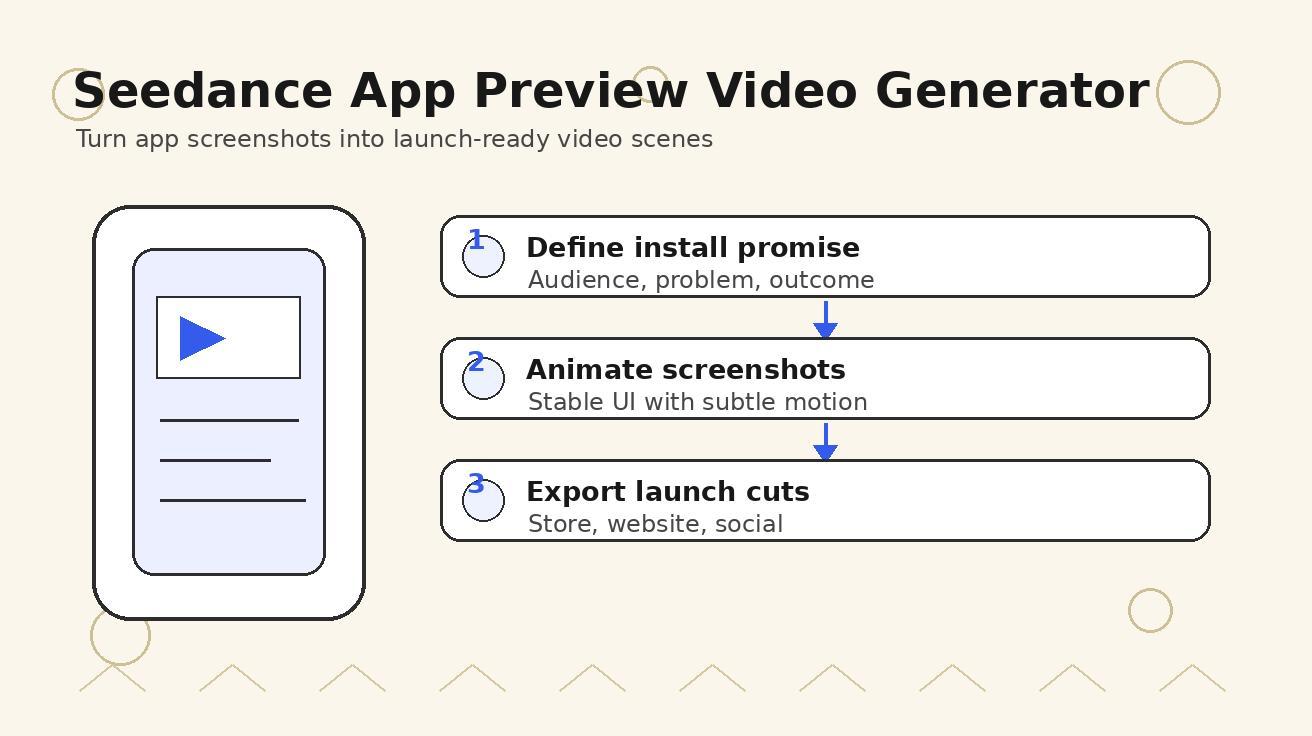
Seedance App Preview Video Generator 2026: Create App Store and Product Launch Clips
Use Seedance to turn app screenshots, feature copy, and launch goals into App Store previews, Google Play promo videos, and product launch clips.
Read article
PixVerse Lip Sync API Tutorial: Upload, Generate, Poll, and Review
A practical PixVerse lip sync API workflow covering source video IDs, audio upload or TTS, request payloads, asynchronous polling, and quality review.
Read article
OpenArt Consistent Character Video Tutorial: Keep One Person Across Scenes
Build one OpenArt character, prepare reference angles, animate short shots, and review or repair face and wardrobe drift across a video sequence.
Read article