
You've probably got the same brief a lot of creators get now. A launch video is due tomorrow, the budget won't stretch to a full shoot, and you still need something that looks organised, intentional, and native to modern feeds. That's where a solid how to vid workflow matters. Not generic text-to-video tricks. A repeatable process that turns one idea into a polished sequence with continuity, movement, and usable 1080p output.
The difference between amateur AI video and work people publish usually comes down to direction. Most weak outputs aren't caused by the model. They're caused by vague prompting, poor shot planning, and zero continuity strategy. Once you start thinking in shots instead of prompts, results improve fast.
From Text Prompt to Cinematic Video in Minutes
A lot has changed for UK creators and marketing teams. The UK Artificial Intelligence in Media Market is projected to grow from USD 0.33 million in 2024 to USD 4.74 million by 2032, with a 34.6% CAGR, driven by generative AI tools that automate video production and personalise content, according to Credence Research's UK AI in media market report. That matters because video creation is no longer a specialist bottleneck. It's becoming a normal production skill.
For practical work, the shift is simple. You no longer start by booking crew, locations, and edit time for every concept. You start with a text prompt, a shot plan, and a clear output goal. If the video is for a product launch, landing page, social ad, course trailer, or property listing, the process can begin with one sentence that defines the scene, subject, action, and mood.
Start with the deliverable, not the tool
Most creators lose time because they open a generator before answering three basic production questions:
- Where will this video live. Website hero, paid ad, Reels, Shorts, email, or presentation.
- What must the viewer understand. Product benefit, atmosphere, transformation, testimonial feel, or story beat.
- What does one finished scene need to do. Establish a setting, show the product, reveal a change, or transition to the next shot.
That thinking keeps the output useful. If you need ad-ready creative, it also helps to review how teams structure hooks, pacing, and visual emphasis. I'd recommend reading AdStellar AI's video ad insights before you generate anything, because ad footage fails for different reasons than cinematic footage. Ads need immediate clarity.
What a strong first prompt actually does
A good prompt gives the model a directorial brief, not a vague idea. It should answer:
- Who is on screen
- Where they are
- What they're doing
- How the camera sees it
- What the light feels like
- What visual style you want
Practical rule: if your prompt could also describe a still image, it's probably too weak for video.
Use the first generation to prove the concept, not to perfect it. Generate one anchor shot. Check framing, motion, and realism. Then build outward into a sequence. If you want a better sense of how 1080p generation fits into that workflow, the Seedance 2.0 1080p overview is a useful technical reference.
The fastest path to a polished video is rarely “type one clever line and hope”. It's shorter, sharper iterations built around planned shots.
Foundations for a Flawless AI Video
Before writing any prompt, lock the production frame. Many otherwise successful AI videos falter at this stage. The model may generate attractive footage, but if the aspect ratio, style choice, and movement assumptions don't match the intended use, the result won't survive editing.

Choose the frame before the scene
Start with aspect ratio. Don't treat it as a formatting detail. It changes composition.
| Format | Best use | What changes in prompting |
|---|---|---|
| 9:16 | Reels, Shorts, TikTok, mobile ads | Keep the subject centred, specify vertical composition, avoid wide environmental detail |
| 16:9 | YouTube, landing pages, presentation screens | You can use wider establishing shots, lateral movement, and more layered backgrounds |
| 1:1 | Feed ads, some social placements | Prioritise medium shots and uncluttered foreground action |
A renovation reveal in 9:16 needs “front-facing camera angle, subject centred, doorway aligned vertically”. The same idea in 16:9 can support “wide static interior shot, kitchen island left frame, window wall right frame”.
Pick one visual language and stay with it
Style libraries are useful, but they tempt people into inconsistency. If your first shot is photorealistic with natural daylight and your second has glossy cyberpunk contrast, the edit will feel stitched together even if the subject matches.
Use style as a production decision:
- Photorealistic works for property, product demos, testimonials, and corporate explainers.
- Illustrative or stylised suits education, concept pieces, mood films, and social storytelling.
- High-contrast cinematic can work for trailers, but often looks too dramatic for practical commercial use.
The safest professional choice is usually less style, not more. Let composition and motion carry the scene.
This accessibility is one reason adoption has spread beyond large teams. Computer vision and image-processing technologies are used by 85% of UK organisations, while small businesses show 50% adoption of AI video tools and SMEs reach 68% usage, according to Vention's UK AI adoption statistics. That doesn't mean every output is good. It means the barrier to trying is low, so the advantage comes from workflow discipline.
Build a mini brief before generating
I use a short pre-prompt checklist:
- Audience fit. Is this meant to feel premium, fast, warm, luxurious, technical, playful, or documentary?
- Shot role. Is it an opener, product detail, emotional beat, or ending reveal?
- Motion type. Static, slow push-in, tracking, pan, handheld feel.
- Edit compatibility. Will this cut cleanly against the next shot?
A practical example helps. If the concept is “new candle brand launch”, don't start with “beautiful candle on a table”. Start with something like: product hero, soft morning light, creamy neutral palette, shallow depth of field, slow dolly-in, premium lifestyle ad feel, 16:9.
That groundwork saves far more time than rewriting bad prompts later.
Crafting Your Story One Perfect Prompt at a Time
A useful how to vid habit is to stop thinking in keywords and start writing like a director giving notes to a camera operator, set designer, and editor at once. Prompts work best when they describe a moving scene with visual priorities.

Weak prompt versus strong prompt
Here's a weak prompt:
A man walks in a forest.
It gives a subject and an action. That's it. The model has to invent age, wardrobe, pace, weather, framing, light, mood, terrain, and camera movement. You might get something usable, but you won't get something repeatable.
Here's the stronger version:
Elderly man with a grey beard wearing a worn tweed jacket walks slowly through a misty pine forest at dawn, soft golden light breaking through the canopy, low-angle tracking shot focused on muddy boots and measured steps, cinematic realism, cool atmospheric fog, subtle depth of field.
The stronger prompt works because it supplies six things at once:
- Character identity through age, beard, and wardrobe
- Action quality through “walks slowly” and “measured steps”
- Location detail through pine forest, mist, mud
- Lighting through dawn and golden light
- Camera instruction through low-angle tracking shot
- Aesthetic target through cinematic realism
A repeatable prompt formula
Use this framework when drafting scenes:
| Prompt element | What to include | Example |
|---|---|---|
| Subject | person, object, environment | young chef in white apron |
| Action | what changes over time | plates a dessert carefully |
| Setting | place and texture | modern restaurant kitchen with brushed steel counters |
| Camera | framing and movement | medium close-up, slow push-in |
| Light | time, source, mood | warm overhead light with soft reflections |
| Style | realism or stylisation cue | polished commercial food video |
That formula is enough for most professional scenes.
Prompt for action, not just appearance
A common mistake is over-describing static details while ignoring motion. If the shot should feel alive, specify how people and objects move.
Better:
- “steam curls from the cup as she lifts it”
- “curtains flutter lightly in the breeze”
- “camera glides from the hallway into the open kitchen”
Worse:
- “nice kitchen, pretty room, modern style”
Those adjectives don't tell the model what the shot should do.
Write verbs first. Nouns support the scene, but verbs make it behave like video.
For creators refining shot language, the Seedance 2.0 prompt guide is a useful reference for structuring detailed instructions.
One commercial example
Say you need a skincare launch clip.
Bad prompt:
- “A woman uses moisturiser in a bathroom.”
Better prompt:
- “Woman in her early thirties applies moisturiser in a bright minimalist bathroom, natural morning window light, close-up on hands smoothing cream across cheek, clean marble surfaces softly blurred in the background, premium beauty advert, gentle camera push-in, realistic skin texture.”
That prompt doesn't just describe a woman and a product. It controls brand feel. It tells the model that this is premium, clean, intimate, and commercially usable.
Weaving a Narrative with Multi-Shot Storytelling
Single clips can look impressive and still be useless. The moment you need a sequence with setup, action, and payoff, continuity becomes the essential craft. Many creators often struggle with this. They can generate one nice moment, but the character changes, the room shifts, and the story falls apart.

Build the story from anchor details
For multi-shot work, define the essential elements before writing any scene:
- Character anchor. Hair colour, clothing, age range, standout feature.
- Location anchor. Room type, colour palette, major objects, time of day.
- Mood anchor. Calm, urgent, premium, nostalgic, documentary.
- Lens logic. Wide first, then medium, then close, or any pattern you choose.
If those anchors drift, the sequence won't cut together cleanly.
A simple three-shot example works well for practice. Use one location and one action chain.
Example sequence with continuity
Try this narrative:
Shot 1
Wide shot of a tidy home office in late afternoon, woman with copper-red hair in a cream knit jumper enters frame from the left, wooden desk by the window, laptop open, soft rain visible outside, cinematic realism.
Shot 2
Medium shot of the same woman at the same desk, she places a notebook beside the laptop and switches on a brass desk lamp, warm glow spreads across the desk, calm focused mood.
Shot 3
Over-the-shoulder shot from behind the same woman as she looks at the lit workspace and begins writing in the notebook, rain streaks on the window, shallow depth of field, gentle push-in.
The reason this works is that every shot repeats the same anchors. Same hair, same jumper, same desk, same weather, same room logic.
What actually keeps shots consistent
Most continuity problems come from changing too many variables at once. If you want the camera to change, keep the wardrobe identical. If you want the lighting to change, keep the composition similar. If you want a location shift, carry a recognisable object across shots.
A good sequence usually follows this pattern:
- Establish the space
- Focus on the action
- Reward the viewer with a detail or consequence
That's enough to make even a short promo feel intentional.
Keep a continuity note beside your prompt window. List hair, outfit, props, room palette, and weather. Copy those details into every related shot.
For a deeper look at linked scene generation, the Seedance multi-shot workflow guide is worth reviewing.
Use edits that the prompts can support
Not every generated shot should be asked to do everything. One shot can carry atmosphere. Another can carry product detail. Another can handle a reveal. If you overload every prompt with story, emotion, movement, and exposition, the sequence becomes muddy.
A useful pacing principle is to alternate between broader framing and more intimate framing. That gives the editor natural contrast.
Here's a visual example of how that rhythm helps storytelling in practice:
<iframe width="100%" style="aspect-ratio: 16 / 9;" src="https://www.youtube.com/embed/R5pB2DXLlmc" frameborder="0" allow="autoplay; encrypted-media" allowfullscreen></iframe>
A better way to draft multi-shot prompts
Instead of writing all prompts from scratch, create a master description first.
Master scene card
- Character: copper-red hair, cream knit jumper, calm expression
- Setting: home office, wooden desk, rain outside window, brass lamp
- Style: photorealistic, soft late afternoon tones
- Mood: quiet concentration
Then write each shot as a variation on that card. This gives you consistency without making every shot visually identical.
That's the move from clip generation to directed storytelling. You stop prompting random moments and start designing sequences that belong together.
Advanced Techniques for Professional Polish
The jump from decent AI footage to client-ready footage usually happens in the details. Motion, lighting logic, edit rhythm, and spatial consistency all matter. If one of those breaks, the viewer may not know why the video feels off, but they'll feel it.

Motion that looks directed, not accidental
Good prompts control movement in two layers. Subject motion and camera motion. If both are chaotic, the shot feels synthetic fast.
A cleaner approach is to pair one active element with one restrained element.
- Subject active, camera restrained. A chef moves quickly while the camera holds a medium static frame.
- Camera active, subject restrained. A product sits still while the camera performs a slow arc or push-in.
- Both subtle. Curtains move gently while the camera drifts forward.
Avoid stacking too many movement instructions in one sentence. “Pan, tilt, zoom, orbit, handheld” in a single prompt usually creates confusion.
Lighting and sound thinking before edit
Even if the generator is doing the image creation, you should still think like an editor. Ask what the cut wants. A soft-lit lifestyle shot cuts well into another soft-lit lifestyle shot. A harsh neon close-up may not.
Also, don't ignore sound planning. One of the most overlooked professional issues is audio-character consistency. A visually consistent character can still feel broken if the voice, tone, or delivery shifts between clips. In UK commercial work, that matters more than many tutorials admit, especially when a polished local accent is part of the brand feel.
Professional polish comes from continuity the viewer doesn't consciously notice.
Perspective locking for before-and-after transitions
This is the technique most tutorials skip, and it's one of the most commercially useful.
For renovation, interior design, product restoration, and property marketing, creators often want a smooth before-and-after transition. The usual mistake is generating a “before” and “after” from roughly similar prompts, then trying to force them together in the edit. That rarely works because the camera height, lens feel, and room geometry don't match.
The better method is perspective locking.
How it works
-
Generate the after-state reference first
Create the final renovated kitchen, bathroom, storefront, or room exactly as you want it framed. -
Study the visual geometry
Note eye level, vanishing lines, window placement, island position, floor direction, and object spacing. -
Prompt the before-state using the same perspective
Keep the camera angle, room layout, and composition identical. Change only the condition of the space. -
Edit the two shots as a transformation pair
Use a cut, morph, or timed dissolve once the perspective alignment is close.
Here's a concrete example.
After prompt
Bright renovated Victorian terrace kitchen, viewed from doorway at eye level, white shaker cabinets, oak flooring, brass handles, central island slightly left of frame, large rear window flooding the room with daylight, photorealistic property marketing style.
Before prompt
Unrenovated Victorian terrace kitchen, same doorway view at eye level, same room proportions, same rear window placement, dated dark cabinets, worn linoleum flooring, no island, muted daylight, photorealistic property marketing style.
The critical instruction is “same doorway view at eye level” plus the repeated room geometry. That creates the lock.
The relevance of the UK AI video market projected to hit $30.1B by 2026 is clear: many tutorials still skip the key step of generating identical-perspective reference images first, even though that's the technique Business of TV highlights in its discussion of AI video trends and Seedance Pro timelapse workflows.
For before-and-after videos, perspective locking does more than improve realism. It makes the transformation believable.
Your Questions on Responsible AI Video Creation Answered
Powerful creation tools need clear guardrails. If you work in the UK, responsible use isn't just about being careful. It's about staying inside legal boundaries that are becoming more explicit.
Can I generate people freely if the video is fictional
No. You need to think about consent, likeness, and harm. The clearest red line is intimate synthetic media. In the UK, creating or requesting the creation of AI-generated intimate images without consent became a criminal offence from 6 February 2026, as outlined in VinciWorks' explanation of the new UK deepfake law. For creators, the practical rule is simple. Don't generate non-consensual sexual or intimate content involving real people, or anything intended to imitate that scenario.
What about style copying and artist likeness
This is getting tighter too. The UK government is proposing a right to personality mechanism that would let artists license their styles or likenesses for compensation, or exempt their work from training entirely, according to Artnet's reporting on the proposed UK right to personality review. That's still a proposal, but it points in one direction. Don't build commercial work around “make this look exactly like a living artist's unmistakable style” if you can avoid it.
Can AI systems train on copyrighted work in the UK
Only in specific circumstances. Under the UK consultation position, AI developers can train on copyright-protected works only if they hold an express licence, unless the right holder has not reserved their rights. The practical guidance is in the UK government's consultation on copyright and artificial intelligence. If you're a creator, reserve your rights where available. If you're commissioning work, keep a record of the assets and references you used.
What standards should creators expect from AI video tools
The UK's AI White Paper sets out five principles that regulators must apply through sector-specific guidance: safety, security and reliability; appropriate transparency and explainability; fairness; accountability and governance; contestability and redress. CMS summarises those UK AI principles in a way that's useful for practitioners. When choosing tools and workflows, look for systems and teams that can explain outputs, ownership, and review processes clearly.
A responsible workflow is straightforward:
- Use licensed or original source assets
- Avoid impersonation and non-consensual likeness generation
- Keep records of prompts, references, and approvals
- Review outputs before publishing, especially for realism-heavy work
That discipline protects both the creator and the client.
If you want to turn rough ideas into polished multi-shot 1080p videos without building a full production stack around every concept, Seedance is worth exploring. It's built for creators who need cinematic output, tighter continuity, and a faster path from prompt to publishable video.
Ready to try it yourself?
Put the steps from this guide into practice with Seedance and turn prompts or images into polished videos in minutes.
Free credits on signup. Plans from $28/month.
Related Articles
More posts in the same locale you may want to read next.
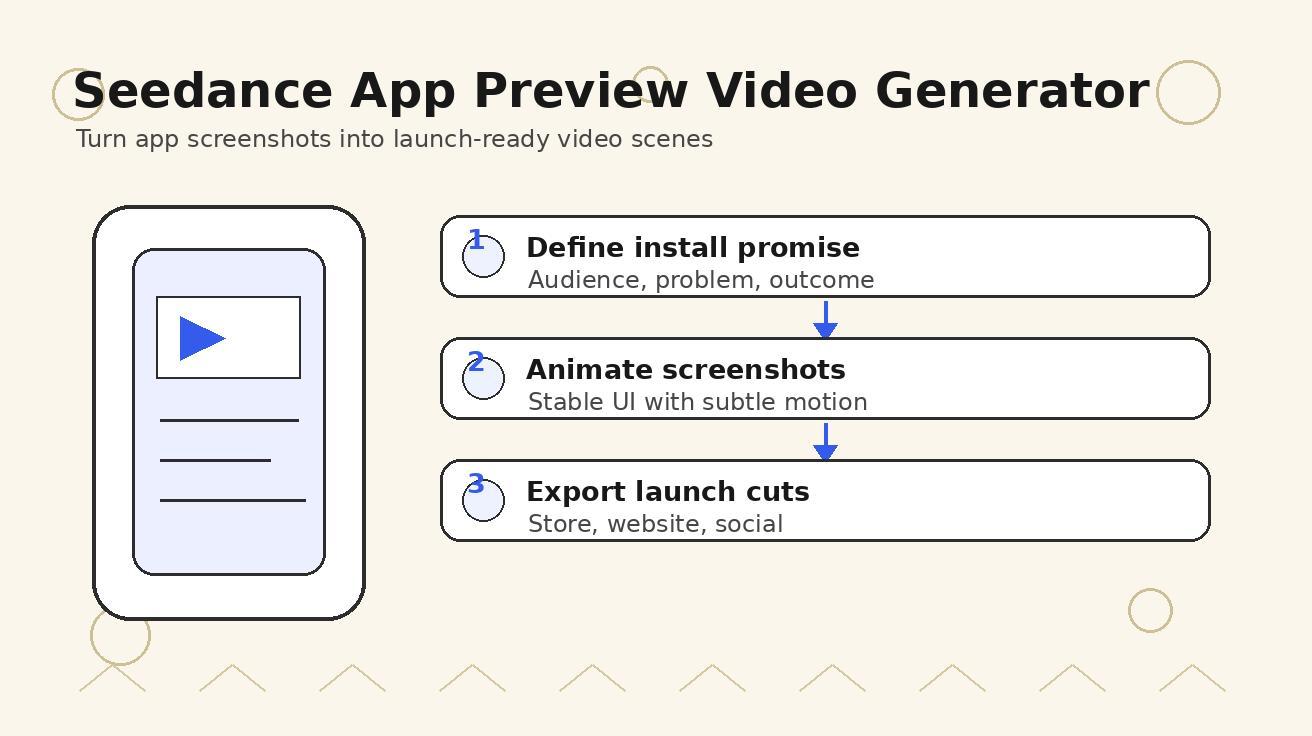
Seedance App Preview Video Generator 2026: Create App Store and Product Launch Clips
Use Seedance to turn app screenshots, feature copy, and launch goals into App Store previews, Google Play promo videos, and product launch clips.
Read article
Gemini AI Video Prompt Examples: Copy-Ready Veo Scenes and a Better Prompt Formula
Copy Gemini AI video prompt examples for cinematic motion, product ads, dialogue, and vertical clips, then adapt them with a practical Veo prompt formula.
Read article
How to Keep Product Shape Consistent in AI Video Ads
Lock product geometry, packaging, labels, references, camera angles, and approval checks so AI video ads preserve the real SKU across every shot.
Read article