
AI video is moving from experiment to everyday production. For small teams, that shift matters less as a headline and more as a budget and workflow change. A text to video creator can turn a written brief into a first cut of a campaign, product clip, or explainer without booking a shoot, hiring talent, or waiting on a full edit cycle.
For marketers, educators, filmmakers, and small business owners, the question is practical. How do you use a text to video creator in a way that saves time, protects your brand, and still feels human?
Many guides stop too early. They explain the novelty, then skip the parts that affect real commercial use: who owns the output, whether you can use it in paid campaigns, how to keep characters and tone consistent, and how to avoid generic visuals that feel imported from nowhere in particular. For a UK business, regional authenticity matters. A café in Manchester, a solicitor in Leeds, and a retailer in London should not all sound like the same internet demo.
A good text to video creator works like a compact production studio guided by language. You provide the brief, much like a creative director handing notes to a production team. The model translates those instructions into scenes, motion, style, and sometimes voice or sound. Then your role shifts from typing to directing: refining prompts, checking brand fit, and deciding whether the result is safe to publish.
That is also why tool choice matters. If you are comparing platforms, this guide to text to video AI tools for creative teams and businesses is a useful starting point.
The businesses getting results from AI video are not treating it as a gimmick. They are using it to test ideas faster, produce more versions for different audiences, and reduce the cost of early-stage production while keeping human review where it counts.
The New Creative Frontier From Text to Video
Video demand keeps rising, but time, budget, and production capacity do not rise at the same pace. That gap explains why text to video has moved from curiosity to working tool so quickly.
A text to video creator changes the first step of production. Instead of starting with cameras, locations, schedules, and edit rounds, you start with a written brief. The software then turns that brief into scenes, motion, style, and pacing. It works a bit like giving a production team a clear creative direction, then getting a draft back in minutes rather than days.
For businesses, the shift is not only technical. It is operational. Video becomes easier to test earlier in the process, before you commit money to a full shoot or lock a campaign into one visual direction. That changes how teams plan launches, pitch concepts, and fill content calendars.
The commercial value is easy to see.
A retailer can try three versions of a product story before choosing one for paid social. A training provider can draft short explainers without waiting for studio time. A local business can create region-specific creative that feels closer to its real audience, instead of publishing generic footage that could belong anywhere.
Practical rule: Use a text to video creator as a fast drafting and testing layer inside your workflow, then apply human review for brand fit, accuracy, rights, and local relevance.
That last part matters more than many guides admit. In business use, speed is only useful if the result is publishable. That means checking whether your platform allows commercial use, whether the visual style matches your brand, and whether the output feels authentic for the market you serve. A video for customers in Birmingham should not sound or look like a vague global stock ad.
What this changes for smaller teams
Small teams often have strong ideas and limited production bandwidth. Text to video helps by reducing the effort needed to get from concept to first draft.
- Campaign testing becomes cheaper: You can compare different hooks, scenes, or tones before paying for full production.
- Production risk drops: If a shoot is delayed or a concept is still uncertain, you still have a way to build visual drafts and keep momentum.
- Creative roles stretch further: A marketer, founder, or educator can produce a useful first version without needing a full crew for every experiment.
- Regional tailoring becomes more realistic: Teams can create variants for different cities, audiences, or offers without rebuilding everything from scratch.
If you are assessing platforms, this guide to text to video AI tools for creative teams and businesses helps compare how different products handle generation, editing, and workflow.
The broader change is simple. Text to video lowers the cost of trying ideas. For creators and businesses, that means more room to experiment, more chances to refine, and a better path from rough concept to usable commercial content.
How a Text to Video Creator Actually Works
A text to video creator works a lot like a film crew compressed into software. Your prompt acts as the script. The model reads it, interprets what should happen, and assembles a moving scene from that instruction.
That sounds magical until you break it down. Once you do, the process becomes much easier to direct.

The prompt is the brief
Think of the prompt as a production brief, not a keyword list.
“Make a coffee advert” is too vague. “A warm morning kitchen scene, close-up of a ceramic mug, sunlight through the window, slow camera push-in, calm premium feel” gives the model something it can stage. You're not only describing objects. You're describing mood, framing, pacing, and intent.
This is why prompting often feels closer to directing than typing.
The model plans scenes from language
Modern systems don't just match words to pictures. They try to infer what your words imply about space, movement, and sequence.
OpenAI says Sora can generate videos up to one minute long while maintaining high visual quality and close adherence to the prompt. That's possible because the model has a deep understanding of language and the physical world, which helps it simulate complex scenes with multiple characters and specific motion types.
In plain language, the system is trying to answer questions a human crew would ask:
- Where is the camera?
- What is moving?
- What stays consistent?
- How should the background behave?
- What style fits the script?
How images become motion
This is the part that often confuses people. A text to video creator doesn't make one image and slide it across the screen.
It generates a sequence of frames that need to feel connected. If one frame shows a red bicycle and the next frame shifts shape, colour, or angle without reason, the illusion breaks. Good video generation depends on continuity.
That continuity is often called temporal consistency. You don't need to remember the term. Just remember the effect. The character should still look like the same character from one moment to the next.
A strong prompt tells the model what should change and what must stay stable.
Why some outputs feel cinematic and others feel odd
The difference usually comes down to specificity and scope.
If you ask for too many dramatic actions, style shifts, and scene changes in one go, the result can feel unstable. If you define one scene clearly, then build from there, the output usually feels more coherent.
A practical way to think about it is this:
| Part of the prompt | What the model needs |
|---|---|
| Subject | Who or what is on screen |
| Setting | Where the scene happens |
| Action | What changes over time |
| Camera | How the viewer sees it |
| Style | The visual mood or aesthetic |
If you want a deeper walkthrough of prompt structure and generation flow, this guide to AI generated video from text gives useful examples.
The key idea is that the AI isn't “thinking” like a filmmaker, but it is performing many filmmaking tasks at once. It interprets your script, stages a scene, predicts motion, and renders a result. Your role is to give it clearer direction.
Key Benefits for Modern Creators and Businesses
The appeal of a text to video creator isn't only speed. It's control over production friction.
Traditional video work often breaks down in the same places. Budgets tighten. Schedules slip. One missing asset delays a launch. AI video doesn't solve every creative problem, but it removes a lot of production drag from early drafts, campaign variations, and repeatable content.

Speed changes the quality of decision-making
When teams can generate visual options quickly, they stop debating abstract ideas and start reacting to actual outputs.
A marketer can compare two creative directions for a product launch. An educator can test whether an animated explanation feels clearer than a talking-head format. A founder can build a first-pass product video before writing a full production brief.
That doesn't just save time. It improves feedback, because people respond better to something they can see.
Lower setup costs widen access
Video production used to have a steep starting cost in time, equipment, and specialist labour. Text to video tools lower that barrier.
For a solo creator, that means fewer blockers between idea and execution. For a small business, it means video no longer has to be reserved for the biggest campaign of the quarter. For internal teams, it means more room to experiment before paying for a full production run.
Creative range becomes easier to explore
A good text to video creator lets you try different tones without rebuilding everything from scratch.
You can ask for:
- A polished product mood: useful for a homepage hero section
- A playful social cut: better for short-form promotion
- A clean explainer style: ideal for tutorials or onboarding
That flexibility matters because one message often needs several formats. If you manage social channels, XBurst's guide to AI social media tools is a practical companion for connecting video creation with the broader publishing workflow.
Commercial safety isn't a side issue
This is the point many articles skip, and it's one of the most important for business users.
A 2025 UK Creativity Report notes that 68% of UK marketing professionals cite “legal uncertainty around AI content ownership” as their primary barrier to adoption. Adobe Firefly addresses this by stating that its model is “commercially safe” for business use, according to Adobe Firefly's UK AI video generator page.
If you're making content for a paying client, a brand campaign, or a business website, this matters more than a flashy demo. Before choosing any tool, ask basic rights questions:
- Can you use the output commercially?
- Does the provider explain training and licensing clearly?
- Can your legal or brand team review the terms easily?
Business takeaway: The right tool isn't only the one with the prettiest sample. It's the one your organisation can actually use with confidence.
Practical Use Cases Across Different Industries
The value of a text to video creator becomes clearer when you place it inside real working days rather than abstract feature lists.

Marketing teams shaping concepts before production
A UK agency gets a brief for a new retail campaign. Before anyone hires talent or scouts locations, the team drafts several AI-generated concept clips: one minimal and premium, one lively and youth-focused, one more cinematic.
That early visual testing is more useful now because models have improved. Meta's Movie Gen uses a 30-billion-parameter model to generate 16-second HD clips at 1080p, showing how quickly the field is moving towards professional-grade storytelling, as described in Quantumrun's overview of Make-A-Video and Movie Gen statistics. For agencies, that means AI outputs can support narrative exploration rather than just rough novelty clips.
Educators turning hard topics into visible stories
A history teacher wants to explain the atmosphere around a major political event. A science tutor wants to show a process that students struggle to picture. A text to video creator can turn those lesson ideas into animated sequences that make abstract material easier to follow.
The practical win isn't spectacle. It's clarity.
A teacher can draft a short scene, review whether the pacing works, and adjust the prompt until the explanation feels right. That makes the tool useful not only for public-facing content, but also for internal teaching materials, online modules, and classroom discussion prompts.
Students often understand a sequence faster when they can see change over time instead of reading about it as a static block of text.
Filmmakers using AI for pre-visualisation
Independent filmmakers often need to communicate tone before they have the budget to shoot. A text to video creator helps them build a proof of concept.
A director can sketch a night street sequence, a dream montage, or a transition idea to show collaborators what the scene should feel like. It won't replace a finished production. It gives everyone a shared visual reference earlier in the process.
That can help with pitches, mood alignment, and shot planning.
Small businesses making polished product videos
A local shop launching a new item doesn't always need a full production day. Sometimes it needs a short, clear video that explains what the product is, who it's for, and why it matters.
A candle brand, for example, might create:
- A homepage loop: soft lighting, slow motion, premium mood
- A social cut: quicker pacing and stronger text cues
- An explainer clip: key ingredients, use, and gift appeal
The point is not that every business should stop filming real products. It's that a text to video creator gives small firms another production lane when budget, time, or logistics are tight.
From Prompt to Production with Seedance
The most useful way to evaluate any text to video workflow is to see how it handles a real project from first idea to final output.
Start with the brief. Say you run a small online homeware shop and want a short launch video for a new lamp collection. You don't need a vague prompt like “make an advert”. You need something closer to a shot brief: a calm evening interior, soft amber light, modern flat, slow camera movement, focus on texture and mood, clean premium aesthetic.
That level of direction gives the model enough structure to build around.

Start with one scene, then think in sequences
Many first-time users try to cram an entire campaign into one prompt. That usually leads to clutter. A better approach is to create one strong scene, then expand.
For example:
- Establish the room and mood.
- Add a product-focused close-up.
- Introduce a movement cue, such as a slow pan or push-in.
- Build a second shot that complements the first.
Multi-shot storytelling is vital. Instead of treating each generation as an isolated clip, you want a workflow that can support connected scenes with consistent style and subject appearance.
One option built for this kind of process is Seedance 2.0's text to video workflow, which focuses on turning detailed prompts into 1080p video and supporting more structured scene creation.
Why cloud workflows matter
A lot of high-quality AI video discussion online implicitly assumes strong local hardware. That's a problem for schools, small businesses, and solo creators.
A primary bottleneck for quality AI video is VRAM. When local hardware can't handle the model properly, visual fidelity can drop, which is why cloud-based tools are often a more practical route for many users, as discussed in the ComfyUI community conversation about AI video hardware constraints.
In practice, cloud generation means you can focus on directing the output instead of building a machine for it. That's especially useful if your work is occasional, client-based, or tied to classroom use.
A simple production checklist
When you move from experimenting to publishing, this checklist helps:
- Define the job first: Is the video for awareness, explanation, sales, or internal training?
- Write for visuals: Mention setting, subject, movement, framing, and mood.
- Keep continuity in mind: If the same character or product appears across scenes, describe stable features clearly.
- Review rights and audio: If you add music or voice, make sure your usage is suitable for the channel and campaign.
If you're pairing generated visuals with soundtrack decisions, these resources for music royalty management can help you think through licensing and usage more carefully.
A quick product walkthrough helps make the workflow concrete:
<iframe width="100%" style="aspect-ratio: 16 / 9;" src="https://www.youtube.com/embed/khm2txDgLlo" frameborder="0" allow="autoplay; encrypted-media" allowfullscreen></iframe>
What good prompting looks like in business use
Compare these two prompts.
Weak version: “Create a nice video for my lamp brand.”
Stronger version: “Modern living room at dusk, warm ambient lamp light, close-up on brushed metal base and linen shade, slow cinematic pan, soft shadows, premium home design feel, suitable for a website hero video.”
The second prompt does three valuable things. It defines the environment, controls the tone, and hints at the delivery context. That gives the model clearer creative constraints.
Clear prompts don't restrict creativity. They replace randomness with usable direction.
For marketers and business owners, that's a significant shift. You're not just generating footage. You're learning how to brief visual systems with the same care you'd use for a designer, editor, or production partner.
The Future of Video and Your Role In It
Many anticipate the next leap in AI video will prioritize better visuals. Sharper motion. longer clips. More realism.
That will happen, but it misses a more important frontier. Authenticity.
For UK audiences, authenticity often means voice, phrasing, cadence, and regional feel. A polished video that sounds generically “international” can still feel wrong for a local brand. That gap is already visible. A 2026 UK Media & AI Trends Survey found that 74% of UK small business owners reject AI video tools that default to “American-neutral” voices, which points to a growing need for tools that support UK-specific accents and dialects, as noted on Synthesia's text to video feature page.
That should change how creators think about quality. It's not only about whether a model can animate a scene. It's whether the result sounds like your audience, reflects your market, and fits your brand context.
The next skill is taste, not just prompting
As tools improve, technical generation will become easier. Choosing what to make will become harder.
Creators who stand out won't be the ones who can type the longest prompt. They'll be the ones who know:
- Which stories deserve video
- What level of realism fits the message
- When a regional voice matters more than visual polish
- How to keep content commercially safe and creatively consistent
Text to video creation is still evolving. That's good news. It means users still have a chance to shape expectations. If enough brands demand local authenticity, safer rights frameworks, and better narrative control, the tools will move in that direction.
The best way to participate is to start making things now. Small experiments teach faster than passive reading. Write a brief. Generate a scene. Review what feels off. Adjust. That loop is where practical skill begins.
If you want a hands-on place to start, Seedance offers a way to turn written prompts into 1080p video inside a cloud-based workflow, which makes it useful for creators who want to test ideas without building a heavy local setup.
Ready to create your own AI video?
Turn ideas, text prompts, and images into polished videos with Seedance. If this article helped, the fastest next step is to try the product.
Free credits on signup. Plans from $28/month.
Related Articles
More posts in the same locale you may want to read next.
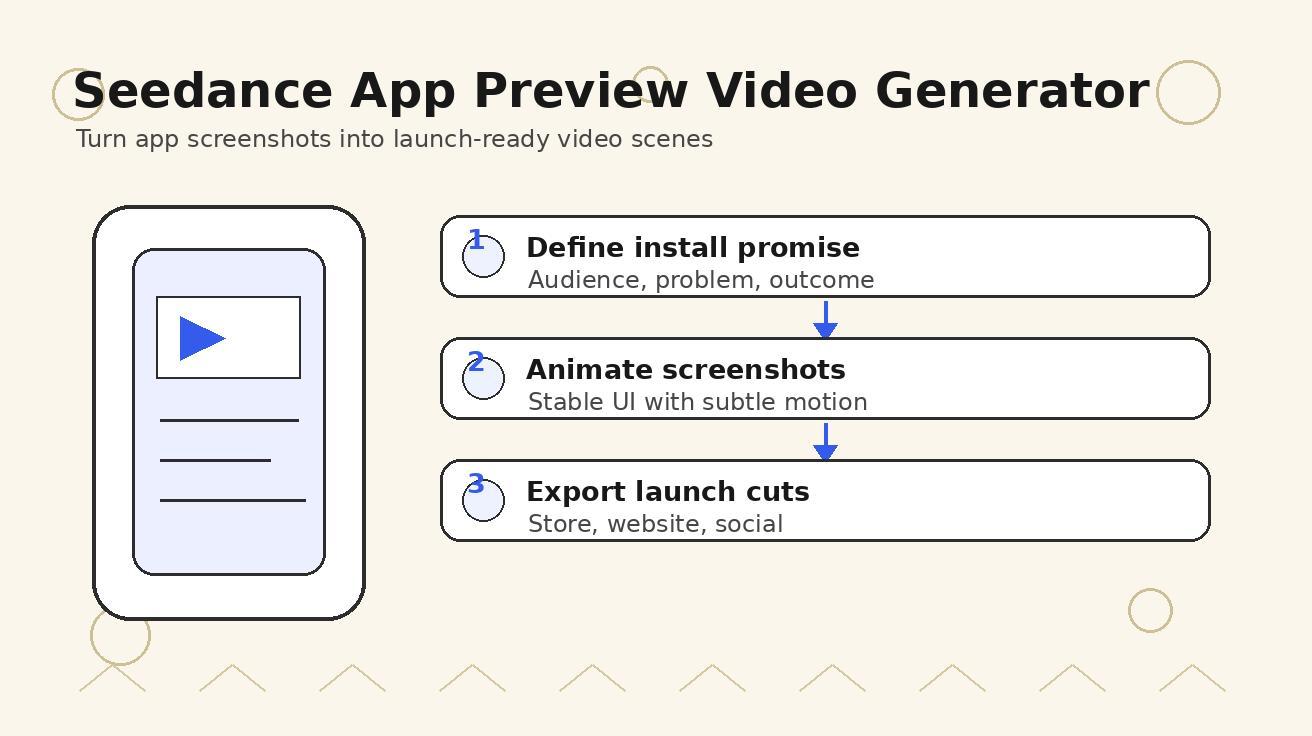
Seedance App Preview Video Generator 2026: Create App Store and Product Launch Clips
Use Seedance to turn app screenshots, feature copy, and launch goals into App Store previews, Google Play promo videos, and product launch clips.
Read article
Gemini AI Video Prompt Examples: Copy-Ready Veo Scenes and a Better Prompt Formula
Copy Gemini AI video prompt examples for cinematic motion, product ads, dialogue, and vertical clips, then adapt them with a practical Veo prompt formula.
Read article
How to Keep Product Shape Consistent in AI Video Ads
Lock product geometry, packaging, labels, references, camera angles, and approval checks so AI video ads preserve the real SKU across every shot.
Read article