
You've probably had this moment already. The idea is clear in your head. A launch film, a product teaser, a classroom explainer, a moody brand piece. Then the usual barriers show up: crew, gear, locations, editing time, revision loops, and a budget that turns a simple concept into a planning problem.
That's why more creators now want to create moving images directly from text, then shape them into something that feels directed rather than randomly generated. The shift isn't just about speed. It's about getting from concept to first draft while the idea still has heat.
The New Wave of Digital Storytelling
Traditional production still has a place. If you need a live-action performance with exact blocking, a real set, and full legal clearances on every frame, a shoot is still the cleanest route. But for concept films, short-form marketing, internal comms, pre-visualisation, and social campaigns, AI video has changed the maths.

In the UK, text-to-video accounts for 46.3% of all AI video creation methods as of January 2026, monthly active users across UK AI video platforms surpassed 3.2 million, representing a 215% year-over-year increase from 2025, and 68% of UK marketing professionals increased video output frequency by 3.5x. Those figures show this isn't fringe experimentation any more. It's active production behaviour in a market that has moved fast.
What changed in practice
The useful change isn't that anyone can type a sentence and get a perfect film. That still doesn't happen. The useful change is that creators can now build visual drafts quickly, test multiple directions, and reserve traditional production for the parts that require it.
A few workflows benefit immediately:
- Property marketing: Teams can mock up neighbourhood mood films and listing visuals quickly. If you work in that space, this guide to AI-powered real estate videos is a practical example of where AI video fits without replacing every part of the sales process.
- Brand content: Short loops, teaser edits, and stylised product stories are now viable even for lean teams.
- Education and training: Instructors can turn scripts into visual lessons without arranging full shoots.
Practical rule: AI video works best when you treat it like a fast visual department, not a magic button.
The strongest results come from people who already understand sequence, pacing, framing, and audience response. The software gives access. Direction still gives meaning.
If you need a useful companion idea for framing scenes with intent, Seedance's article on visual storytelling is worth reading because the quality jump usually comes from story logic, not from adding more adjectives to a prompt.
From Big Idea to First Frame
The fastest way to get unusable output is to open a generator before you've made creative decisions. Good AI video starts the same way a proper shoot starts. You decide what the scene is about, what the audience should feel, and what must stay consistent from shot to shot.
Start with story pressure
Don't begin with style. Begin with the moment.
Ask these questions on paper first:
- What changes in the scene? A character discovers something, chooses something, loses something, enters somewhere.
- What should the viewer feel? Unease, excitement, warmth, urgency, curiosity.
- What must the audience remember afterwards? The product, the character, the reveal, the setting.
That gives you a narrative spine. Even a ten-second clip needs one.
Build a small director's brief
I keep this compact. One line for the idea, one line for the mood, one line for the visual language, one line for the character.
| Element | Working note |
|---|---|
| Core beat | A young founder enters a quiet studio before dawn and switches on the first prototype |
| Mood | Focused, tense, hopeful |
| Visual style | Photoreal, cool tones, soft practical lights, restrained camera movement |
| Character | Mid-30s, understated wardrobe, calm but tired, precise gestures |
This is enough to stop the prompt from drifting.
Make a shot list before you prompt
A lot of weak AI videos come from trying to describe an entire mini-film in one generation. Break it into shots instead.
For example, if you're creating a startup brand opener:
- Shot 1 shows the exterior or room, enough to establish place.
- Shot 2 moves closer to the person and the object that matters.
- Shot 3 captures the emotional beat, often with a close-up or reaction.
A clear three-shot plan will outperform a vague paragraph almost every time.
Use mood words that are visual
“Powerful” and “creative” aren't visual directions. “Rain-soaked pavement”, “cold fluorescent office light”, “handheld tension”, and “shallow depth of field” are.
Try a practical mood board using simple text clusters:
- Urban future: reflective glass, magenta signage, wet streets, distant traffic haze
- Heritage craft: oak workbench, window daylight, dust in air, natural fabric, slow camera
- Children's education: bright classroom, rounded shapes, gentle movement, warm palette
The point isn't to sound clever. It's to give the model a coherent visual field to work inside. When people struggle to create moving images that feel cinematic, the issue usually starts here. The prompt is trying to invent the film because the director didn't.
Writing Prompts That Direct Your AI Cinematographer
A strong prompt does three jobs at once. It tells the model what exists in frame, how the camera behaves, and what kind of light shapes the scene. If one of those jobs is missing, the output often looks generic even when the image quality is decent.

The anatomy of a usable prompt
A prompt should usually include these parts:
-
Subject
Who or what is on screen? Be specific enough to anchor identity. -
Action
What happens physically? Walking, turning, placing an object, glancing up, opening a door. -
Setting
Where are we? Futuristic underpass, narrow Victorian hallway, modern clinic reception. -
Composition
Wide shot, medium shot, over-the-shoulder, close-up, low angle. -
Camera motion
Slow push-in, lateral tracking, locked-off frame, handheld drift. -
Lighting
Golden hour sidelight, harsh overhead office lighting, neon backlight, soft window fill. -
Style and texture
Photoreal, anime-inspired, analogue grain, polished commercial finish, muted palette.
A weak prompt and a better one
Weak version:
Woman in a city walking, cinematic, futuristic.
Better version:
Medium-wide shot of a woman in a charcoal trench coat walking through a futuristic London side street at night, wet pavement reflecting blue and magenta signage, camera tracks alongside her at a steady pace, she turns her head towards a glowing shop window, soft atmospheric haze, cinematic photoreal style, controlled motion, realistic fabric movement, shallow depth of field, cool colour grade.
That second version gives the model decisions instead of hopes.
Why longer prompts often work better
Action matters more than many users realise. Action Recognition Score metrics show 89% correct portrayal of requested motions only when prompts exceed 50 tokens with explicit motion descriptors according to this technical overview of model prompting and motion performance.
That lines up with what works in production. If the motion is important, spell it out. “Walks confidently” is weaker than “walks at a measured pace, left shoulder slightly forward, coat hem moving in the wind, camera tracks from right to left”.
For a deeper prompt breakdown, the AI video prompt guide is useful because it pushes beyond single-line prompts into more controllable structure.
Negative prompts and motion control
Negative prompts are useful when the model keeps introducing repeated errors. I use them to suppress issues like extra fingers, warped objects, random background faces, unstable lighting changes, or unwanted text overlays.
A simple practical pair looks like this:
- Main prompt: close-up of ceramic cup placed on wooden counter, barista hand enters frame, warm morning light, gentle rack focus
- Negative prompt: no extra hands, no logo distortion, no background crowd, no flickering reflections, no exaggerated steam
Field note: If motion looks vague, add verbs and body mechanics before you add more style language.
That one change usually improves output more than piling on aesthetic references.
Crafting a Cohesive Narrative with Multi-Shot Sequences
A single generated clip can look impressive and still fail as a story. The harder job is carrying one character, one world, and one emotional rhythm across several shots without everything mutating in between.

The common break point is character drift. Hair changes, clothing changes, face structure shifts, and the environment restyles itself between scenes. In UK AI video generation, 28% of small business owners fail to achieve character consistency across 3+ scenes due to inadequate first-last-frame control, while reference-to-video methods reduce that failure rate from 28% to 9% when explicitly enabled. That's the production problem to solve.
A three-shot example that holds together
Use one visual identity sheet before you generate anything. Mine usually includes:
- character age range
- wardrobe anchors
- hair and facial markers
- palette rules
- environment rules
- camera language rules
Then I build the sequence.
Shot 1
Establishing wide shot. A woman crosses a futuristic city plaza at dusk. Glass towers, wet ground, muted teal signage, slow lateral camera move.
Shot 2
Mid-shot. Same woman stops at a kiosk and lifts a translucent device. Same trench coat, same hairstyle, same dusk palette, same city materials, camera slightly closer and lower.
Shot 3
Close-up. She reacts to a message on the device. Reflected city light on face, shallow depth of field, background bokeh echoes the signage colours from the first shot.
The trick is obvious but often skipped. Repeat the identity anchors in every shot. Don't assume the model remembers.
What to lock and what to vary
You need consistency, but not uniformity. Lock these:
- Character markers: clothing, hair, age cues, accessories
- World rules: architecture, palette, weather, time of day
- Visual treatment: realistic, stylised, glossy, gritty
Vary these:
- shot size
- camera distance
- action beat
- emotional intensity
For multi-scene workflows, Seedance 2.0 multi-shot is one example of a setup built around carrying narrative continuity across shots.
A working reference helps. This clip shows the kind of sequencing logic worth studying before you generate your own:
<iframe width="100%" style="aspect-ratio: 16 / 9;" src="https://www.youtube.com/embed/-PhU3VFMkK4" frameborder="0" allow="autoplay; encrypted-media" allowfullscreen></iframe>
Practical fixes when continuity slips
If scene two drifts, don't regenerate the whole sequence immediately. Start narrower.
Try this order:
- Reassert the subject first by repeating fixed character descriptors.
- Reassert the frame relationship such as “same character, same wardrobe, same environment”.
- Reduce visual noise by cutting extra style terms that may be pulling the output elsewhere.
- Use an end-frame or reference frame when the tool supports it.
I've found that multi-shot storytelling gets better when the prompts behave like a shooting script. One scene establishes. The next scene develops. The third scene pays off. That's how you create moving images that feel intentional instead of merely animated.
Polishing Your AI-Generated Film for Export
Generation is the draft. Post-production is where the work becomes watchable.
The most common quality issue is stability. 34% of UK content creators cite temporal flickering as their most frequent pitfall, according to Lambda Films' write-up on AI video production and temporal flickering. In plain terms, parts of the image pulse or shift in brightness when they should stay stable.
A simple QC pass
Review every clip for these problems before export:
- Temporal flickering: check walls, skin tones, tablet screens, and any smooth background.
- Object integrity: hands, jewellery, cups, buttons, and product edges often reveal the fakery first.
- Physics drift: fabric, smoke, reflections, and walking cycles can lose credibility fast.
- Frame continuity: make sure cuts don't jump in colour temperature or apparent time of day.
Don't watch the first pass for story alone. Watch it once with the sound off and look only for defects.
When to regenerate and when to edit around it
If the issue sits in the background for a second and the main action holds, you can often cut around it. If the subject's face flickers, the hand count changes, or the product deforms, regenerate the shot. Those errors don't become less visible after export.
There's a useful parallel in 3D and product visualisation. This overview of mattress rendering process stages shows the same core truth: polished output depends on structured review, not just generation.
For delivery, export at 1080p when the platform supports it, then tailor the aspect ratio to the destination. Social placements, web headers, decks, and paid ads all punish different mistakes. A beautiful shot in the wrong crop still fails.
Advanced Tips and Responsible AI Creation

Once the fundamentals are stable, the gains come from subtle control. Small changes in camera language can make AI output feel directed rather than generated.
Advanced moves worth testing
-
Use restrained camera verbs
“Slow push-in” and “gentle lateral track” usually hold up better than overcomplicated motion requests. -
Prompt transitions emotionally
If shot one is distant and observational, let shot two become more intimate. The sequence feels edited with intent. -
Tune one variable at a time
If colour, lens feel, framing, and motion all change between versions, you won't know what improved the result.
One body section where it makes sense to mention a tool is here. Seedance can be used for text and multi-shot video generation when you need to carry a narrative across linked scenes, but the same directing discipline applies regardless of platform.
The legal line in the UK
Responsible creation isn't an optional extra. In the UK, creating or requesting the creation of AI-generated intimate images without consent became a specific criminal offence under Section 66D of the Sexual Offences Act 2003 as of 6 February 2026, and the law targets the act of creation itself, as outlined in this summary of the UK deepfake offence.
That means creators need hard internal rules.
- Get consent before likeness-based work if a real person is identifiable.
- Avoid imitation prompts tied to living artists or recognisable IP unless you have a clear right to do it.
- Label AI-generated outputs clearly where transparency matters, especially in commercial and institutional contexts.
Responsible AI practice protects the subject, the client, and the creator at the same time.
The people who build sustainable workflows are the ones who pair technical skill with judgement. That's what keeps AI video useful instead of risky.
If you want to put this into practice, start with a short three-shot sequence and test it in Seedance. Keep the story simple, lock your character details early, and treat each prompt like a directing note rather than a wish.
Ready to try it yourself?
Put the steps from this guide into practice with Seedance and turn prompts or images into polished videos in minutes.
Free credits on signup. Plans from $28/month.
Related Articles
More posts in the same locale you may want to read next.
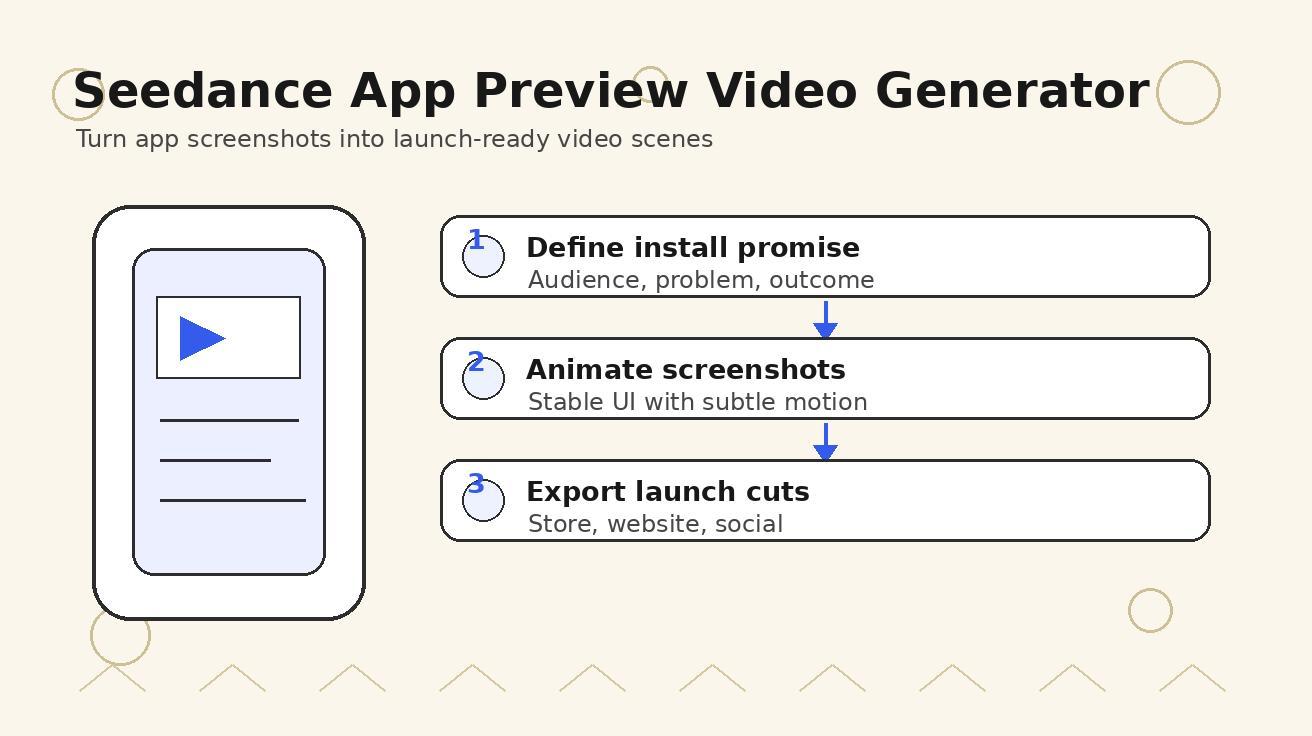
Seedance App Preview Video Generator 2026: Create App Store and Product Launch Clips
Use Seedance to turn app screenshots, feature copy, and launch goals into App Store previews, Google Play promo videos, and product launch clips.
Read article
Gemini AI Video Prompt Examples: Copy-Ready Veo Scenes and a Better Prompt Formula
Copy Gemini AI video prompt examples for cinematic motion, product ads, dialogue, and vertical clips, then adapt them with a practical Veo prompt formula.
Read article
How to Keep Product Shape Consistent in AI Video Ads
Lock product geometry, packaging, labels, references, camera angles, and approval checks so AI video ads preserve the real SKU across every shot.
Read article