
You've probably done this already. You had a strong idea for a video, maybe a product story, a lesson intro, a social ad, or a short film scene. Then the practical questions arrived. Who's filming it? What location fits? How do you light it, edit it, add motion, keep the character looking the same, and still publish on time?
That's the moment many ideas die. Not because the story is weak, but because the workflow is heavy.
A Video Text Creator changes that equation. Instead of starting with cameras, footage, and a timeline, you start with language. You describe the scene, the action, the mood, the pacing, and increasingly, the shot sequence itself. That shift matters. It turns video creation from a production problem into a storytelling problem, which is where many creators do their best thinking.
The most important change isn't that AI can generate a clip. It's that advanced tools can now help shape multi-shot narrative video. That's a different category. It moves the technology away from novelty visuals and towards something much closer to filmmaking.
The End of the Traditional Video Workflow
Lena runs marketing for a small brand. She wants a launch video that opens on a rainy street, cuts to a close-up of a product in use, then ends with a bright lifestyle scene and a simple call to action. On paper, it sounds manageable.
In the old workflow, it rarely is.
She needs a concept, script, shot list, gear, a location, someone to operate the camera, someone to edit, and enough time to revise the final cut when the first version doesn't match the original idea. If one piece slips, the whole project slows down. Many creators know this feeling. A video idea can be excellent and still never get made because the process around it feels too expensive, too technical, or too slow.
That's why the rise of the Video Text Creator feels less like another app and more like a workflow reset. You're no longer forced to build the entire production stack before testing an idea. You can describe what you want, generate a first version, see what works, and refine from there.
Why the old process blocks good ideas
Traditional production asks you to commit early. You often need to decide on visual direction before you've seen anything on screen. That's hard if you're a solo creator, a teacher making course content, or a business owner trying to publish consistently.
A text-led workflow lowers that barrier.
- You can test ideas quickly before booking people or buying assets.
- You can explore tone visually without mastering editing software first.
- You can build from story first, not from equipment first.
A lot of abandoned video concepts weren't bad ideas. They were ideas trapped inside a difficult process.
If you've been working with scripts, blog posts, ad copy, or lesson plans, this shift will feel familiar. It's the same reason text tools became useful for writers. Clear language becomes the input, and the machine helps produce the first draft.
For creators who want to see how text and video increasingly work together, Seedance has a useful overview of video and text workflows that reflects this broader change in production thinking.
Demystifying the Video Text Creator
The easiest way to understand a Video Text Creator is to stop thinking of it as editing software. It behaves more like an AI film crew.
You bring the brief. The system interprets it.
If you write, “A tired chef closes a small restaurant at night, flicks off the lights, then smiles at a final takeaway order on the counter,” you're not adding text onto existing footage. You're asking the tool to construct a visual scene from meaning. It has to infer setting, lighting, framing, movement, and emotional tone from your words.

Think in roles, not code
A helpful analogy is this:
| Role in a film crew | What the Video Text Creator does |
|---|---|
| Director | Interprets your intent, mood, and scene instructions |
| Cinematographer | Chooses visual framing, motion, and perspective from the prompt |
| Production designer | Builds the look of the environment, props, and atmosphere |
| Editor | Shapes pacing and transitions in the generated result |
That's why prompt writing matters so much. Your text isn't just a caption. It's a hybrid of script, shot brief, and creative direction.
How a prompt becomes a scene
The process feels technical under the hood, but the practical version is simple:
-
You describe the scene
Include subject, setting, action, style, and mood. -
The model maps language to visual elements
It connects words like “foggy”, “handheld”, “warm café light”, or “slow reveal” to likely visual patterns. -
It assembles motion and composition
Rather than giving you a static image, it creates a moving sequence with timing and continuity. -
You review and refine
You adjust the prompt the same way a director would revise a brief after seeing dailies.
Where readers often get confused is here. They assume a Video Text Creator works like slideshow software with fancy automation. It doesn't. The more advanced systems are trying to generate the entire visual narrative, not decorate pre-existing media.
Practical rule: write prompts like you're briefing a human crew that needs clarity, not like you're typing search keywords.
For example, compare these two prompts:
-
Weak prompt
“Coffee shop video ad” -
Stronger prompt
“Morning coffee shop scene, soft natural light through front window, barista pouring latte art, close-up on cup, then wide shot of customers chatting, warm cinematic style”
The second one gives the system much more to work with. It introduces mood, action, shot variety, and visual texture. That's where better results usually begin.
Key Features That Unlock Creative Potential
The difference between a toy and a serious storytelling tool often comes down to features that support continuity, control, and sequence. A basic generator can make a striking clip. A stronger Video Text Creator can help you build a scene that develops across shots.

Multi-shot storytelling
This is the big leap.
Older AI video tools often felt like they were built for isolated moments. You could generate “a robot walking through neon rain” and get something visually interesting, but the result often behaved like a single moving postcard. It looked good, yet didn't really progress.
Multi-shot storytelling changes that. You can prompt for a sequence that opens wide, cuts closer, shifts angle, and advances the action.
Consider the before and after:
-
Before
You needed stock clips, manual editing, and a strong sense of timeline structure just to test a short narrative. -
After
You can prompt a mini-sequence such as:
“Opening wide shot of a deserted beach at dawn, cut to a runner tying laces, then side tracking shot as they sprint along the shore, reflective and cinematic mood.”
That's filmmaking logic. Not just clip generation.
Character consistency
Many readers hear “AI video” and immediately think of one major weakness. The person changes from shot to shot. Hair shifts. Clothes drift. Facial structure softens or morphs. The scene becomes unusable for storytelling.
That's why character consistency matters so much. If your main subject stays recognisable across multiple scenes, you can create ads, explainers, and dramatic sequences that feel intentional rather than stitched together.
A practical example:
-
Without consistency
A teacher character in an explainer starts in one classroom and appears as a different person in the next shot. -
With consistency
The same teacher can point to a map, walk through a corridor, and appear again in a closing scene while preserving visual identity.
For narrative work, that continuity is often the difference between “interesting experiment” and “usable production asset”.
Style control
A modern Video Text Creator should let you dial in aesthetics with precision. Style is not decoration. It's part of meaning.
A prompt can ask for:
- Photorealism for a product demonstration
- Animated softness for a children's lesson
- Cyberpunk visuals for a music teaser
- Documentary naturalism for a social campaign concept
Style works best when it supports the story. A cyberpunk look can make a launch video memorable, but it can also overwhelm a simple tutorial.
If you're comparing tools, Seedance outlines a set of Seedance 2.0 features that are useful to evaluate because they connect style choice to story construction rather than treating visual style as a separate gimmick.
Resolution and professional output
There's one feature that sounds mundane until you need it. Output quality.
A rough-looking video might be fine for internal ideation. It's not fine when you want to publish on a brand channel, use it in a course, or insert it into a pitch. Professional work needs clean output, stable motion, and details that hold together when viewers watch on larger screens.
Here's the simple test:
| Need | Why it matters |
|---|---|
| Clear resolution | Helps the video look intentional rather than draft-like |
| Smooth motion | Prevents scenes from feeling broken or distracting |
| Visual detail | Supports product shots, faces, and environmental realism |
The creative potential doesn't come from one feature in isolation. It comes from how these capabilities combine. Multi-shot structure gives you sequence. Character consistency gives you coherence. Style control gives you tone. Good output quality makes the result usable.
Practical Use Cases Across Industries
The fastest way to understand a Video Text Creator is to see where it saves effort and expands what's possible. Not in theory. In actual projects people could start this week.

Marketing teams making ad variants
A marketer launching a new skincare product rarely needs one video. They need several. One version may lean premium, another may feel playful, and a third may focus on routine and practicality.
With a Video Text Creator, the team can generate multiple narrative directions from the same core concept.
Sample prompt
“Bright bathroom morning scene, close-up of serum bottle on marble counter, young woman applies product in mirror, cut to texture shot on skin, clean modern aesthetic, calm upbeat pacing”
That's useful for social testing because you can swap style, setting, or mood without organising another shoot.
If your social workflow begins with audience reactions rather than a blank page, it can also help to create Shorts scripts from comments. That's a smart way to turn real viewer language into scripts before using a video tool to visualise them.
Educators turning lessons into scenes
Daniel teaches history. He wants students to feel the atmosphere of a moment, not just memorise names and dates. Instead of opening with bullet points, he creates a short visual sequence that shows a crowded port, workers unloading cargo, and a narrator setting the scene.
Sample prompt
“Animated historical explainer, busy harbour town in an earlier era, ships at dock, merchants moving through market, gentle educational tone, clear visual storytelling, warm illustrated style”
This approach works well for introductions, recaps, and visual hooks. It helps students enter the topic before the denser material begins.
When learners can see the environment, they often grasp the stakes of the story more quickly.
Small businesses producing product demos
A local maker selling handmade candles may not have lights, lenses, or a studio corner that looks polished on camera. That doesn't mean they can't produce a compelling demonstration video.
They can prompt for elegant close-ups, packaging reveals, and home setting scenes that communicate mood and use case.
Sample prompt
“Cosy living room at dusk, candle being lit on wooden table, soft glow fills the room, close-up of label and texture, then wider shot with book and blanket, intimate lifestyle ad feel”
That kind of prompt doesn't replace real customer footage in every case, but it gives a small business owner a practical way to create launch assets without filming from scratch.
Filmmakers using pre-visualisation
For directors and indie producers, a Video Text Creator can behave like a rapid pre-vis tool. Instead of spending hours drawing boards or cutting temporary references together, they can generate a rough scene flow that clarifies tone and camera logic.
Sample prompt
“Night alley confrontation, opening overhead shot, cut to tense close-up of protagonist, reverse shot on rival stepping from shadow, rain reflecting neon signs, thriller pacing”
This is especially helpful when you need to communicate a sequence to collaborators who think visually.
Business communication and internal storytelling
Internal updates are often dry because they rely on slides and talking heads. A communications lead can create a short visual summary that opens with workplace scenes, transitions into key initiatives, and ends with a clear message from leadership.
A practical pattern looks like this:
- Opening scene with the workplace environment
- Middle sequence showing process, team activity, or product context
- Closing frame with a concise message or invitation
That structure makes routine communication easier to watch and easier to remember.
Why This Technology Is a Game Changer
A Video Text Creator matters because it changes who gets to make ambitious video work. It also changes how early an idea can become visible.
In a traditional production model, many decisions happen before you see a usable version of the concept. That delay creates friction. Teams debate the script, estimate the shoot, gather assets, then wait for editing. The longer that chain becomes, the less likely people are to experiment.
Speed changes the creative loop
When a creator can move from idea to draft quickly, the conversation changes. Instead of arguing about what a scene might look like, they can react to an actual version on screen.
That has a subtle but important effect. Feedback gets sharper. Revisions get more concrete. Creative energy goes into improving the story rather than defending assumptions about it.
- Fast prototyping helps teams compare directions early
- Rapid revision keeps momentum alive
- Visual drafts reduce ambiguity in reviews
Lower production overhead opens the field
Traditional video work often requires equipment, space, performers, editing time, and specialist knowledge. That setup still has value. But it also excludes people with good ideas and limited resources.
A text-led process removes much of that overhead. A solo educator can make an explainer. A startup can produce launch visuals. A filmmaker can test a scene before committing to production choices.
The real advantage isn't only saving effort. It's making more ideas possible to explore.
Creative freedom expands when technical barriers shrink
This is the benefit people often underestimate. Tools like this don't just accelerate output. They let creators think more boldly.
If a scene used to require a location scout, set dressing, and post-production, many people wouldn't attempt it. Now they can test strange visual moods, unusual transitions, or more cinematic sequencing without asking first whether the logistics are realistic.
That freedom matters for storytelling. It gives creators permission to try.
There's also a strategic side to this. Teams that can experiment visually tend to learn faster. They can test tone, structure, pacing, and audience fit with less operational drag. In practice, that means the Video Text Creator becomes not just a production shortcut, but a tool for creative decision-making.
Spotlight on Seedance Your AI Storytelling Tool
Some tools in this space are built mainly for single-shot spectacle. They generate an eye-catching moment, but struggle when the work needs sequence, continuity, and narrative intent. That's where the conversation becomes more interesting.

Seedance fits this discussion because it focuses on the part of AI video creation that matters most for storytellers: moving beyond isolated clips into multi-shot storytelling, while also supporting 1080p output, character continuity, and style control from photorealistic scenes through to more stylised aesthetics.
That combination is useful for marketers building campaign narratives, educators shaping lesson intros, and filmmakers testing scene progression. Instead of treating each generated result like a disconnected visual fragment, the tool supports a more directed approach to sequence and narrative flow.
Where it fits in a creator workflow
A practical way to use a tool like this is to think in layers.
| Workflow stage | What to do |
|---|---|
| Concept | Write the core story beat in one sentence |
| Scene design | Expand it into setting, subject, action, and mood |
| Shot logic | Add the sequence, such as wide shot, close-up, reaction shot |
| Refinement | Adjust style, pacing, and continuity after the first result |
For many creators, the initial requirement isn't an editing timeline. They need a fast way to see whether the scene in their head can hold together visually.
For a closer look at the product itself, the Seedance 2.0 page shows how that text-to-video workflow is presented.
Seeing the storytelling model in action
The platform works best when you write prompts that carry cinematic intent. For example, a prompt doesn't need to stop at “woman walking in city”. You can specify the rain, the lens feel, the emotional tone, the transition to a closer shot, and the consistency of the subject between scenes.
That's the practical difference between an AI clip generator and an AI filmmaking tool. One gives you motion. The other helps you shape a sequence.
A short demo makes that easier to grasp:
<iframe width="100%" style="aspect-ratio: 16 / 9;" src="https://www.youtube.com/embed/0HIRIT7px9Y" frameborder="0" allow="autoplay; encrypted-media" allowfullscreen></iframe>
One point is worth keeping in view. Better outputs still depend on better direction. The tool can generate. You still need to decide what the scene should communicate, what changes between shots, and what visual language supports the story. That's good news for ambitious creators, because it means craft still matters.
Your Next Steps in AI Video Creation
Getting started with a Video Text Creator is easier if you use a simple mental model. Think less like a software operator and more like a director giving a clear brief.
Think like a director
Start with the scene, not the tool. Ask yourself what the viewer should see first, what changes next, and how the scene should feel.
A weak idea is “make a promo video”. A stronger starting point is “open on a quiet studio desk, reveal the product in close-up, then show it in use under warm light”.
Write a descriptive prompt
Use concrete language. Name the subject, setting, action, style, and mood. If sequence matters, say so.
Try this structure:
- Subject
Who or what is on screen? - Setting
Where does it happen? - Action
What changes over time? - Style and mood
Cinematic, playful, documentary, surreal? - Shot flow
Wide shot, close-up, tracking shot, reveal, cutaway
Your first prompt should be descriptive enough to guide the scene, but simple enough that you can still revise it easily.
Iterate like an editor
Don't expect the first generation to be final. Treat it like a draft. Watch what works, then tighten the brief.
If the scene feels flat, add camera movement or emotional tone. If the subject drifts, reinforce character details. If the pacing feels rushed, ask for fewer actions and cleaner shot transitions.
That loop is where the power sits. You're no longer waiting until the end of production to discover whether the idea works. You can shape it while it's still fluid.
If you want to move from rough ideas to visual stories without building a full production setup first, Seedance is a practical place to experiment with text-led video creation. Start with one scene, write it like a director's brief, and see how far a clear prompt can take the story.
Ready to create your own AI video?
Turn ideas, text prompts, and images into polished videos with Seedance. If this article helped, the fastest next step is to try the product.
Free credits on signup. Plans from $28/month.
Related Articles
More posts in the same locale you may want to read next.
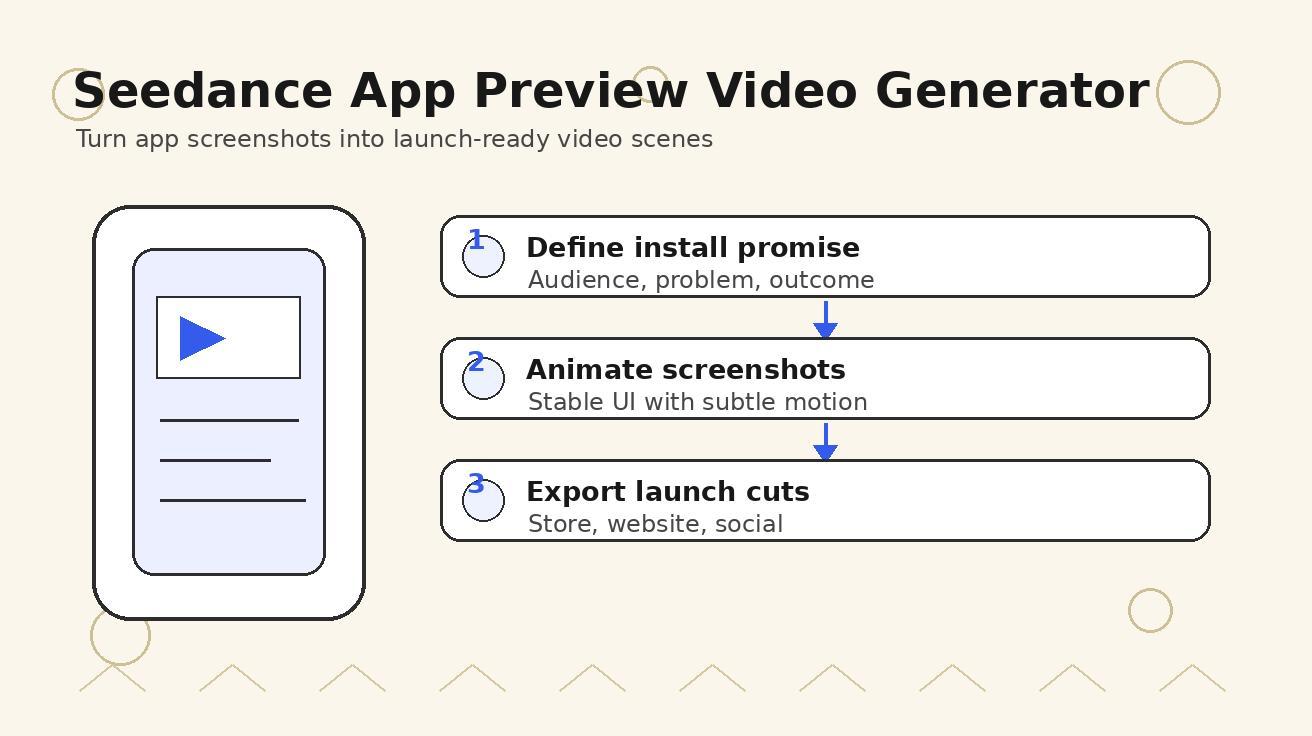
Seedance App Preview Video Generator 2026: Create App Store and Product Launch Clips
Use Seedance to turn app screenshots, feature copy, and launch goals into App Store previews, Google Play promo videos, and product launch clips.
Read article
Gemini AI Video Prompt Examples: Copy-Ready Veo Scenes and a Better Prompt Formula
Copy Gemini AI video prompt examples for cinematic motion, product ads, dialogue, and vertical clips, then adapt them with a practical Veo prompt formula.
Read article
How to Keep Product Shape Consistent in AI Video Ads
Lock product geometry, packaging, labels, references, camera angles, and approval checks so AI video ads preserve the real SKU across every shot.
Read article