
91% of UK businesses now use video in their marketing, and 93% of those marketers report positive ROI, according to 2026 UK market data. That should change how small business owners think about video.
This is no longer a branding extra for companies with spare budget. It's a practical sales and trust tool. Used properly, video can explain an offer faster than text, answer objections before a call, and help a small business look organised without looking corporate.
The mistake I see most often is starting with cameras, editing apps, or social platforms. Start with the business result instead. If a video doesn't help you win enquiries, improve conversions, shorten sales conversations, or support repeat purchases, it's just content.
Practical examples matter here. A local bakery might use short product videos to push same-day orders. A trades business might record common repair explanations to qualify leads before the phone rings. A consultant might turn one client question into a homepage explainer, a LinkedIn clip, and an email follow-up asset. The format changes, but the rule stays the same. Tie every video to a job it needs to do.
Why Video Is Non-Negotiable for Your Small Business in 2026
Companies that publish useful video often grow faster than those relying on text and static images alone. For a small business, that gap shows up in practical places. More qualified enquiries, fewer repetitive sales calls, better conversion on key pages, and stronger follow-up after the first purchase.
The reason is simple. Video carries more of the buying experience in less time. A prospect can hear how you explain the service, see the product in use, and judge whether your business feels credible before they ever contact you. That matters even more for smaller firms competing against better-known brands.
Cheap production has changed the equation too. A phone camera, basic lighting, a screen recorder, and AI tools for scripting, captions, clean-up, or repurposing are enough to build a working system. The standard to aim for is clarity, not polish for its own sake. If you want a practical framework for planning that system, this guide to a video content marketing strategy is a useful starting point.
Focus on outcomes you can measure
Small businesses get better results from videos tied to one business job.
Use video to reduce friction in the sales process:
- Generate enquiries: Record a short offer video that explains who the service is for, what happens next, and how to get in touch.
- Explain a service: Use a talking-head clip or screen recording to answer the question prospects ask before they buy.
- Build trust: Show customer results, before-and-after examples, or a walkthrough of how the work is delivered.
- Support repeat sales: Send setup videos, care instructions, or onboarding clips after purchase to cut support time and improve retention.
A good test is blunt. If the video has no clear next action, it is probably not doing a business job.
Match the format to the point in the buying cycle
Different videos solve different problems. A short social clip can get attention, but it rarely closes the sale on its own. An explainer on a service page can. A testimonial can remove hesitation. A demo can help someone decide faster.
| Video Type | Best Used For | Typical Next Step |
|---|---|---|
| Short social clip | Attention and discovery | Visit profile or website |
| Explainer video | Clarity and conversion | Book, enquire, or buy |
| Testimonial | Trust and objection handling | Request quote |
| Product demo | Purchase confidence | Add to basket |
| FAQ video | Sales support | Contact team |
The trade-off is straightforward. Broad reach content can attract more viewers, but buyer-intent content usually produces better ROI on a small budget. I usually advise small businesses to start with the videos that shorten the path to revenue, then expand into awareness content once that base is working.
A florist will usually get more value from a seasonal pre-order video than a generic brand reel. A local accountant will usually get more bookings from a plain-English tax deadline video than from clever edits. Video works best when it answers a real buyer question, removes doubt, and points to the next step.
Building Your Video Marketing Blueprint
A good video plan is boring in the right way. It removes guesswork, keeps spending under control, and stops you making random clips that never connect to revenue.
Start with a one-page blueprint. If you run a small business, that's enough.
The four decisions that shape everything
First, define the outcome. Choose one priority for the next round of videos: more leads, better conversion on your website, more foot traffic, stronger retention, or improved sales conversations.
Second, decide who each video is for. Be specific. “Homeowners in Leeds looking for kitchen renovations” is useful. “Anyone interested in home improvement” is not.
Third, identify the recurring questions buyers ask. Those become your content pillars. Price. Process. Timescales. Results. Mistakes to avoid. Comparisons. Those topics are usually more valuable than broad brand messaging.
Fourth, pick the distribution point before production. A homepage explainer, an Instagram Reel, a YouTube tutorial, and an email follow-up clip all need different treatment.
Matching video type to your business goal
Use this as a working tool when planning your next batch of content.
| Video Type | Primary Goal | Best Platforms | Example for a Small Business |
|---|---|---|---|
| Explainer video | Clarify an offer | Website homepage, landing page, email | A bookkeeping firm explaining monthly service packages |
| Customer testimonial | Build trust | Website, LinkedIn, sales follow-up | A local gym member describing why they stayed |
| Behind-the-scenes clip | Show personality and process | Instagram Reels, Facebook, TikTok | A bakery showing the morning prep for fresh orders |
| Product demo | Reduce buying friction | YouTube, product pages, email | A skincare brand showing how to use one product properly |
| FAQ video | Handle objections | Website, Instagram, YouTube Shorts | A mortgage broker answering “How much deposit do I need?” |
If you want help structuring those themes into a repeatable plan, this guide to a video content marketing strategy is a useful planning reference.
Compare the three production paths honestly
Small businesses usually have three realistic options. Each can work.
| Production Path | Cost Reality | Time Requirement | Quality Ceiling | Best Fit |
|---|---|---|---|---|
| DIY smartphone | Lowest upfront spend | Highest owner involvement | Good enough if executed cleanly | Service businesses, founders, local shops |
| AI generation | Low to moderate spend | Fast once prompts are clear | Strong for ads, explainers, concept visuals | Lean teams needing output quickly |
| Agency or freelancer | Highest spend | Less hands-on production time | Highest polish when the brief is strong | High-stakes launches, premium brands |
DIY gives you speed and authenticity, but weak lighting and poor audio can undermine trust fast. AI gives you output and flexibility, but generic prompts create generic videos. Agency work can look excellent, but if the strategy is vague, you can spend a lot on something pretty that doesn't convert.
The cheapest route is the one that gets used consistently. An expensive video you publish once is less useful than a simple format you can repeat every month.
A practical example: a local dog groomer might record regular smartphone clips for Instagram, use AI to create seasonal offer ads, and hire a freelancer once a year for a polished homepage video. That mix is often smarter than committing to one production style for everything.
Smart Video Production on a Small Budget
Most small businesses don't have a studio, a camera operator, or time for endless retakes. That's fine. You can still produce effective video if you choose a format that fits your budget and your workflow.
In the UK ROI context, short-form videos under 60 seconds achieve the highest engagement, with 59% of viewers watching more than half their duration. For platforms like Instagram Reels and TikTok, 61% of UK marketers report success with videos of 30 to 60 seconds at 1080p resolution, according to Lambda Films' UK video marketing statistics.
That gives small businesses a useful constraint. Shorter is often better, especially when you're producing with limited time and equipment.

Choose the production route that matches the task
DIY smartphone video works well when trust matters more than polish. Founders, consultants, trades, coaches, and local retailers often do well with direct-to-camera clips. Use daylight from a window, keep the phone at eye level, and record in a quiet room. Bad sound ruins more videos than bad visuals.
AI-generated video makes sense when you need speed, variety, or visuals you can't easily film yourself. It's especially useful for promo clips, product ads, concept visuals, and location-style edits when you don't have a crew. If you're exploring that route, how to make a nice video breaks down prompt quality, visual consistency, and practical production choices. Mentioning one tool plainly, Seedance turns text descriptions into 1080p videos and can be used for short ad-style content when filming from scratch isn't realistic.
Freelancers or specialist teams are worth considering when your video sits on a key sales page or supports a major campaign. Even if you're UK-based, it can help to review how production specialists think about planning, scripting, and visual execution. This breakdown of Brisbane business video production is useful because it shows the practical difference between filming for looks and filming for business outcomes.
Make hyper-local content without a big crew
A lot of small businesses want local relevance but don't have access to local filming talent or multiple locations. You don't need to fake a big production. Keep it grounded.
Use local phrases your customers use. Reference service areas naturally. Show real packaging, uniforms, vans, storefront details, or appointment settings. If you use AI visuals or stock footage, blend them with genuine business assets so the final result still feels like your company.
A simple example: a cleaning company in Manchester could create one general offer video, then localise versions by changing the opening line, on-screen text, service area mention, and call to action for different postcodes. That's often enough.
Use a simple script structure
For most short videos, this four-part structure works:
- Hook the problem in the first line.
- Show the offer or answer quickly.
- Add proof or clarity with a result, process, or example.
- End with one CTA only.
For example, a physiotherapist might open with: “Back pain after long desk days?” Then show a quick mobility tip, mention who it's for, and finish with: “Book an assessment through the link.”
Here's a useful walkthrough on what polished short-form creation can look like in practice:
<iframe width="100%" style="aspect-ratio: 16 / 9;" src="https://www.youtube.com/embed/dhtNxptltGY" frameborder="0" allow="autoplay; encrypted-media" allowfullscreen></iframe>
Post-production checklist that lifts the quality
You don't need advanced editing. You do need consistency.
- Trim hard at the start: Cut hesitation, greetings, and dead space so the first second gets to the point.
- Add captions: Many people watch without sound, so your message must still work with the sound off.
- Include brand cues: Use the same colours, logo treatment, and type style across videos.
- Correct framing issues: Straighten the horizon, crop for platform format, and keep the subject centred.
- Use simple music carefully: Background music should support the tone, not compete with speech.
- End with a clear CTA: “Book now”, “Get a quote”, or “Visit the shop today” works better than a vague sign-off.
Raw footage rarely looks expensive. Clean editing, readable captions, and a direct message make it look credible.
Polishing Your Videos for Professional Impact
Most small business videos don't fail because the idea was weak. They fail because the final version feels unfinished. Viewers notice small quality issues immediately. Inconsistent fonts, awkward cuts, poor caption timing, and mismatched audio all reduce trust.
Polishing isn't about making your work look like a television advert. It's about removing distractions so the viewer focuses on the message.
Edit for clarity before style
Start by cutting anything that slows the viewer down. Long introductions, repeated phrases, and over-explaining are common problems. Keep the pace tight and let each clip do one job.
Then look at visual consistency. Choose one logo placement, one text style, and one colour treatment for all your videos. If every clip looks different, the business feels less organised.
A practical example: a local estate agent might use the same opening title card, lower-third name label, and closing contact screen in every video. That small system makes smartphone footage feel deliberate.
Captions are not optional
If your message only works with sound on, you're making life harder for yourself.
Many small business owners add captions as a final afterthought. They should be built into the process. Good captions improve accessibility, hold attention, and make short clips easier to understand in busy environments. They're also one of the fastest ways to make a simple video look more finished.
Don't let auto-captions go out unchecked. One wrong keyword in a service explanation can change the meaning and damage trust.
Build a repeatable finishing kit
Keep your editing stack simple. You don't need dozens of assets. You need a basic pack that can be reused:
- Intro and outro screens: Keep them short and branded.
- Lower thirds: Use them for names, roles, or locations.
- Music library: Save a few tracks that fit your tone.
- Caption style: Use one readable format across platforms.
- Thumbnail template: Create a recognisable cover style for YouTube or website embeds.
For a café, that might mean warm colours, soft music, handwritten-style headings, and a thumbnail format that always shows the featured product. For a solicitor, it might mean clean neutral graphics, quiet music, and sharper text-led thumbnails.
That level of polish doesn't require a big budget. It requires decisions made once, then reused every time.
Promoting Your Videos to Reach the Right People
Posting a video and hoping the algorithm does the rest isn't a strategy. Small businesses get better results when they publish with a distribution plan, adapt the asset to each platform, and track what happens after the view.
For UK small businesses, optimal video length for social media ads is under 60 seconds to maximise engagement, while website explainers should be 1 to 2 minutes. UK marketers report that 87% of video campaigns directly increased website traffic and sales, according to SundaySky's 2025 video marketing statistics.
That doesn't mean every video belongs everywhere. It means each placement should have a purpose.

Tailor the same idea for different channels
One core video can produce several versions.
A bakery launching a weekend special could use:
- Instagram Reel: Quick product reveal with an on-screen offer.
- Facebook post: Slightly longer clip with location details and collection times.
- Website banner video: Short loop supporting the order page.
- Email embed thumbnail: A still image linked to the main promo video.
A B2B consultant could use:
- LinkedIn clip: A direct pain-point opener.
- Landing page explainer: A clearer version with service detail.
- Sales email follow-up: A personal webcam video answering one objection.
- YouTube upload: A searchable version with a keyword-led title.
If you're creating paid or organic short-form campaigns with AI, this guide on how to create AI video ads that convert in 2026 gives practical direction on structuring the message and adapting creative for different placements.
Challenge vanity metrics early
A lot of small businesses stop at reach, likes, and watch time because those figures are easy to find. They're useful signals, but they're not proof of commercial impact.
Treat platform metrics as diagnostic, not final. If a video gets attention but no clicks, the offer or CTA may be wrong. If people click but don't convert, the landing page may be the problem. If only existing followers engage, the targeting may be too narrow.
Build a simple promotion routine
Promotion works better when it's systematic.
- Publish with platform intent: Write a different caption for Instagram than for YouTube.
- Lead with relevance: Start with the customer problem, not your business name.
- Reuse intelligently: Turn one explainer into clips, stories, thumbnails, and email assets.
- Respond to comments: Questions in comments often reveal the next video you should make.
- Cross-promote: Add video to product pages, service pages, newsletters, and sales messages.
A strong video with weak distribution usually loses to a decent video with disciplined promotion.
Match the CTA to the business model
Here, practical examples matter most.
A local salon should not end every video with “follow for more”. If the goal is bookings, the CTA should be “Book this month's treatment through the link”. A trades business should point people to a quote form. An online shop should send viewers to a product page. A consultant should offer a call or a diagnostic.
Promotion is not just about reach. It's about sending the right viewer to the next useful step.
Measuring What Matters and Proving Your ROI
It's common for many small businesses to lose confidence in video. They post consistently, see respectable engagement, but can't prove whether any of it helped the business. That uncertainty usually leads to one of two bad decisions: abandoning video too early, or continuing blindly.
Data from Adobe UK shows that 78% of UK small businesses fail to track whether video leads to qualified opportunities or closed deals, as explained in Adobe's video marketing guidance.
That gap is the problem. Not low reach. Not low confidence on camera. Poor measurement.

Track the business event, not just the platform event
Platform analytics tell you what happened on the platform. Your business needs to know what happened after.
A useful measurement setup for small businesses can stay simple:
- Website visits from video: Use tagged links so you can see which videos drove traffic.
- Lead form submissions: Create dedicated landing pages or CTA links for specific campaigns.
- Calls or bookings: Ask new enquiries where they found you, then log it consistently.
- Sales support impact: Note whether prospects watched a demo or explainer before converting.
For example, if a home maintenance company posts a boiler service video on Facebook, the useful question isn't only “How many views did it get?” It's “How many quote requests came from people who clicked through that video?”
Use a basic ROI review every month
You don't need complex attribution software to get started. Review each video against four points:
| Check | What to Look For |
|---|---|
| Attention | Did the right audience stop and watch? |
| Action | Did they click, enquire, book, or buy? |
| Fit | Did the message match the landing page or offer? |
| Repeatability | Can you make another version of this efficiently? |
This monthly review helps you separate interesting content from useful content.
Watch for the hidden weak points
Some videos fail because the message is off. Others fail because the offer is unclear, the thumbnail is weak, or the next step creates friction. Don't blame the format too quickly.
If people watch but don't click, test the CTA. If people click but don't convert, improve the page. If one topic consistently drives stronger leads, make more on that topic and cut the rest.
The point of measurement isn't to justify every video. It's to identify which videos deserve more budget, more variations, and better placement.
A practical example: a bookkeeping firm may discover that tax deadline reminder videos don't get the most engagement, but they produce the highest quality enquiries. That's the kind of insight that changes budget decisions.
Your Journey into Video Marketing Starts Now
Video marketing for small businesses works when it's treated like part of the sales process, not a creative side project. The strongest results usually come from simple systems. Pick one goal. Make one useful video type. Publish it where your buyers already pay attention. Track what happens next.
You don't need a full studio, a huge ad budget, or a polished presenter to begin. You need a clear message, a believable offer, and the discipline to measure real outcomes. That's enough to start building momentum.
Keep it practical. Record one FAQ video. Turn one customer question into a short clip. Test one offer with one landing page. Improve the next version based on clicks, leads, and sales conversations. That's how small businesses build a video engine that supports growth.
The businesses that win with video usually aren't the loudest. They're the most consistent, the most useful, and the clearest about what they want the viewer to do next.
If you want a faster way to turn ideas into usable marketing videos, Seedance is worth exploring. It gives small businesses a practical option for creating 1080p video from text prompts, which is useful when filming everything manually isn't realistic.
Ready to create your own AI video?
Turn ideas, text prompts, and images into polished videos with Seedance. If this article helped, the fastest next step is to try the product.
Free credits on signup. Plans from $28/month.
Related Articles
More posts in the same locale you may want to read next.
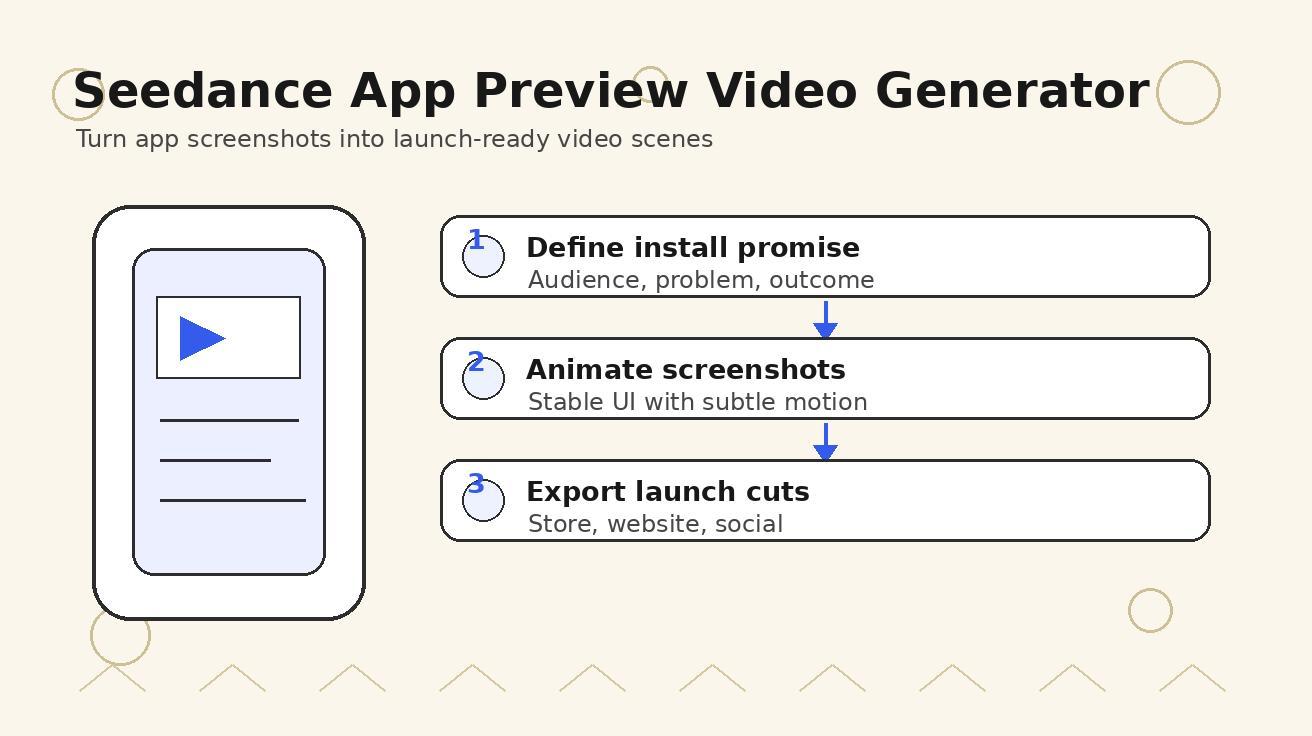
Seedance App Preview Video Generator 2026: Create App Store and Product Launch Clips
Use Seedance to turn app screenshots, feature copy, and launch goals into App Store previews, Google Play promo videos, and product launch clips.
Read article
Gemini AI Video Prompt Examples: Copy-Ready Veo Scenes and a Better Prompt Formula
Copy Gemini AI video prompt examples for cinematic motion, product ads, dialogue, and vertical clips, then adapt them with a practical Veo prompt formula.
Read article
How to Keep Product Shape Consistent in AI Video Ads
Lock product geometry, packaging, labels, references, camera angles, and approval checks so AI video ads preserve the real SKU across every shot.
Read article