
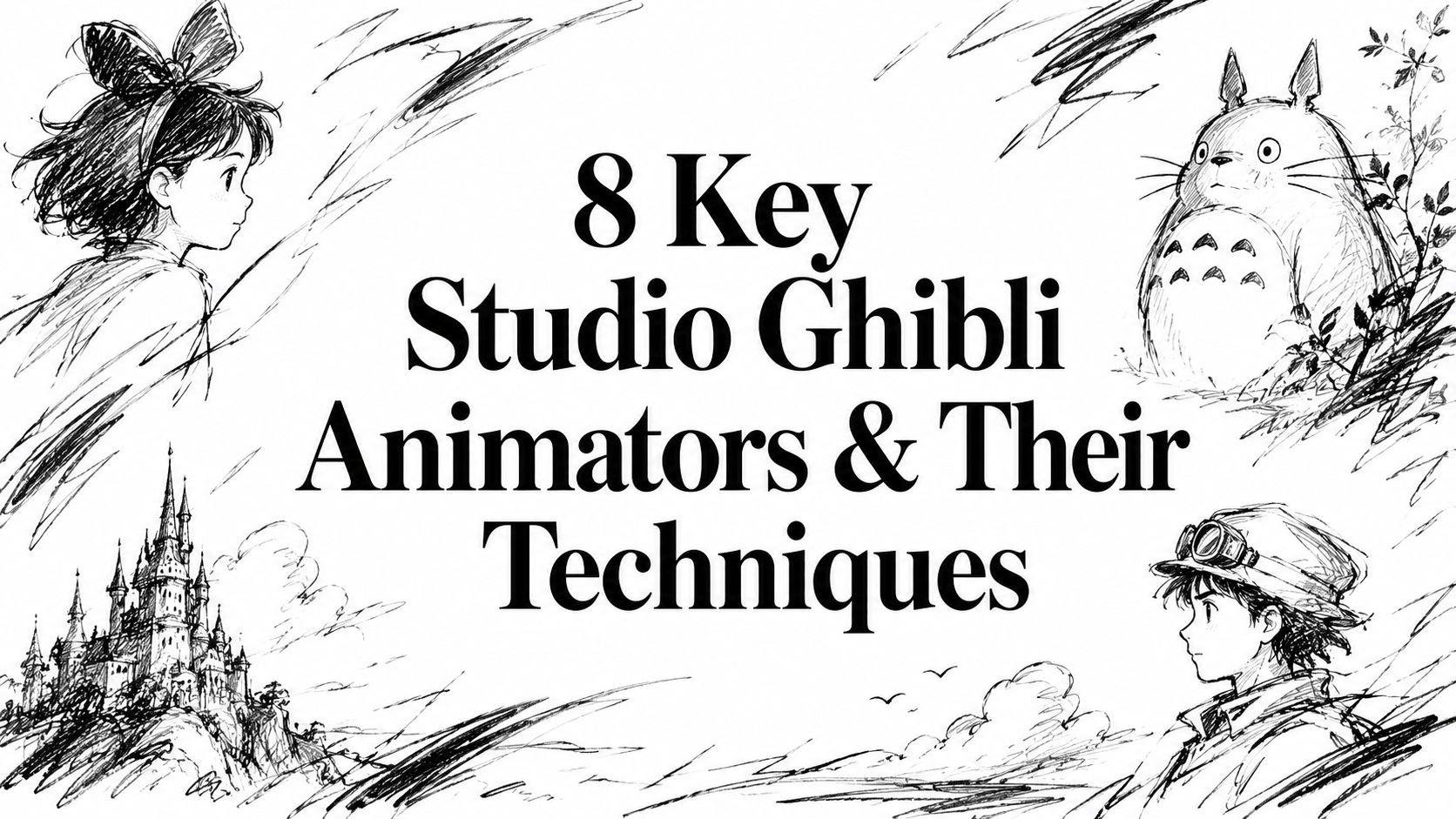
A child pauses before stepping into a tunnel. The wind stirs the grass, their shoulders tighten, and the world feels larger for a second. That kind of moment is why Studio Ghibli films stay with people. The movement carries meaning before a line of dialogue does.
The magic behind Studio Ghibli animators isn't accidental. Studio Ghibli was founded on 15 June 1985 by Hayao Miyazaki, Isao Takahata, and Toshio Suzuki, and the studio has produced 22 feature films from Castle in the Sky on 2 August 1986 to The Boy and the Heron on 14 July 2023, according to the Studio Ghibli overview. Their methods were built through decades of disciplined craft in Japan, not through shortcuts. For modern creators, including anyone using AI video generators, that matters because the lesson isn't “copy the look”. It's “understand the decision behind the look”.
This breakdown treats Studio Ghibli animators as teachers. Their work offers practical rules for character acting, composition, action, creature motion, effects, and hybrid production. If you create explainer videos, branded shorts, indie films, classroom media, or concept trailers, you can borrow these principles and apply them directly in your prompts, shot lists, and revisions.
Table of Contents
- 1. Hayao Miyazaki - Master of Expressive Character Animation
- 2. Isao Takahata - Pioneering Realistic Movement and Composition
- 3. Katsuya Kondō - Character Design Excellence and Anatomical Precision
- 4. Shinji Otsuka - Master of Action Sequences and Dynamic Movement
- 5. Yoji Takeshige - Background Art and Environmental Storytelling
- 6. Megumi Kagawa - Creature Animation and Fantastical Character Movement
- 7. Takeshi Inamura - Visual Effects Animation and Particle Effects
- 8. Kazuyoshi Katayama - Technical Innovation and Digital Animation Pioneer
- Studio Ghibli Animators, 8-Point Skills Comparison
- From Inspiration to Creation Applying Ghibli's Lessons
<a id="1-hayao-miyazaki-master-of-expressive-character-animation"></a>
1. Hayao Miyazaki - Master of Expressive Character Animation
Miyazaki's great strength is that his characters don't just move. They think through movement. A hand hesitates before opening a door. A face brightens for a beat, then drops when doubt returns. Those tiny transitions make viewers feel that a character has an interior life.
For creators using AI video, this changes how you prompt. Don't ask for “a happy girl running through a field” and expect emotional nuance. Ask for “a young girl who starts cautiously, glances left as if listening, then relaxes into a small smile before breaking into a light run”. The second prompt gives the model emotional timing, not just action.
<a id="micro-movements-that-reveal-thought"></a>
Micro-movements that reveal thought
The practical lesson is specificity. If you want expressive acting, define the body language at the same level you'd define costume or location.
- State the emotion shift: Write the starting feeling and the ending feeling in the same prompt. For example, “nervous at first, then calmly determined”.
- Name the facial behaviour: Ask for a furrowed brow, tightened lips, softened eyes, or a delayed smile.
- Keep movement natural: Use verbs like turns, pauses, leans, exhales, or reaches slowly. Those read as human. They work better than exaggerated flailing for character-led scenes.
Practical rule: When a scene matters emotionally, prompt the transition between feelings, not just the final feeling.
A useful scenario is a product film with a human lead. If you're making a short ad for a journalling app, don't open with a generic “woman smiles at desk”. Try a sequence where she stares at a blank page, taps the pen once, breathes out, writes the first line, then settles. That progression creates empathy.
Studio Ghibli animators are often discussed for their beauty, but beauty follows observation. Watch how people adjust a sleeve, tuck hair behind an ear, or shift their weight when uncertain. Those are the details worth feeding into your storyboard or prompt stack.
<a id="2-isao-takahata-pioneering-realistic-movement-and-composition"></a>
2. Isao Takahata - Pioneering Realistic Movement and Composition
Takahata approached animation like a director of lived space. His scenes feel organised, not crowded. People occupy rooms in ways that suggest relationships, tension, and status before anyone speaks.
That principle is essential for AI storytelling because many generated scenes collapse into visual clutter. A prompt can describe a kitchen, three characters, sunlight, steam, groceries, and a cat. But if you don't define where those elements belong, the result often feels flat.
<a id="build-scenes-through-space-not-just-subjects"></a>
Build scenes through space, not just subjects
Think in shots, not isolated images. Decide who is nearest the camera, who sits deeper in frame, and what object anchors the eye. If two characters are in conflict, separate them physically. If they're aligned, place them on the same visual plane or give them mirrored poses.
A strong workflow is to map a sequence before generating anything:
- Shot one: Establish the room and entrances.
- Shot two: Move closer to the character who controls the scene.
- Shot three: Reverse angle to reveal how another character reacts.
- Shot four: Insert a detail shot, such as a teacup, open window, or shifting curtain.
That kind of planning works especially well with cinematography and lighting techniques for story-driven scenes, where framing and light direction shape the mood as much as performance does.
Composition isn't decoration. It tells the viewer where power, distance, and attention belong.
A practical example is a classroom animation. If a teacher is reassuring a nervous pupil, place the pupil small in the frame first, surrounded by desks and negative space. In the next shot, move the teacher closer but slightly lower, so the posture feels supportive rather than imposing. The emotional effect comes from placement.
Takahata's lesson for modern creators is simple. Don't generate a pretty frame first and force story into it later. Build the spatial logic first. The emotion will read more clearly.
<a id="3-katsuya-kondo-character-design-excellence-and-anatomical-precision"></a>
3. Katsuya Kondō - Character Design Excellence and Anatomical Precision
Strong character design saves time later. Kondō's kind of design thinking gives a character a recognisable silhouette, believable proportions, and features that remain stable from angle to angle. That matters in hand-drawn work, and it matters even more when you're trying to keep AI-generated characters consistent across multiple scenes.
Here's the portrait reference style many creators aim for when they want a soft, painterly character presence:

<a id="design-for-repeatability"></a>
Design for repeatability
A good design brief includes more than hair colour and clothing. It should cover face shape, nose type, posture, age cues, fabric textures, shoe style, and any recurring accessories. If a teenager always wears a loose grey scarf, slightly oversized coat, and has a rounded jaw with alert eyes, repeat those traits in every prompt.
That repetition is what makes a character feel authored rather than random. It also supports character consistency across multiple generated scenes in Seedance, where stable visual anchors help carry identity from shot to shot.
Try this structure when drafting your base prompt:
- Core identity: “Seventeen-year-old boy, slim build, messy dark hair, thoughtful expression.”
- Anatomical grounding: “Realistic proportions, natural shoulders, hands slightly large for age.”
- Signature details: “Soft grey scarf, worn satchel, ink stains on fingertips.”
- Behavioural cue: “Often looks sideways before speaking, posture slightly guarded.”
A useful real-world application is branded storytelling. If a small business wants a recurring animated shopkeeper character across social clips, that character needs rules. Without rules, the face shifts, the body changes, and trust erodes.
Kondō's lesson is that appealing design isn't just attractive design. It's durable design. If the character can't survive a close-up, a profile, and a walking shot while still feeling like the same person, the design isn't finished.
<a id="4-shinji-otsuka-master-of-action-sequences-and-dynamic-movement"></a>
4. Shinji Otsuka - Master of Action Sequences and Dynamic Movement
Action fails when it's fast but unreadable. Otsuka-style thinking keeps motion energetic while preserving weight, direction, and intent. You feel why a character moved, how they used force, and what changed because of the motion.
That's the standard to chase in AI video. Many tools can generate impact. Fewer can generate coherent action unless you guide them carefully. The fix is to treat action as a chain of decisions rather than one spectacular blur.
<a id="action-needs-cause-and-consequence"></a>
Action needs cause and consequence
If a character leaps, ask what pushed them to leap. If they swing a staff, where does it begin, where does it land, and how does the body recover after impact? Those details create physical credibility.
A practical action prompt often works best as a short sequence rather than one long block. For example:
- Beat one: “The courier spots a falling crate and plants his right foot.”
- Beat two: “He lunges forward, shoulders low, reaching with both hands.”
- Beat three: “The crate hits his forearms, forcing a backward step.”
- Beat four: “He regains balance, exhales sharply, and drags it aside.”
This approach helps marketers and filmmakers alike. A sports brand might use it for a training montage. An educator might use it for a historical battle visualisation. A game studio might use it for a proof-of-concept trailer. In every case, the movement should express intention, not just excitement.
Fast motion still needs clear geometry. The viewer should know where the body started, where it travelled, and where it ended.
Camera choice matters too. A side view can clarify a jump. A low angle can make a strike feel heavier. An overhead view can map pursuit through space. If the sequence gets muddled, split it into more shots. Clarity beats chaos every time.
<a id="5-yoji-takeshige-background-art-and-environmental-storytelling"></a>
5. Yoji Takeshige - Background Art and Environmental Storytelling
A Ghibli environment rarely feels like wallpaper. The setting tells you who lives there, what they value, what season it is, and whether the scene invites comfort or unease. Takeshige's kind of background thinking turns place into story.
That's useful for anyone making AI-assisted videos because backgrounds often get treated as afterthoughts. The result is generic scenery. A better approach is to write the location as if it has a biography.
Here's the sort of environment reference that supports that mindset:

<a id="turn-locations-into-narrative-tools"></a>
Turn locations into narrative tools
Describe architecture, weathering, light, sound cues, and cultural details. A temple gate isn't just red wood in a forest. It might have damp stone, faded paint near the base, paper lanterns catching warm dusk light, moss along the steps, and a narrow path that suggests infrequent but meaningful use.
That level of specificity is the foundation of visual storytelling through environment, mood, and symbolic detail. It helps your scenes feel inhabited.
Use this simple test. Ask whether someone could infer the story world from the background alone. If the answer is no, add stronger environmental signals.
- History: Include signs of age, repair, neglect, or ritual use.
- Culture: Add materials, objects, and layout choices tied to a believable place.
- Mood: Define the light quality. Mist, late-afternoon gold, indoor glow, or overcast blue all tell different stories.
- Continuity: Reuse key details in later shots so the location remains stable.
A practical example is a hospitality brand video. Instead of prompting “cosy countryside inn”, build a more useful scene: low-beamed ceiling, hand-thrown ceramic cups, rain tapping on old windowpanes, muddy boots by the door, and warm light from the kitchen beyond. That background already tells a story about welcome, weather, and class of experience.
The best environments don't compete with the characters. They deepen them.
<a id="6-megumi-kagawa-creature-animation-and-fantastical-character-movement"></a>
6. Megumi Kagawa - Creature Animation and Fantastical Character Movement
Fantasy breaks when creatures move like costumes. Kagawa-style creature work feels convincing because the motion follows some internal logic. Even the strangest being seems to obey its own anatomy, weight, and instincts.
That's a powerful lesson for AI-generated worlds. If you ask for “a magical spirit” without describing how it moves, many systems default to vague floating or random twitching. The design might look inventive, but the behaviour won't feel alive.
Here's a useful visual reference for that balance between wonder and structure:

<a id="invented-beings-still-need-physical-logic"></a>
Invented beings still need physical logic
Start with real animal references. If your creature has fox-like legs and bird-like wings, decide which parts drive movement. Does it stalk low to the ground, then hop to a higher perch before gliding? Does it tilt its head like a curious corvid? Does its tail stabilise turns?
These prompts work well:
- Movement source: “Moves with the cautious light steps of a fox.”
- Aerial behaviour: “Short wing-assisted hops rather than full sustained flight.”
- Temperament cue: “Pauses to listen before committing to motion.”
- Weight logic: “Feathered upper body, compact torso, quick landings on stone.”
A practical use case is children's educational content. Suppose you're creating a forest guide character for an ecology video. A creature that moves according to readable animal behaviours will feel friendlier and more memorable than one that hovers and sparkles.
Strange designs become believable when their movement borrows from familiar life.
You can also use creature logic in branding. A mascot for a wellness app might move softly, with slow breathing rhythms and calm head turns. A mascot for an adventure game should show quicker reactions, spring-loaded posture, and sharper directional changes. The body language teaches the audience what kind of world they're entering.
<a id="7-takeshi-inamura-visual-effects-animation-and-particle-effects"></a>
7. Takeshi Inamura - Visual Effects Animation and Particle Effects
Effects are often where creators overdo it. Glowing dust, magical trails, water spray, smoke, sparks. Add too much and the scene turns noisy. Inamura's value as a model is restraint with purpose. Effects clarify energy, danger, weather, impact, or transformation.
If you're generating scenes with AI, write effects as communication tools. Ask what the effect tells the viewer that the base action cannot tell alone.
<a id="effects-should-explain-the-scene"></a>
Effects should explain the scene
Water can show speed. Ash can show aftermath. Steam can show warmth and enclosure. Wind-blown pollen can make a setting feel seasonal and gentle. Once you define the job, the effect becomes easier to control.
A smart prompt doesn't just say “add magic”. It says “a faint blue aura around the character's hands to suggest controlled healing energy, with slow drifting particles that don't obscure the face”. That keeps the storytelling priority clear.
Try these effect-writing habits:
- Name the phenomenon: Smoke, cinders, ripples, mist, droplets, embers, dust.
- Define scale: Fine particles, heavy spray, narrow beam, soft halo.
- Set behaviour: Swirling, drifting, bursting outward, sinking, clinging to surfaces.
- Protect readability: Specify that the effect should frame the subject, not cover key expressions or actions.
A practical scenario is product advertising. A tea brand might use rising steam and soft window condensation to communicate warmth. A fantasy book trailer might use floating paper ash and flickering light to suggest ancient magic. A travel reel might use sea spray and moving fog to create atmosphere without drowning the subject.
Effects should support the emotional centre of the shot. If the audience remembers the particles but not the story beat, the effect did too much.
<a id="8-kazuyoshi-katayama-technical-innovation-and-digital-animation-pioneer"></a>
8. Kazuyoshi Katayama - Technical Innovation and Digital Animation Pioneer
The useful lesson here isn't that digital tools replace traditional craft. It's that hybrid workflows can preserve artistic intent while expanding what a small team can produce. That idea matters now because many creators feel forced to choose between “authentic” hand-made work and AI-assisted production. They don't need to.
Studio Ghibli animators worked within a studio culture rooted in domestic Japanese production, and there are no documented UK-specific animator statistics tied to the studio's core films, as noted in this background summary on Studio Ghibli and its Japan-based production model. The relevant takeaway for creators outside Japan is qualitative. Influence travels widely even when the original production process remains local.
<a id="use-technology-to-support-the-hand-made-feeling"></a>
Use technology to support the hand-made feeling
A strong hybrid workflow often looks like this. Generate a base sequence with AI. Then refine the timing, redraw a key pose, repaint a background texture, replace awkward hands, or adjust colour grading to unify the sequence. Technology handles iteration speed. Human judgement handles taste.
This is especially practical for small teams:
- Concept stage: Generate multiple visual directions quickly.
- Previs stage: Build rough multi-shot sequences before committing to final scenes.
- Refinement stage: Correct anatomy, continuity, and key emotional beats by hand or with targeted edits.
- Finish stage: Unify lighting, texture, and movement rhythm so the piece feels designed rather than assembled.
A filmmaker might use this for a short pitch trailer. A teacher might build a historical re-enactment with painterly atmosphere. A small business might create a brand story that would otherwise require a full animation crew. The point isn't to mimic a studio pipeline exactly. It's to borrow the discipline behind it.
Katayama's broader lesson is that tools matter less than standards. If a digital shortcut weakens clarity or feeling, cut it. If it gives you more room to shape story, keep it.
<a id="studio-ghibli-animators-8-point-skills-comparison"></a>
Studio Ghibli Animators, 8-Point Skills Comparison
A useful way to read this chart is to treat each animator as a specialist solving a different storytelling problem. One focuses on facial nuance. Another controls space and staging. Another makes action readable. For creators using AI video tools, that shift matters. You are not copying a look. You are choosing a method.
| Style / Primary Focus | 🔄 Implementation Complexity | ⚡ Resource requirements | 📊 Expected outcomes (⭐ Quality) | 💡 Ideal use cases / Tips |
|---|---|---|---|---|
| Hayao Miyazaki, Expressive character animation | Very high, meticulous frame-by-frame micro-movements | High, skilled animators and time-intensive work | ⭐ Exceptional emotional depth and character believability | Use for character-driven scenes. Write prompts around specific emotional beats, eye focus, hand tension, and small posture shifts |
| Isao Takahata, Realistic movement & composition | High, complex camera work and spatial planning | High, multi-shot staging and detailed backgrounds | ⭐ Strong spatial realism and narrative clarity | Define camera angle, character spacing, and how the environment shapes the scene. Treat blocking like live-action direction |
| Katsuya Kondō, Character design & anatomical precision | Medium, design-focused consistency across poses | Medium, detailed character sheets and references | ⭐ High recognizability and consistent character appeal | Build clear appearance descriptors, turnaround references, and pose rules so the character stays stable across shots |
| Shinji Otsuka, Action choreography & dynamic movement | High, precise choreography and camera timing | Medium–High, planning multiple cuts and motion studies | ⭐ High-impact, clear action that supports story | Break action into beats: setup, acceleration, impact, recovery. Prompt each beat separately so motion stays readable |
| Yoji Takeshige, Background art & environmental storytelling | Medium–High, layered painted environments and lighting | Medium, art resources and cultural references | ⭐ Strong atmosphere and immersive world-building | Specify architecture, weather, time of day, surface texture, and lived-in details. The setting should reveal history, not just location |
| Megumi Kagawa, Creature & fantastical movement | Medium, grounded in observed animal motion | Medium, reference studies and anatomy constraints | ⭐ Believable non-human motion and personality | Start with one or two real-animal references, then adjust stride, weight, and rhythm to make the creature feel invented but convincing |
| Takeshi Inamura, Visual effects & particle animation | High, technical particle/fluid simulations | High, compute, specialized skills, and iteration | ⭐ Spectacular effects that improve perceived production value | Add effects with a job to do. Smoke can hide a transition. Dust can show impact. Glow can direct attention |
| Kazuyoshi Katayama, Hybrid digital-traditional innovation | High, integrating pipelines and hybrid techniques | Medium–High, tools, iteration, and technical know‑how | ⭐ Flexible aesthetics and expanded creative possibilities | Use AI for rough generation, then correct timing, redraw key poses, and unify color and texture by hand for a controlled hybrid result |
The comparison becomes clearer if you group the skills by function. Miyazaki, Kondō, and Kagawa shape performance through bodies and faces. Takahata, Takeshige, and Otsuka control how scenes read in space and time. Inamura and Katayama focus on finish and process, which means they affect polish as much as style.
That distinction helps with production planning.
If you are a solo creator, do not try to apply all eight approaches at once. Pick the bottleneck in your current work. If your characters feel stiff, study Miyazaki and Kondō. If your action is confusing, study Otsuka. If your scenes look pretty but empty, Takeshige is the better model.
AI tools fit best as accelerators inside this framework, not as substitutes for it. A generator can produce many candidate shots quickly, but it still needs direction on gesture, staging, effects, and consistency. The chart works like a decision map. It shows which artistic problem you are solving, what effort it requires, and which prompts, references, or manual fixes will get you closer to the result.
<a id="from-inspiration-to-creation-applying-ghiblis-lessons"></a>
From Inspiration to Creation Applying Ghibli's Lessons
The genius of Studio Ghibli animators lies in how they treat every visual choice as storytelling. A facial twitch can reveal doubt. A room layout can signal emotional distance. A background can carry history. A creature can feel impossible and still move in a way the body accepts as true. That's the lesson to take forward.
For modern creators, especially those working with AI video tools, the biggest mistake is chasing surface imitation. Soft colours, painterly skies, and whimsical details aren't enough. The deeper craft sits in intention. Why does the character pause there? Why is the camera low? Why does the wind move in this shot but not the last one? Why does the effect bloom gently rather than explode? Those decisions build meaning.
If you want results that feel richer, start every project with three questions. What should the audience feel in this moment? What movement best expresses that feeling? What visual details support it without distracting from it? That habit alone will improve prompts, storyboards, and revisions.
It also helps to think in layers. First, define the dramatic beat. Second, define the body language. Third, define the space around the character. Fourth, define any environmental or visual effects. Finally, test consistency across shots. That order keeps you from polishing backgrounds before the scene itself works.
A practical example makes this easier. Suppose you're creating an AI-generated short about a young baker opening her shop before sunrise. The weak version says, “cosy animated bakery, beautiful lighting, girl preparing bread”. The stronger version breaks it down. She opens the door with sleepy hands, pauses in the cold entryway, lights a single lamp, flour dust catches in the air, and the room slowly warms as she begins kneading. That second version has intention, movement, atmosphere, and progression.
That's why Studio Ghibli animators remain such useful teachers. They show that animation isn't only about motion. It's about observation organised into story. You don't need a giant studio to apply that lesson. You need a sharper eye, more deliberate prompts, and the patience to revise until each choice feels earned.
With a tool like Seedance, that process becomes more accessible. You can build multi-shot scenes, test alternative compositions, refine recurring characters, and shape atmosphere without needing a full production pipeline. The technology won't supply taste for you. But it does give you a faster path from idea to moving image, which means you can spend more of your energy on the part that matters most. Clear storytelling.
If you want to turn these animation principles into actual video workflows, Seedance is a strong place to start. It lets creators turn detailed prompts into cinematic 1080p videos, build multi-shot sequences with stronger continuity, and explore painterly, character-led storytelling without the cost of a traditional production setup. For marketers, educators, filmmakers, and small businesses, that makes it easier to test ideas quickly while still aiming for polished, emotionally readable visuals.
Ready to create your own AI video?
Turn ideas, text prompts, and images into polished videos with Seedance. If this article helped, the fastest next step is to try the product.
Free credits on signup. Plans from $28/month.
Related Articles
More posts in the same locale you may want to read next.
Seedance App Preview Video Generator 2026: Create App Store and Product Launch Clips
Use Seedance to turn app screenshots, feature copy, and launch goals into App Store previews, Google Play promo videos, and product launch clips.
Read article
Best AI Video-to-Video Models in 2026
The best AI video-to-video models in 2026 for editing footage you already shot: Higgsfield Genjutsu, Seedance 2.x, Runway Aleph, Luma Modify and Kling Omni compared.
Read article
Kling 4.0 vs Seedance 2.5: Full Comparison
Kling 4.0 vs Seedance 2.5 compared by spec: 30-second clips, keyframes vs 50 references, audio, 4K and 10-bit color, editing, and which model fits which job.
Read article