
Seedance vs Luma Dream Machine: Which AI Video Generator is Better in 2026
Meta Description: Compare Seedance and Luma Dream Machine in 2026. Detailed analysis of video quality, character consistency, camera movements, pricing, and use cases to find the best AI video generator for your needs.
Tags: AI video generator, Seedance, Luma Dream Machine, video AI comparison, text-to-video, image-to-video, AI filmmaking
Category: comparison
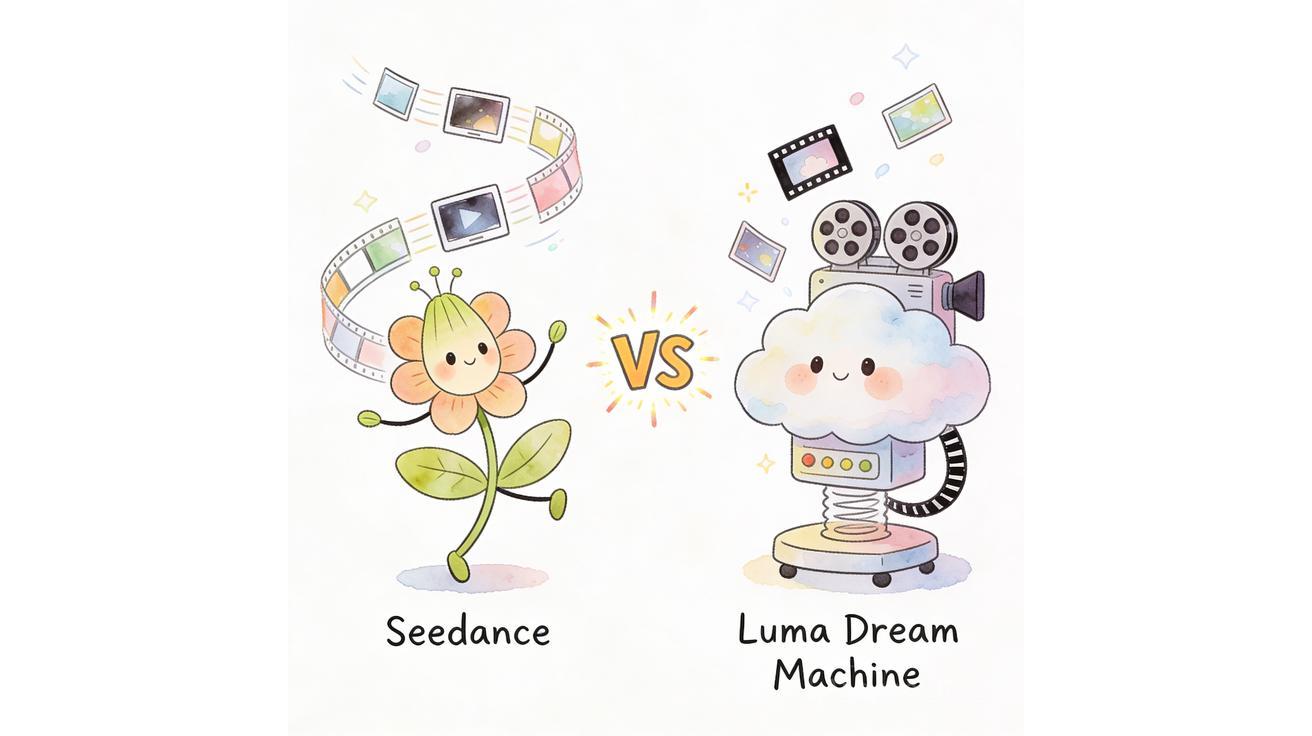
Cover Image Prompt: A playful hand-drawn doodle illustration comparing two AI video generators. On the left, a dancing seed/flower character with video frames flowing around it representing Seedance. On the right, a dreamy cloud-machine hybrid with film reels and video clips floating around it representing Luma Dream Machine. In the middle, a friendly "VS" battle sign with sparks. Whimsical cartoon style, soft pastel colors, white background, doodle aesthetic, kawaii cute style, minimalist line art with watercolor fills
The AI video generation landscape has evolved dramatically over the past year, transforming from a novelty into a powerful creative tool that filmmakers, marketers, and content creators rely on daily. As we navigate through 2026, two platforms have emerged as standout contenders in this rapidly maturing space: Seedance, the innovative video generation model from Nereo, and Luma Dream Machine, the acclaimed offering from Luma Labs that has captured the imagination of creators worldwide.
The demand for AI-powered video creation has never been higher. From indie filmmakers seeking to storyboard their next project to marketing teams producing dozens of video assets weekly, the ability to transform text descriptions or static images into compelling motion content has become invaluable. But with so many options available, choosing the right tool for your specific needs can feel overwhelming.
This comprehensive comparison dives deep into what makes Seedance and Luma Dream Machine tick. We'll examine everything from raw video quality and character consistency to pricing structures and ideal use cases. Whether you're a seasoned video professional or just beginning your AI video journey, this guide will help you make an informed decision about which platform deserves your investment in 2026.
What is Seedance?
Seedance represents Nereo's ambitious entry into the AI video generation arena, positioning itself as a next-generation solution designed from the ground up to address the limitations that have plagued earlier video AI models. Built on a sophisticated architecture that prioritizes both visual fidelity and temporal coherence, Seedance aims to deliver professional-grade results that can stand alongside traditionally produced content.
At its core, Seedance leverages a unique approach to video generation that combines advanced diffusion techniques with proprietary motion prediction algorithms. This hybrid methodology allows the platform to generate smooth, natural-looking motion while maintaining the high visual quality that Nereo has become known for in the image generation space. The model has been trained on an extensive dataset of cinematic content, giving it an inherent understanding of film language, camera movements, and visual storytelling principles.
One of Seedance's most compelling features is its exceptional handling of complex scenes involving multiple subjects and environmental interactions. Unlike many competitors that struggle with object permanence and spatial relationships, Seedance demonstrates remarkable consistency in how elements within a scene relate to one another across frames. This capability proves particularly valuable when creating content that features character interactions, product demonstrations, or narrative sequences.
The platform offers both text-to-video and image-to-video capabilities, with the latter being particularly impressive. When provided with a reference image, Seedance can extrapolate motion and temporal evolution while preserving the stylistic elements and compositional integrity of the source material. This makes it an excellent choice for animating existing visual assets, whether they're photographs, illustrations, or AI-generated artwork.
Seedance also distinguishes itself through its intuitive user interface and thoughtful workflow integrations. The platform provides granular control over camera movements, allowing users to specify everything from subtle dolly movements to complex orbital shots. Additionally, Seedance supports negative prompting and style references, giving creators fine-grained control over the aesthetic direction of their generated content.
Another notable strength lies in Seedance's approach to aspect ratio and resolution flexibility. The platform supports generation in multiple formats, from vertical 9:16 content optimized for mobile platforms to cinematic 16:9 and even ultra-wide 21:9 ratios suitable for theatrical presentation. This versatility makes Seedance equally suitable for social media content creators and professional filmmakers working on diverse deliverables.
What is Luma Dream Machine?
Luma Dream Machine burst onto the AI video scene with considerable fanfare, quickly establishing itself as one of the most capable and accessible video generation platforms available. Developed by Luma Labs, a company with deep roots in 3D reconstruction and neural rendering technologies, Dream Machine benefits from years of research into how computers understand and recreate visual reality.
The foundation of Luma Dream Machine lies in its ability to generate highly realistic, physically plausible video content from minimal input. The model excels at creating footage that adheres to real-world physics and lighting principles, resulting in outputs that often feel remarkably grounded despite being entirely synthetic. This photorealistic bent has made Dream Machine particularly popular among creators working on commercial projects, architectural visualization, and product marketing materials.
Dream Machine's text-to-video capabilities have garnered significant attention for their ability to interpret complex prompts with nuance and sophistication. The platform demonstrates strong comprehension of cinematographic terminology, allowing users to describe specific camera angles, lens characteristics, lighting setups, and motion dynamics in natural language. This makes it accessible to creators who may not have technical backgrounds but understand how to articulate their creative vision.
The image-to-video functionality in Dream Machine is equally impressive, offering users the ability to breathe life into static visuals with convincing motion. The platform handles various input types well, from photographs to digital illustrations, adapting its generation approach to preserve the essential characteristics of the source material while introducing appropriate movement and temporal variation.
One of Dream Machine's standout characteristics is its generation speed. Luma Labs has optimized the inference pipeline to deliver results quickly, enabling rapid iteration and experimentation. This efficiency proves invaluable in production environments where time is of the essence, allowing creators to generate multiple variations, evaluate options, and refine their approach without lengthy waits between generations.
The platform also offers robust support for camera controls, enabling users to specify precise camera movements and transitions. Whether you need a smooth tracking shot following a subject through a space or a dramatic crane shot revealing a scene, Dream Machine provides the tools to achieve these effects with minimal hassle. The camera movement system integrates seamlessly with the generation process, ensuring that motion feels natural and motivated rather than artificially imposed.
Dream Machine has also built a strong community around its platform, with active user groups sharing techniques, prompt strategies, and creative applications. This ecosystem has contributed to a rich knowledge base that helps new users get up to speed quickly while providing inspiration for experienced creators looking to push the boundaries of what's possible.
Detailed Comparison
Video Quality and Aesthetics
When evaluating video quality, both Seedance and Luma Dream Machine deliver impressive results, but they exhibit distinct aesthetic characteristics that may appeal to different creators and use cases.
Seedance tends toward a cinematic aesthetic that emphasizes artistic interpretation alongside technical fidelity. The platform excels at generating content with rich color grading, atmospheric lighting, and film-like motion blur. This makes it particularly well-suited for narrative content, music videos, and any project where a distinct visual style is paramount. Seedance handles stylized content exceptionally well, whether you're aiming for the look of 35mm film, anime-inspired visuals, or painterly aesthetics.
Luma Dream Machine, by contrast, prioritizes photorealism and physical accuracy. The generated footage often exhibits excellent detail preservation, realistic lighting interactions, and natural material properties. For commercial applications where the content needs to blend seamlessly with live-action footage or when depicting real-world products and environments, Dream Machine's commitment to realism proves advantageous.
Both platforms handle resolution admirably, generating crisp footage at standard HD resolutions with support for higher resolutions depending on subscription tiers. However, Seedance shows a slight edge in maintaining visual coherence across longer sequences, while Dream Machine excels in fine detail rendering within individual frames.
Character Consistency
Character consistency represents one of the most challenging aspects of AI video generation, and this is where the differences between Seedance and Luma Dream Machine become particularly apparent.
Seedance has made character consistency a cornerstone of its development, implementing sophisticated identity preservation mechanisms that help maintain character appearance across scenes and shots. When generating content featuring human subjects or stylized characters, Seedance demonstrates remarkable ability to keep facial features, clothing, and physical attributes stable throughout the duration of the video. This consistency extends to multiple characters within a scene, with Seedance maintaining proper spatial relationships and interactions between subjects.
The platform's approach to character animation also deserves mention. Seedance generates naturalistic body movements that respect anatomical constraints while maintaining the fluidity expected in professional video content. Characters move with purpose and weight, avoiding the uncanny or puppet-like motions that can plague lesser video generation models.
Luma Dream Machine approaches character consistency with its characteristic emphasis on physical plausibility. Characters generated by Dream Machine move in ways that adhere to real-world physics and biomechanics, resulting in motion that feels grounded and authentic. While Dream Machine has improved significantly in maintaining facial consistency over time, it can occasionally exhibit subtle drift in character appearance across longer sequences.
For projects where character recognition and consistency are critical—such as branded content featuring recurring personas or narrative works following specific protagonists—Seedance currently holds an advantage. However, Dream Machine's characters often exhibit more naturalistic movement patterns, particularly in complex actions and environmental interactions.
Camera Movements
Camera movement capabilities represent a crucial differentiator between AI video generation platforms, as dynamic, well-executed camera work can elevate generated content from interesting curiosities to compelling cinematic pieces.
Seedance offers an extensive camera control system that rivals professional filmmaking tools. Users can specify precise camera movements including push-ins, pull-outs, tracking shots, crane movements, and complex combinations thereof. The platform's understanding of cinematographic language allows for nuanced descriptions like "slow dolly forward with subtle rack focus" or "handheld documentary style with natural micro-jitters." What sets Seedance apart is how these camera movements integrate with the generated content—the motion feels motivated and organic rather than mechanically applied.
The platform also excels at simulating different lens characteristics, from wide-angle distortion to telephoto compression and everything in between. This allows creators to match specific aesthetic goals or maintain visual continuity with existing footage shot on particular lens configurations.
Luma Dream Machine provides similarly robust camera controls, with particular strength in physics-based camera behaviors. The platform generates camera movements that respect momentum, inertia, and natural operator tendencies. This results in handheld-style footage that feels authentically human-operated rather than algorithmically generated.
Dream Machine's camera system shines in its ability to maintain proper parallax and perspective relationships during complex movements. As the virtual camera moves through a scene, the platform accurately renders how different elements at various distances should shift relative to one another, creating convincing depth and dimensionality.
Both platforms support 360-degree and orbital camera movements, though Seedance tends to produce smoother, more cinematic orbits while Dream Machine excels at ground-level tracking shots that follow subjects through environments.
Text Prompt Understanding
The ability to accurately interpret and execute text prompts is fundamental to any AI video generation platform, and both Seedance and Luma Dream Machine have invested heavily in developing sophisticated natural language understanding capabilities.
Seedance demonstrates excellent comprehension of descriptive language, effectively translating detailed scene descriptions into visual content. The platform handles complex prompts with multiple elements, relationships, and actions with impressive accuracy. Where Seedance particularly shines is in its understanding of artistic and stylistic terminology—it can interpret references to specific cinematographers, film genres, visual artists, and aesthetic movements, incorporating these influences into generated content.
The platform also handles temporal descriptions well, understanding concepts like "gradually revealing," "suddenly cutting to," or "slowly transitioning from." This temporal awareness allows for prompts that describe not just static scenes but evolving sequences of events and visual changes over time.
Luma Dream Machine exhibits strong prompt comprehension with particular aptitude for technical and physical descriptions. The platform excels at interpreting specifications related to lighting setups, material properties, environmental conditions, and physical phenomena. When prompts include detailed information about how light should interact with surfaces or how materials should behave under various conditions, Dream Machine delivers accurate and physically plausible results.
Dream Machine also demonstrates excellent understanding of spatial relationships and scene composition. Prompts describing specific arrangements of elements within a frame, depth layering, or compositional principles are executed with precision.
Both platforms support negative prompting, allowing users to specify elements or characteristics to avoid in generated content. This proves invaluable for fine-tuning results and eliminating common AI generation artifacts or unwanted elements.
Image-to-Video Quality
Image-to-video capabilities have become increasingly important as creators seek to animate existing visual assets, and both platforms offer strong performance in this area with distinct characteristics.
Seedance approaches image-to-video generation with an emphasis on preserving the artistic intent and stylistic qualities of the source image. When provided with reference images, Seedance analyzes color palettes, compositional structures, textural details, and stylistic elements, then extrapolates motion that feels consistent with these established visual parameters. This makes it an excellent choice for animating artwork, illustrations, or stylized photographs where maintaining aesthetic coherence is paramount.
The platform handles various input types well, from high-resolution photographs to digital paintings and AI-generated artwork. Seedance particularly excels at adding atmospheric motion—gentle camera movements, environmental effects like falling leaves or drifting mist, and subtle lighting changes that bring static images to life without overwhelming their core composition.
Luma Dream Machine brings its characteristic photorealism to image-to-video conversion, generating motion that respects the physical properties and spatial relationships established in the source image. When animating photographs or realistic renders, Dream Machine produces results that feel like authentic captured footage rather than artificial motion applied to static content.
Dream Machine's strength lies in its ability to infer three-dimensional structure from two-dimensional inputs, enabling more complex camera movements and environmental interactions. The platform can generate convincing parallax, depth-of-field changes, and object occlusions that maintain the illusion of three-dimensional space.
Both platforms support video extension, allowing users to generate additional footage that continues from an existing video clip. This capability proves invaluable for creating longer sequences or transitioning between different shots while maintaining visual continuity.
Generation Speed
Generation speed significantly impacts workflow efficiency and creative iteration, and this is an area where Luma Dream Machine has traditionally held an advantage, though Seedance has made substantial improvements.
Luma Dream Machine has built its reputation partly on rapid generation times, often delivering results in under a minute for standard resolution clips. This speed enables creators to quickly iterate through variations, test different prompts, and refine their approach without lengthy delays. For production environments where multiple assets need to be generated quickly, Dream Machine's efficiency proves invaluable.
The platform achieves these speeds through optimized inference pipelines and efficient model architecture. Luma Labs has clearly prioritized generation speed as a key user experience factor, and this focus shows in the snappy performance that allows for rapid creative exploration.
Seedance has historically prioritized quality over speed, with generation times typically running longer than Dream Machine. However, recent updates have significantly improved Seedance's performance, bringing generation times much closer to parity while maintaining the platform's high-quality output standards.
The trade-off between speed and quality remains a consideration. For quick iterations and rough concept generation, Dream Machine's faster generation proves advantageous. For final deliverables where quality is paramount, Seedance's slightly longer generation times may be acceptable given the enhanced output quality.
Both platforms offer options for generation quality levels, allowing users to choose faster, lower-quality previews or slower, higher-quality final renders depending on their immediate needs.
Pricing Comparison
Pricing structures play a crucial role in platform selection, particularly for creators and organizations working with varying budget constraints and production volumes.
Seedance operates on a credit-based subscription model with multiple tiers designed to accommodate different usage levels. The entry-level tier provides a generous allocation of monthly credits suitable for individual creators and small projects, while higher tiers offer significantly increased credit pools, priority processing, and access to advanced features like higher resolution outputs and extended video lengths. Enterprise plans provide custom solutions for organizations with substantial volume requirements or specific integration needs.
The credit system in Seedance is straightforward, with different generation types consuming predictable amounts of credits. Text-to-video generations typically consume fewer credits than image-to-video conversions, and longer or higher-resolution outputs require proportionally more credits. This transparency helps users plan and budget their usage effectively.
Luma Dream Machine similarly employs a tiered subscription structure, with pricing designed to scale from individual hobbyists to professional production teams. The platform's free tier offers limited generations for users wanting to explore the technology, while paid tiers unlock increased generation limits, higher resolutions, and commercial usage rights.
Dream Machine's pricing is competitive with other professional video generation tools, and the platform occasionally offers promotional pricing or bonus credits for annual subscriptions. The per-generation cost proves reasonable for most use cases, though heavy users generating hundreds of clips monthly will find the costs add up quickly on standard tiers.
When comparing value, both platforms offer reasonable pricing for the capabilities provided. Seedance may offer better value for creators prioritizing quality and consistency, while Dream Machine's speed advantage may justify its cost for time-sensitive workflows. Organizations should evaluate their specific needs—volume, quality requirements, speed priorities—to determine which platform offers the better overall value proposition.
Best Use Cases for Each
Understanding the ideal applications for each platform helps creators make informed decisions about which tool best suits their specific projects and workflows.
Seedance Excels At:
Narrative and Storytelling Content: Seedance's strength in character consistency, cinematic aesthetics, and temporal coherence makes it ideal for narrative projects, short films, and storytelling applications where maintaining visual continuity across scenes is essential.
Music Videos and Artistic Content: The platform's ability to interpret artistic styles and generate visually striking, stylized footage aligns perfectly with music video production and experimental artistic projects. Creators can achieve distinctive looks that would be difficult or expensive to produce through traditional means.
Brand Content with Recurring Characters: For marketing campaigns featuring mascots, brand ambassadors, or recurring characters, Seedance's consistency capabilities ensure that character appearances remain stable across multiple pieces of content.
Social Media Content Creation: With strong support for vertical formats and the ability to generate eye-catching, shareable content quickly, Seedance serves social media creators well, particularly those focusing on platforms like TikTok, Instagram Reels, and YouTube Shorts.
Concept Visualization: Filmmakers and creative directors can use Seedance to quickly visualize concepts, storyboard sequences, and communicate visual ideas to stakeholders before committing to full production.
Luma Dream Machine Excels At:
Commercial and Product Visualization: Dream Machine's photorealistic output and physical accuracy make it perfect for product demonstrations, architectural visualization, and commercial content where realism is paramount.
Rapid Prototyping and Iteration: The platform's generation speed enables quick exploration of ideas, making it ideal for brainstorming sessions, client presentations, and situations where multiple variations need to be generated and evaluated rapidly.
Educational and Instructional Content: When creating explanatory videos, tutorials, or educational materials depicting real-world phenomena, Dream Machine's adherence to physical accuracy ensures that generated content remains truthful and instructive.
Marketing Materials Requiring Realism: For advertisements, promotional content, and marketing materials that need to blend seamlessly with live-action footage or depict real products and environments convincingly, Dream Machine delivers the necessary realism.
Architectural and Interior Visualization: The platform's ability to generate physically accurate spaces with proper lighting and material properties serves architects, interior designers, and real estate professionals well.
Conclusion and Recommendation
As we assess Seedance and Luma Dream Machine in 2026, it becomes clear that both platforms represent impressive achievements in AI video generation, each with distinct strengths that make them suitable for different applications and creator preferences.
Seedance emerges as the platform of choice for creators prioritizing artistic expression, narrative coherence, and character consistency. Its cinematic approach, sophisticated camera controls, and exceptional ability to maintain visual continuity across sequences make it ideal for storytelling applications, branded content, and artistic projects where aesthetic quality takes precedence. For filmmakers, content creators working with recurring characters, and anyone seeking to produce visually distinctive content that stands out, Seedance offers compelling advantages.
Luma Dream Machine, meanwhile, establishes itself as the go-to solution for applications demanding photorealism, physical accuracy, and rapid iteration. Its impressive generation speeds, commitment to realistic output, and strong performance in commercial visualization tasks make it invaluable for product marketing, architectural visualization, and any project where generated content needs to blend seamlessly with real-world footage. For commercial producers, marketers, and creators working under tight deadlines, Dream Machine's efficiency and realism prove decisive advantages.
The choice between these platforms ultimately depends on your specific needs, creative goals, and workflow requirements. Many professional creators find value in maintaining access to both tools, using Dream Machine for rapid prototyping and realistic visualization tasks while turning to Seedance for narrative content and artistic projects demanding higher production values.
For those choosing just one platform, consider your primary use cases: if you create narrative content, social media videos with distinctive styles, or branded content featuring recurring elements, Seedance likely serves you better. If your work centers on product visualization, commercial content requiring realism, or rapid iteration under tight deadlines, Luma Dream Machine may be the more appropriate choice.
As both platforms continue to evolve and improve, the gap between them narrows while their respective strengths become more refined. The competition between Seedance and Luma Dream Machine ultimately benefits creators, driving innovation and raising the bar for what's possible with AI-generated video content. Whichever platform you choose, you're gaining access to powerful creative capabilities that were unimaginable just a few years ago, opening new possibilities for visual storytelling and content creation in 2026 and beyond.
Ready to create your own AI video?
Turn ideas, text prompts, and images into polished videos with Seedance. If this article helped, the fastest next step is to try the product.
Free credits on signup. Plans from $28/month.
Related Articles
More posts in the same locale you may want to read next.
Seedance App Preview Video Generator 2026: Create App Store and Product Launch Clips
Use Seedance to turn app screenshots, feature copy, and launch goals into App Store previews, Google Play promo videos, and product launch clips.
Read article
Best AI Video-to-Video Models in 2026
The best AI video-to-video models in 2026 for editing footage you already shot: Higgsfield Genjutsu, Seedance 2.x, Runway Aleph, Luma Modify and Kling Omni compared.
Read article
Kling 4.0 vs Seedance 2.5: Full Comparison
Kling 4.0 vs Seedance 2.5 compared by spec: 30-second clips, keyframes vs 50 references, audio, 4K and 10-bit color, editing, and which model fits which job.
Read article