
How to Generate Leads That Convert
Effective lead generation isn't about casting a wide net and hoping for the best. It's about building a strategic system that attracts, engages, and converts your ideal customers. This guide provides actionable insights and practical examples to build a lead generation engine that stops you from wasting time and money on people who were never going to buy from you in the first place.
Building Your Foundation for Lead Generation
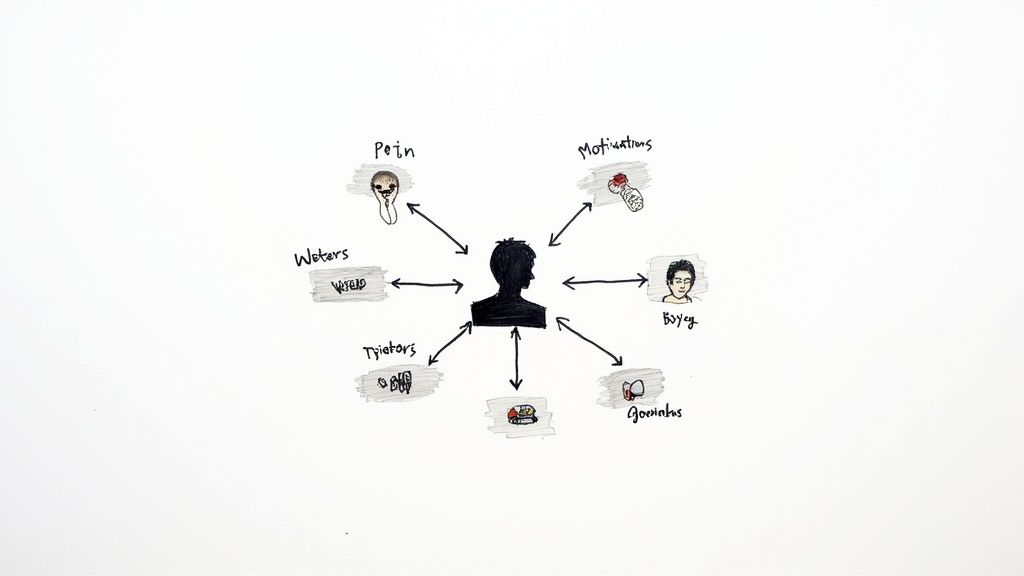
Before launching any campaign, you need absolute clarity on who you're trying to reach. A strong foundation for generating leads begins once you figure out how to identify your target audience. This goes beyond surface-level demographics like age or location.
The goal is to build a detailed Ideal Customer Profile (ICP). This is a semi-fictional, data-driven representation of your perfect customer.
To create an effective ICP, you need to answer specific, practical questions:
- Pain Points: What is the single biggest operational headache they face daily? For instance, is it managing inventory, reducing customer churn, or navigating complex regulations?
- Motivations: What professional goal are they trying to achieve? Are they tasked with cutting costs by 10%, increasing team efficiency, or launching a new product line?
- Buying Triggers: What specific event would force them to actively seek a solution like yours? A common trigger is a major project failure, a new compliance deadline, or a key competitor gaining market share.
- Information Sources: Where do they go for trusted advice? Is it industry-specific publications like The Manufacturer, LinkedIn groups focused on supply chain logistics, or tech review sites like G2 and Capterra?
A Practical Example of an ICP
Let's make this actionable. Imagine you sell fleet management software to UK logistics firms. Your ICP might be 'David, Head of Operations'.
- Role: David manages warehouse operations, fleet scheduling, and last-mile delivery for a medium-sized company in the Midlands.
- Pain Points: He’s constantly battling rising fuel costs, inefficient delivery routes, and high driver turnover. His current software is clunky, lacks real-time tracking, and is causing a spike in customer complaints about late deliveries.
- Motivations: David is under pressure from the board to improve on-time delivery rates by 15% this fiscal year. Achieving this means a significant performance bonus and professional recognition.
- Buying Trigger: A major client has just threatened to pull their multi-year contract due to persistent delivery delays. He now has an urgent mandate to find and implement a new fleet management solution within the next quarter.
With this level of detail, your marketing shifts. You're no longer selling to a vague 'logistics manager'. You're creating content that solves David's specific, urgent problems. Every blog post, ad, and email should speak directly to his pain points.
Mapping the Customer Journey
Knowing who David is is half the battle. Now you need to understand how he solves his problems. A customer journey map is an actionable tool that visualizes the path a prospect takes from initial awareness to purchase. This helps you pinpoint the exact moments to provide value.
For someone like David, that journey is a practical series of steps:
- Awareness Stage: The problem is now undeniable. David goes to Google and searches for practical solutions with terms like "fleet management software UK," "how to reduce delivery delays," or "best vehicle tracking for logistics."
- Consideration Stage: David now has a shortlist of potential vendors. He’s actively comparing features, reading case studies from other UK logistics companies, and signing up for webinars that demonstrate tangible results.
- Decision Stage: He’s narrowed it down to two or three vendors. He's now requesting personalized demos and asking for detailed pricing proposals to present to his finance director for budget approval.
Understanding this journey allows you to create perfectly timed, actionable content. A blog post on "5 Ways to Cut Fleet Fuel Costs" is perfect for the awareness stage. A detailed case study or a compelling promotional video demonstrating your software's ROI will have a much bigger impact during the decision stage. Learning how to make promotional videos that showcase results is a key skill here.
Getting Leads to Come to You: The Power of Inbound Marketing
The most valuable leads are those who find you. Instead of interrupting prospects who aren't interested, inbound marketing focuses on creating genuinely useful content and experiences that naturally draw your ideal customers in. It’s a strategy built on solving problems first, which in turn attracts, engages, and captures qualified leads.
This isn't just theory; it's a market reality. While UK businesses generate an average of 1,877 leads per month, the average cost per lead is around £160. With 97% of people hanging up on cold calls, a value-first inbound approach is the most sustainable path to growth.
Create Content That Actually Solves Problems
The core of a successful inbound strategy is creating content that provides actionable solutions to your ICP's real-world problems. This means moving beyond generic articles and building strategic assets for each stage of their journey.
Here are some practical examples:
- For the Awareness Stage: A UK accounting software firm could create a definitive guide titled, "The Small Business Owner's Action Plan for Making Tax Digital (MTD)." This directly answers a pressing question their audience is searching for.
- For the Consideration Stage: A B2B tech company can produce a detailed case study: "How UK Retailer [Client Name] Cut Inventory Spoilage by 30% Using Our System." This provides tangible proof and builds credibility.
- For the Decision Stage: Create a "Competitor Comparison Checklist" that transparently stacks your features against two or three main rivals. This helps leads who are actively evaluating options and need to justify their decision internally.
This infographic highlights how different content types perform in attracting and converting leads.
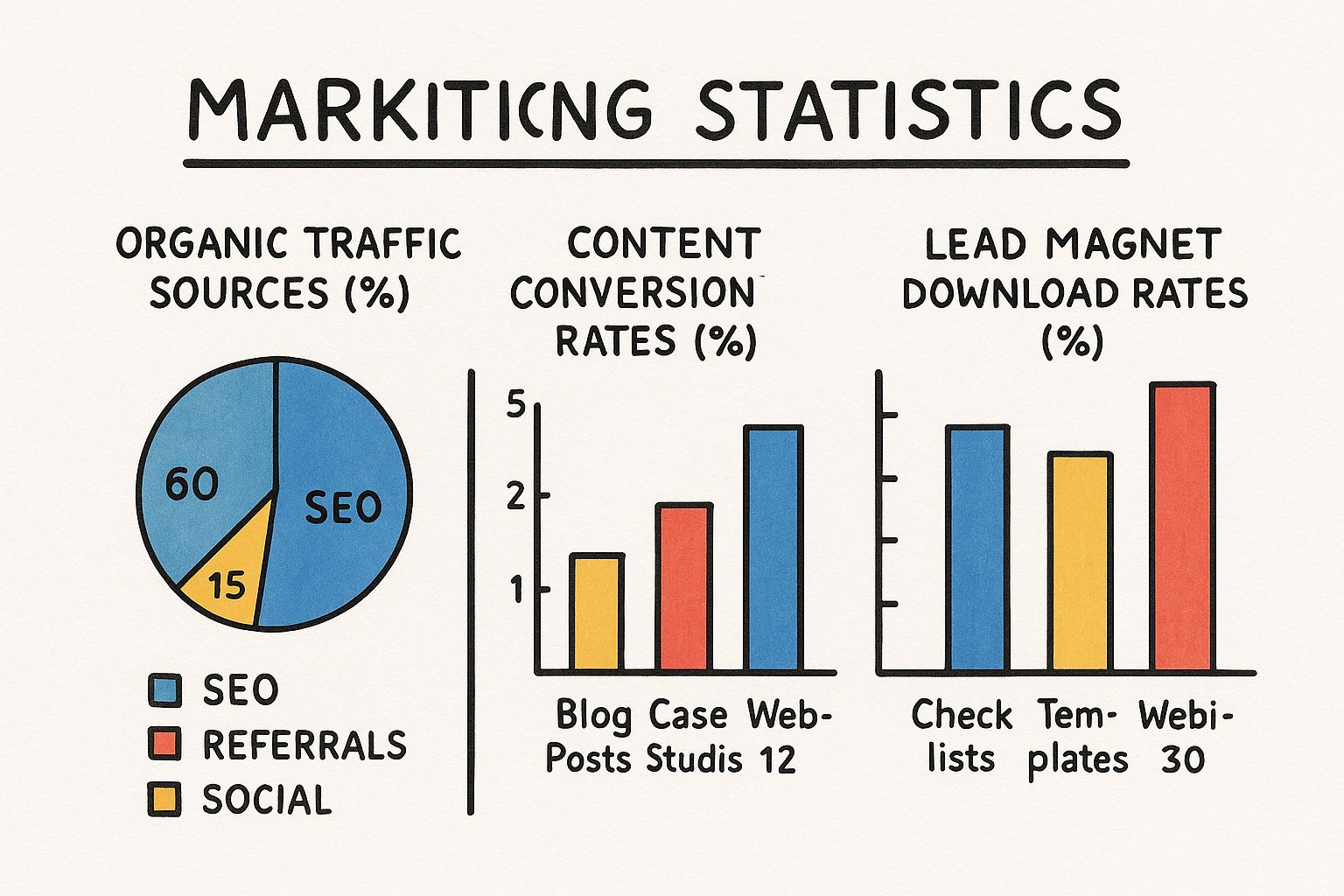
While SEO is crucial for driving initial traffic, high-value, practical assets like webinars, templates, and checklists are what excel at converting that traffic into qualified leads.
Engineer Landing Pages That Convert
Your brilliant content is wasted if your landing page fails to convert. A high-performing landing page has a single, clear purpose: to convince the visitor that your resource is valuable enough to exchange their contact information for.
Actionable Tip: Your landing page is not your homepage. Remove all distractions—no main navigation, no footer links, no social media icons. Every element must guide the user towards filling out the form.
To build a page that converts, focus on these essential components:
- A Benefit-Oriented Headline: It must match the ad or link they clicked and clearly state the value. Instead of "Ebook Download," try "Get the 10-Point Checklist to Cut Your Logistics Costs."
- Scannable Bullet Points: Nobody reads long paragraphs. Use bullets to highlight the key takeaways and actionable insights they will gain.
- A Minimalist Form: Only ask for what you absolutely need. For a top-of-funnel checklist, a name and business email is usually sufficient. Every extra field you add will reduce your conversion rate.
- A Strong Call-to-Action (CTA): Replace generic words like "Submit" with action-driven, first-person language. "Get My Free Template" or "Download the Guide Now" consistently outperform passive alternatives.
The Secret to an Irresistible Lead Magnet
A lead magnet is the valuable resource you offer in exchange for contact details. The key is to provide a practical tool or shortcut that solves a specific, nagging problem for your ideal customer.
Forget generic ebooks. The best lead magnets are actionable.
Practical Lead Magnet Examples:
- For a Fintech company: An interactive "UK Small Business Cash Flow Projection Template" in Google Sheets or Excel. It's a usable tool, not just passive content, that directly helps business owners manage their finances.
- For a Marketing Agency: A "2024 Content Calendar Template with Key UK Retail Holidays." This is an instant time-saver for their target audience of marketing managers.
- For a Software Development Firm: A "Technical Project Scoping Checklist." This helps potential clients organize their requirements before an initial consultation, making the first sales call more productive.
By creating these genuinely useful assets, you’re not just collecting emails; you’re positioning your brand as a trusted expert. This is a crucial first step in any effective video content marketing strategy as well, establishing the authority needed for your visual content to resonate.
Making LinkedIn Your B2B Lead Generation Powerhouse
https://www.youtube.com/embed/3Y7sW7ob3hY
For any UK B2B business, LinkedIn is a high-potential lead generation engine. It provides a direct line to decision-makers you simply can't find elsewhere. With 53% of B2B marketers using it to find prospects and brands seeing a 33% increase in purchase intent from LinkedIn ads, ignoring it is not an option. You can see more on how UK businesses are excelling at lead generation on dolead.com.
Start by Building a Laser-Focussed Prospect List
The "spray and pray" approach is a recipe for failure. Success on LinkedIn starts with precise targeting. This is where a tool like LinkedIn Sales Navigator becomes indispensable. It allows you to filter the entire LinkedIn network with granular precision.
Actionable Example: Imagine you sell compliance software to UK financial services firms. With Sales Navigator, you can build a highly targeted prospect list using these filters:
- Geography: London, Manchester, or Edinburgh.
- Industry: Financial Services.
- Company Headcount: 51-200 employees (targeting mid-sized firms).
- Job Title: "Compliance Officer," "Head of Risk," or "CFO."
- Activity Filter: "Posted on LinkedIn in the last 30 days" (to find active users).
This level of detail ensures you focus your energy exclusively on prospects who are a perfect fit, dramatically increasing your chances of starting a meaningful conversation.
Getting Your Connection Request Accepted
You've built your list. Now, you need them to accept your connection request. A generic request is almost always ignored. Personalization is the key.
Actionable Tip: A great connection request is short, provides context, and focuses on them, not you. Your only goal is to open a conversation, not to pitch. Ditch the default "I'd like to connect with you on LinkedIn" message.
Here are practical templates you can adapt:
- Reference Their Content: "Hi [Name], your recent article on fintech regulation was insightful, especially your point on [specific insight]. I'd be keen to connect and follow your work."
- Cite a Mutual Group: "Hello [Name], I noticed we're both members of the UK Marketing Leaders group. I'm always looking to connect with other professionals in the space. Best, [Your Name]."
- Acknowledge Their Company's Achievement: "Hi [Name], I saw that [Their Company] was recently featured in [Publication] for your work in the renewable energy sector—congratulations. Would love to connect."
None of these templates are selling. They are conversation starters.
Use Niche Groups to Build Authority
Joining and participating in relevant LinkedIn groups is a powerful, yet underutilized, strategy. These groups are concentrated hubs where your ideal customers discuss the very problems your business solves.
Your role is not to spam links but to become a helpful, trusted voice.
- Actionable Step: Dedicate 15 minutes twice a week to browse 2-3 key groups. Answer one question with a detailed, helpful comment. Don't mention your product unless it's directly relevant.
This approach cultivates high-quality inbound leads. Members will see your consistent, valuable contributions, view your profile, and often reach out to you directly. To go deeper, explore these LinkedIn Prospecting strategies.
LinkedIn Lead Generation Channels Comparison
Choosing the right approach on LinkedIn depends on your specific goals and resources. Here is a practical comparison to guide your strategy.
| Channel | Best For | Effort Level | Potential ROI |
|---|---|---|---|
| Direct Outreach (Sales Navigator) | Highly targeted, high-value leads and account-based marketing. | High | High |
| LinkedIn Ads | Scaling lead generation quickly and building brand awareness in specific UK markets. | Medium | Medium-High |
| Content Marketing (Company Page) | Building long-term brand authority and attracting inbound interest. | High (Consistent) | High (Long-term) |
| Group Engagement | Establishing expertise and generating warm inbound leads through community trust. | Medium | Medium-High |
A blended strategy is often the most effective. Use paid ads for immediate lead flow while your organic content and group engagement build long-term authority and nurture relationships.
Integrating AI and Automation to Scale Your Efforts
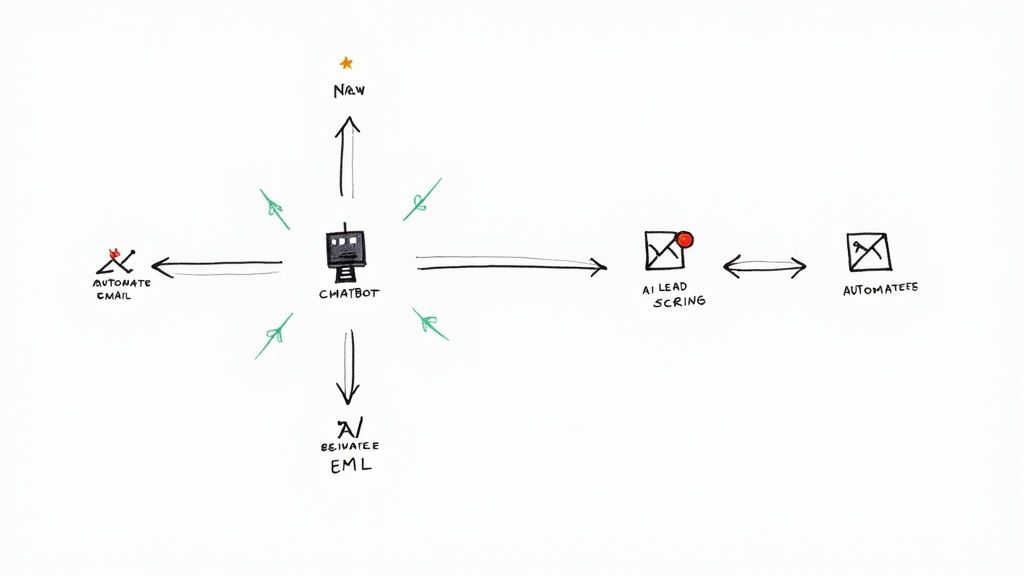
There is a hard limit to how many leads you can generate manually. To scale effectively, you need to work smarter, not just harder. Artificial intelligence and automation are the keys to unlocking that scale. They build a system that works for you 24/7, handling repetitive tasks so your team can focus on what humans do best: building relationships and closing deals.
Enrich Data and Score Leads Automatically
One of AI's most powerful applications is data enrichment. When a new lead subscribes to your newsletter, AI tools can instantly take that single email address and build a detailed profile.
These systems scan public data sources to find and append crucial information:
- Job title and company name.
- Company size and industry.
- Links to their LinkedIn profile.
This enriched data then fuels predictive lead scoring. An AI model analyzes a lead's attributes (like job title and company size) and their on-site behavior (pages visited, content downloaded) to assign a numerical score. A lead who visits your pricing page and has the right job title gets a high score and is flagged for immediate sales follow-up. A junior employee who only downloaded an introductory guide gets a low score and is placed into an automated nurturing sequence.
Deploy an Always-On Chatbot Qualifier
Your website is your 24/7 storefront. An AI-powered chatbot acts as your always-on sales development representative, engaging visitors the moment they arrive.
Modern chatbots are sophisticated tools that understand natural language and ask intelligent qualifying questions.
A Practical Chatbot Scenario: A prospect lands on your pricing page at 10 p.m. on a Tuesday. The chatbot initiates a conversation: "Hi there! Exploring our plans? To help me point you in the right direction, are you a team of under 50 or over 50?" Based on their answer, it can share a relevant case study or pricing guide. If the prospect shows high intent, the chatbot can access your sales team's calendar and book a demo for the following morning, all without human intervention.
By qualifying leads around the clock, chatbots ensure no opportunity is missed. They turn passive website visitors into actively engaged prospects, accelerating the sales cycle.
Automate Personalised Nurture Sequences
Once a lead is captured, automation allows you to nurture that relationship at scale. Instead of generic email blasts, you can create automated email workflows that trigger based on a lead's specific actions, delivering the right message at the right time.
Example Nurture Sequence for a Whitepaper Download: Imagine someone downloads your whitepaper on "The Future of E-commerce Logistics." This single action triggers a fully automated, value-driven workflow.
- Day 1 (Instant): An email delivers the whitepaper link and suggests a related blog post on "3 Common Logistics Bottlenecks."
- Day 4: A follow-up email shares a short video case study of how a similar company improved its delivery efficiency.
- Day 8: An email invites them to an upcoming webinar on "Optimizing Your Supply Chain for 2025."
- Day 12: The final email in the sequence offers a free, no-obligation consultation with a logistics specialist.
This entire sequence provides value and builds trust systematically, ensuring that when the lead is ready to buy, your brand is top of mind. Research shows UK businesses using AI for lead generation see a 2.8x increase in qualified leads, making the investment in automation a clear path to scalable growth.
Nurturing Leads and Optimising for Conversion
Capturing a lead is only the beginning. The real work is in building a relationship, proving your value, and guiding that prospect toward becoming a customer. This is lead nurturing, and it's critical because most leads aren't ready to buy immediately. Companies that excel at lead nurturing generate 50% more sales-ready leads at a 33% lower cost.
Building an Effective Nurturing Strategy
A strong nurturing strategy is about delivering relevant content at the right time. The goal is to build a relationship, not just push for a sale.
Actionable Nurturing Example: A prospect downloads your introductory guide. Instead of having a salesperson call them immediately, an automated sequence delivers value over time:
- Email 1 (Day 3): Share a related blog post that dives deeper into a topic mentioned in the guide.
- Email 2 (Day 7): Send a link to a customer testimonial video.
- Email 3 (Day 12): Invite them to a relevant, educational webinar.
This gradual delivery of value builds credibility. When they are finally ready to make a purchasing decision, your brand will be the one they trust.
Prioritising Your Hottest Prospects with Lead Scoring
As you generate more leads, your sales team can't give equal attention to everyone. Lead scoring is a practical system that automatically ranks prospects based on their profile and engagement.
You assign points for different attributes and actions:
- Attribute: Job title is "Head of Marketing" (+10 points).
- Action: Visited the pricing page (+15 points).
- Action: Requested a demo (+50 points).
- Action: Opened 3 nurturing emails (+5 points).
Once a lead's score crosses a set threshold (e.g., 100 points), they are automatically flagged as a "sales-qualified lead" (SQL) and an alert is sent to the sales team. This ensures your team focuses their valuable time on prospects who are most likely to convert.
Lead nurturing acts as a critical bridge between marketing and sales. It systematically warms up prospects and uses intelligent scoring to hand over only the most qualified leads to the sales team.
A Practical Introduction to Conversion Rate Optimisation
While nurturing is a long-term play, Conversion Rate Optimisation (CRO) is about making immediate, data-driven improvements to your key conversion points, like landing pages. The core of CRO is A/B testing: creating two versions of a page (A and B) and showing each to a portion of your audience to see which performs better.
Actionable Tip: When A/B testing, change only one element at a time (e.g., the headline OR the button color, not both). This is the only way to know for sure what caused the change in performance.
Common elements to test include:
- Headlines: "How to Achieve X" vs. "Achieve X in 3 Easy Steps"
- Call-to-Action (CTA) Button Text: "Get Started" vs. "Request a Demo"
- Form Length: Does removing the 'phone number' field increase submissions?
A Real-World Example of CRO in Action
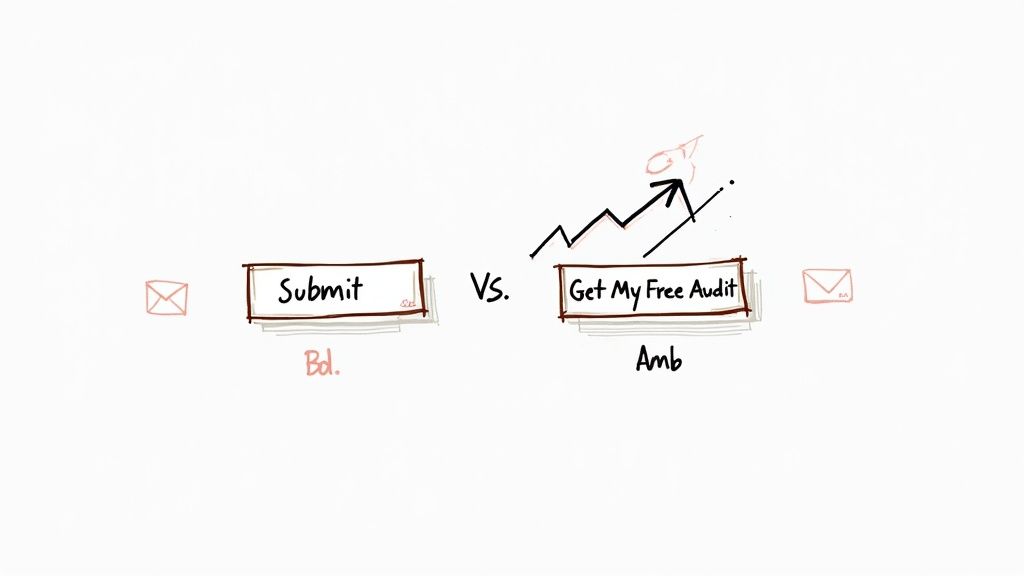
Let's make this tangible. A B2B software company has a landing page for a free business audit. The CTA button on their form originally said "Submit."
They ran an A/B test. Version A kept "Submit." Version B changed the button text to "Get My Free Audit." This new text is more specific, action-oriented, and reinforces the value proposition.
After running the test for two weeks with 5,000 visitors, the results were clear. The page with the "Get My Free Audit" button had a 42% higher conversion rate. This small, five-minute change resulted in a significant increase in qualified leads without any additional ad spend. That is the power of systematic optimisation.
Common Questions About Lead Generation
Even with a strong strategy, practical questions will always arise. Here are answers to some of the most common hurdles in lead generation.
How Long Does It Take to See Results?
The timeline for lead generation results varies significantly by channel.
- Paid Advertising: Using platforms like Google Ads or LinkedIn ads, you can start seeing new leads within 24-48 hours of launching a campaign. This makes it ideal for generating quick wins and testing offers.
- SEO and Content Marketing: This is a long-term investment. It typically takes 3-6 months of consistent effort to gain traction in search rankings and see a steady flow of organic leads. The payoff is a sustainable, low-cost lead source.
Actionable Insight: A blended approach is most effective. Use paid ads for immediate results while simultaneously building your long-term SEO and content engine for sustainable growth.
What Is the Difference Between an MQL and an SQL?
Understanding the distinction between a Marketing Qualified Lead (MQL) and a Sales Qualified Lead (SQL) is crucial for aligning your marketing and sales teams.
- An MQL is a lead who has engaged with your marketing (e.g., downloaded a whitepaper) and fits your target demographic, but has not yet indicated buying intent. They are interested but still in the research phase.
- An SQL is a lead who has taken an action that signals a clear intent to buy, such as requesting a quote, asking for a demo, or using a pricing calculator.
The Rule: Marketing nurtures MQLs. The lead should only be handed over to the sales team once they become an SQL. This ensures that salespeople spend their time on conversations that are likely to result in revenue.
How Much Should a UK Business Budget for Lead Generation?
There is no one-size-fits-all answer, but there are practical guidelines. Many B2B companies allocate 5-10% of their total revenue to marketing, with a significant portion of that dedicated to lead generation activities.
The most important metrics to track are:
- Customer Acquisition Cost (CAC): The total cost to acquire one new customer.
- Lifetime Value (LTV): The total revenue a customer will generate for your business over their lifetime.
The Actionable Rule: Your LTV must be significantly higher than your CAC (a common benchmark is a 3:1 ratio). As long as your lead generation activities are profitable and delivering a strong return on investment, you can confidently scale your budget.
Ready to bring your lead generation ideas to life with visuals that actually get noticed? With Seedance, you can turn your concepts into professional 1080p videos in just a few minutes. It's perfect for creating eye-catching promotional content, persuasive customer testimonials, and social media videos that stop the scroll and drive action. Start creating for free and see just how simple high-quality video production can be. Discover the power of AI at https://www.seedance.tv.
Article created using Outrank